

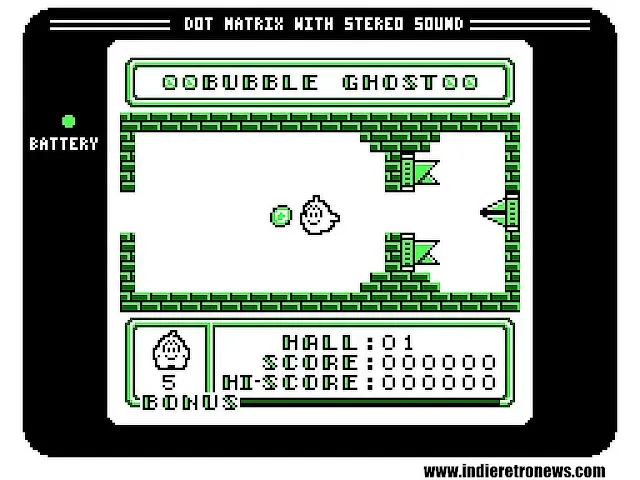
Bubble Ghost, the delicate and demanding puzzle adventure first released for Game Boy in 1990, has received a new fan conversion for the Amstrad CPC 6128. Created by Kirby2000, the project brings the entire haunted-fortress challenge to Amstrad hardware, recreating all 35 stages, their puzzle components, and the game's complete ending sequence.
The conversion centers on the same unusual premise that defined the Game Boy original. Players control a benevolent ghost attempting to guide a fragile soap bubble through a series of dangerous rooms. The spirit cannot simply pick up or push the bubble in a conventional platform-game fashion. Instead, the bubble must be moved by carefully blowing it through each chamber, making position, timing, and restraint essential.
It is a simple idea with a surprisingly tense result. A bubble is naturally vulnerable, and the haunted fortress is built to make every small error feel consequential. Spikes, fans, candles, and hostile phantoms complicate the route through each room, while the remaining bonus timer adds another layer of pressure. The player needs to preserve the bubble, find a safe path, and make progress before the time available for a stronger result runs down.
A faithful 35-stage Amstrad adaptation
Kirby2000's version is described as a complete conversion rather than a small selection of stages or a loose reinterpretation. Every one of the original 35 rooms is present, along with the puzzle mechanisms required to solve them. The ending has also been included, giving the Amstrad CPC 6128 release a full beginning-to-finish structure for players who want to take on the entire fortress.
For useful background on this topic, read Star Wars: Galactic Racer Leads a Packed Week of Indie Game Releases and Reveals.
That completeness matters for a game such as Bubble Ghost. Its identity is tied less to a single gimmick than to the gradual development of that gimmick across many rooms. Early chambers establish the basic need to blow the bubble with care. Later scenarios can make the player consider hazards, movement patterns, room layout, and the limited amount of control available to the ghost. Recreating the full set means the conversion can preserve that escalation rather than reducing the experience to a technical demonstration.
The central mechanic also makes this an especially fitting game for retro puzzle fans. There is no need for elaborate combat systems or sprawling maps to create difficulty. The tension comes from managing a brittle object with indirect movement, then learning how the individual room hazards change the safest approach. A path that appears straightforward can become risky if the bubble is blown too hard, held in the wrong place, or sent too close to an obstacle.
Guiding the bubble, not touching it
The ghost's inability to directly contact the bubble is the key rule behind every decision. Rather than treating the bubble as a standard object to carry, players have to work around it and direct a stream of air toward it. That distinction gives each room a physical, almost toy-like puzzle quality. The bubble has to be encouraged along, not forced into place.
Candles are among the objects that must be dealt with during the journey. Snuffing them out is part of navigating the fortress, while spikes and moving fans create immediate danger. Rival phantoms further reinforce the haunted setting and add another complication to the bubble's route. Combined, these elements turn compact single-screen chambers into carefully arranged obstacle courses.
The bonus timer ensures that simply finding a safe solution is not the only consideration. Players can work through rooms cautiously, but the timer encourages efficiency and repeat attempts. That balance suits the format well: a room may be understood quickly, yet executing it cleanly can take more practice. The conversion's preservation of these mechanics means the Amstrad edition retains both the puzzle-solving side and the score-minded urgency of the original design.
Game Boy-inspired presentation on the CPC 6128
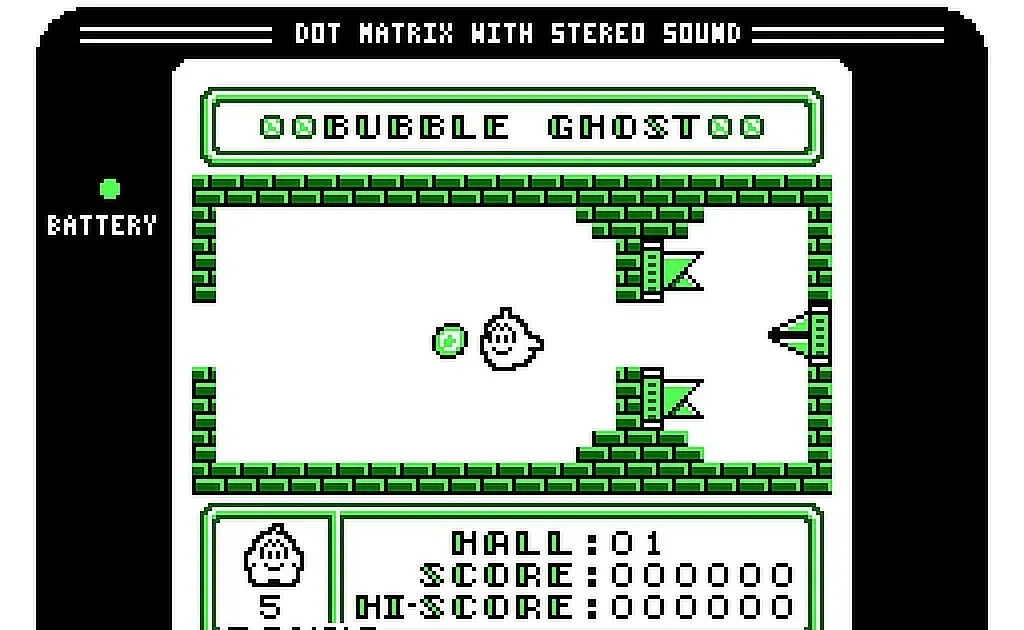
Visually, the conversion deliberately honors its handheld roots. It uses Game Boy-style graphics while placing the play area within a custom themed screen frame. This approach keeps the adaptation connected to the look of the 1990 release instead of trying to redesign the game around a completely different visual identity.
The presentation also begins with a loading screen adapted from the original retail box art. For a project built around faithful conversion work, that is a notable touch. It frames the game as an Amstrad version of a familiar classic while acknowledging the packaging and visual character associated with its Game Boy debut.
Using a themed frame can be especially appropriate for a title originally designed around a small handheld display. It creates a clear visual boundary for the action and lets the gameplay retain its compact, room-by-room focus. The result is a presentation built around recognition and preservation: the core game is intended to look and feel connected to its Game Boy form, even as it runs on a different machine.
AY-chip soundtrack and flexible loading options
While the graphics lean into the Game Boy heritage, the audio uses one of the defining features of the Amstrad CPC family. The conversion recreates the classic music and retro sound effects through the computer's internal AY audio chip. This gives the project an Amstrad-specific technical character without changing its underlying game structure.
The release has also been designed with several ways of loading software on a CPC 6128 in mind. It can be started from an original 3-inch floppy disk drive, a modern Gotek drive, or an M4 SD card adapter. Once loaded into memory, gameplay does not require additional disk access.
That detail is more important than it may initially appear. A game based on short, tightly timed rooms benefits from uninterrupted play. With the software remaining in memory after the initial load, players can move from attempt to attempt without disk activity interrupting the action. It also makes the conversion practical for enthusiasts using either original storage media or newer hardware solutions in their retro setups.
- Original game basis: the 1990 Game Boy release of Bubble Ghost.
- Target machine: Amstrad CPC 6128.
- Developer: Kirby2000.
- Content: all 35 original stages, puzzle mechanisms, and the full ending sequence.
- Audio: recreated music and sound effects using the CPC's internal AY chip.
- Loading support: original 3-inch floppy drives, Gotek drives, and M4 SD card adapters.
- Disk behavior: no further disk access is needed during gameplay after the game has loaded into memory.
Why projects like this matter
Fan conversions are often valuable not only because they make a game playable on additional hardware, but because they ask how faithfully a design can be translated within the constraints and strengths of another system. In this case, the goal is clear: retain the 35-room puzzle journey, preserve its signature bubble-blowing mechanic, and pair Game Boy-style visuals with audio made for the Amstrad's own sound hardware.
Bubble Ghost is also a strong candidate for this kind of treatment because its appeal is not dependent on spectacle. Its rooms are built around clarity, precision, and escalating hazard placement. Those qualities can survive a platform transition when the movement rules, stage layouts, and feedback remain intact. The inclusion of all original stages and the ending indicates that this project is focused on delivering the whole challenge rather than only revisiting its most recognizable idea.
For Amstrad CPC 6128 owners, the release offers another opportunity to explore a distinctive Game Boy puzzle game through native hardware. For players familiar with the handheld version, it provides a different way to experience the same ghostly fortress, complete with CPC audio and support for both vintage and modern loading methods.
Most importantly, the conversion preserves what makes the game memorable: one helpful ghost, one extremely breakable bubble, and a long sequence of rooms where a carefully measured breath can be the difference between progress and disaster.
Community
Discussion
Start the conversation.
No comments have been posted yet.