

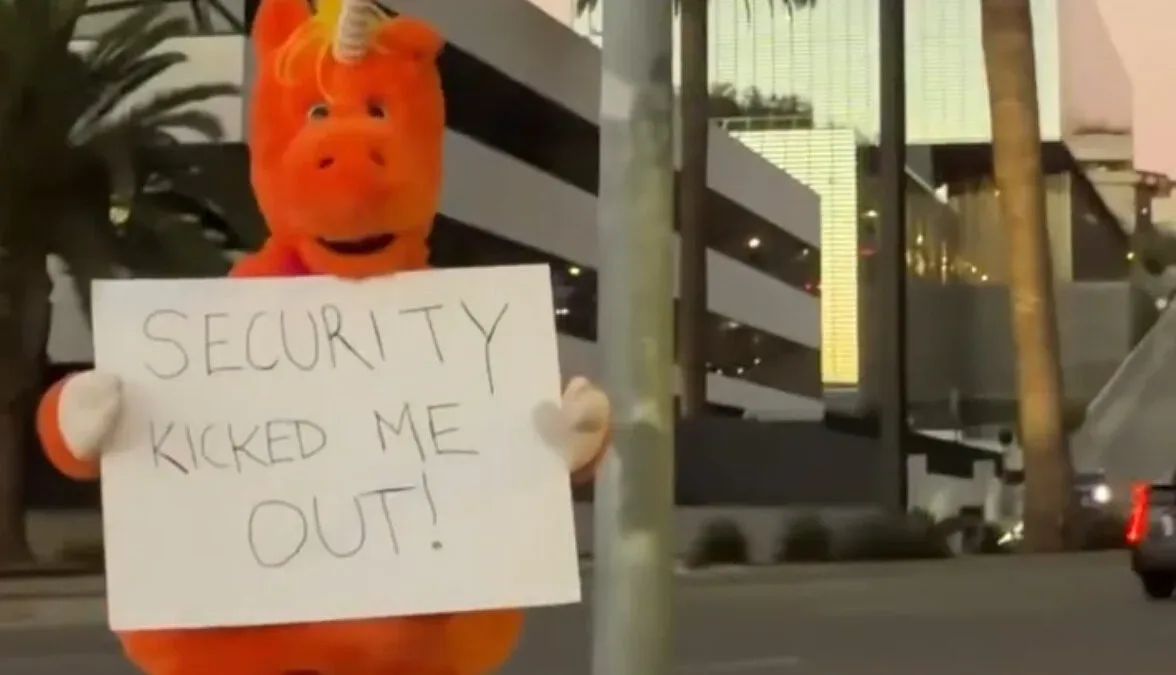
Halloween Horror Nights has become one of the most reliable places for horror fans to see famous monsters, slashers, demons and nightmares brought into the physical world. But there are limits to who gets through the gates. Buddy the Unicorn, a large orange mascot connected to a newly released horror movie, learned that lesson the hard way after appearing at Universal Studios Hollywood during the seasonal event.
A short video shows Buddy spending time around the Universal Studios Hollywood parking area, where the brightly colored character poses for photos and draws attention from visitors. The visit does not last long. Park employees eventually approach the mascot and remove Buddy from the premises, ending an attempted crossover between a rising movie creature and one of the biggest Halloween attractions in the United States.
The sequence has a deliberately promotional feel, and some of its staging is easy to suspect. Still, the basic outcome makes sense within the operating rules of a major theme-park Halloween event. Universal's Halloween Horror Nights is built around performers, scare zones and carefully controlled visual environments. Allowing an unaffiliated full-body mascot--particularly one advertising another studio's horror release--to wander among guests would create obvious issues for the park.
Why Buddy Was Never Likely to Stay
Halloween Horror Nights is not a conventional costume party. Guests are generally not permitted to arrive in costumes, a policy designed to avoid confusion between visitors and employees while maintaining safety in crowded spaces. The restriction becomes even more understandable during an event filled with blood-smeared performers, masks, chainsaws, elaborate prosthetics and dimly lit streets.
For useful background on this topic, read Final Fantasy VII Revelation Team Wants Players to Discover Its Ending for Themselves.
Buddy's look also creates an unusual contrast with the event's usual atmosphere. The mascot is huge, orange and superficially friendly, closer at first glance to a children's television character than a typical horror icon. That contrast is the point. Buddy is the central costumed figure in a new film from Casper Kelly, whose previous work includes Adult Swim's famously surreal viral segment Too Many Cooks.
In the film, the colorful character belongs to a Barney-like children's television program, but the cheerful plush exterior conceals something much more sinister and otherworldly. That kind of premise is well suited to modern horror: take a familiar symbol of childhood comfort, twist it into a source of dread, and let the audience fill in the gap between what the character appears to be and what it truly is.
The parking-lot appearance plays directly into that tension. Buddy is not depicted charging at people or acting like a conventional slasher. Instead, the character hangs around, takes photos and looks almost harmless until staff intervene. In a setting such as Halloween Horror Nights, that seemingly benign behavior is exactly what makes the intrusion memorable. It places an unfamiliar mascot beside an event where guests are already primed to expect that any character might turn threatening.
A Growing Audience for Lean Horror Releases
Buddy's movie arrives with a notable cast that includes Cristin Milioti, Keegan-Michael Key, Patton Oswalt and Michael Shannon. Despite being made on a relatively modest budget, the film has already exceeded its projected box-office performance by several million dollars. Its early results fit a broader pattern seen this year, with audiences showing considerable enthusiasm for lower-cost horror movies even as larger, more traditional blockbuster releases compete for attention.
Horror has always had an advantage when it comes to memorable marketing. A distinctive monster, mask or mascot can often communicate a movie's identity faster than a conventional trailer hook. Buddy's orange silhouette is easy to recognize, and the character's forced exit from a famous Halloween destination gives the film another piece of playful, shareable imagery without needing to reveal the movie's central scares.
It also demonstrates how theatrical horror increasingly operates beyond the cinema. The genre's creatures can become photo-op characters, convention fixtures, Halloween costumes, collectibles and social-media shorthand. The most successful designs take on lives of their own. Even a brief moment near a major haunted-event entrance can help turn an emerging character into something audiences recognize immediately.
That does not mean every horror mascot will become a permanent seasonal staple. Universal has its own brands, agreements and event plans to protect. Yet the broader appetite for characters like Buddy is clear, especially as horror fans seek out experiences that feel communal and participatory rather than limited to a theater screening.
Halloween Horror Nights Keeps Expanding Its Roster
Even without Buddy, Universal Studios' Halloween Horror Nights has no shortage of recognizable names this season. Licensed properties are typically given dedicated haunted-house attractions, allowing visitors to walk through detailed environments based on the films and series they know. This year's lineup includes Hellraiser, Sinners, Stranger Things and Killer Klowns From Outer Space.
The event has also expanded the ways it uses horror licenses. Rather than reserving every recognizable character for an enclosed maze, the parks have increasingly placed additional figures in public areas. Terrifier's Art the Clown and Obsession's "Freaky" Nikki have been introduced as roaming characters, able to lurk around guests, pose for photographs and deliver sudden scares outside the boundaries of a specific attraction.
That approach matters because it makes the entire park feel more unpredictable. A haunted house has a clear beginning and end: visitors queue, enter, move through a designed path, then exit. Walkabout characters blur that boundary. Guests might encounter a familiar villain while heading to another maze, standing in a food line or simply crossing a scare zone. The park becomes part haunted attraction, part horror-character playground.
It also helps explain why a surprise Buddy appearance could draw such quick interest. Halloween Horror Nights has trained its audience to look around corners for unexpected figures. A giant orange unicorn from a current horror movie is not part of the announced program, but in the context of the event, the idea is just plausible enough to make people look twice.
From a Seasonal Event to a Year-Round Horror Business
The Halloween season at Universal has been getting longer, denser and more ambitious. What was once principally a seasonal draw has become a major entertainment engine, built around high-demand intellectual properties and an audience willing to return for new houses, merchandise, food, performers and scare-zone changes. The annual event is increasingly supplemented by horror offerings that stretch beyond the traditional autumn calendar.
Universal opened a year-round Halloween Horror Nights attraction in Las Vegas last year, giving fans a permanent destination for the brand's style of cinematic scares. That expansion is a strong sign that demand is not confined to September and October. People want horror as an ongoing entertainment category, whether that means movies, games, haunted houses, immersive venues or character encounters.
For movie studios, that environment creates a tempting opportunity. A viral mascot can build awareness for a new release, while a hit film can potentially become a future attraction, seasonal maze or roaming-character presence. The road from theatrical horror oddity to theme-park fixture is not guaranteed, but it is easier to imagine now than it was when Halloween events were more limited in scale.
Could Buddy Return One Day?
Buddy's removal should not be read as a permanent banishment from the wider Halloween landscape. The character simply was not an authorized part of Universal Studios Hollywood's event during this appearance, and the park had practical rules to enforce. If the film continues outperforming expectations and Buddy develops into a durable fan favorite, the mascot may have more official Halloween opportunities in the future.
For now, the stunt captures a peculiar truth about contemporary horror culture. A candy-colored unicorn can be a menace. A parking lot can become a miniature scare zone. And getting kicked out of Halloween Horror Nights may be one of the most effective ways for a new monster to announce that it wants a place among the genre's established maniacs.
Until then, Halloween Horror Nights remains packed with its own authorized horrors--and visitors heading through Universal Studios Hollywood may still find plenty of killers, demons and clowns without the help of one uninvited orange unicorn. If Buddy keeps building an audience, however, a future return may be less about sneaking in and more about receiving an invitation.
Community
Discussion
Start the conversation.
No comments have been posted yet.