

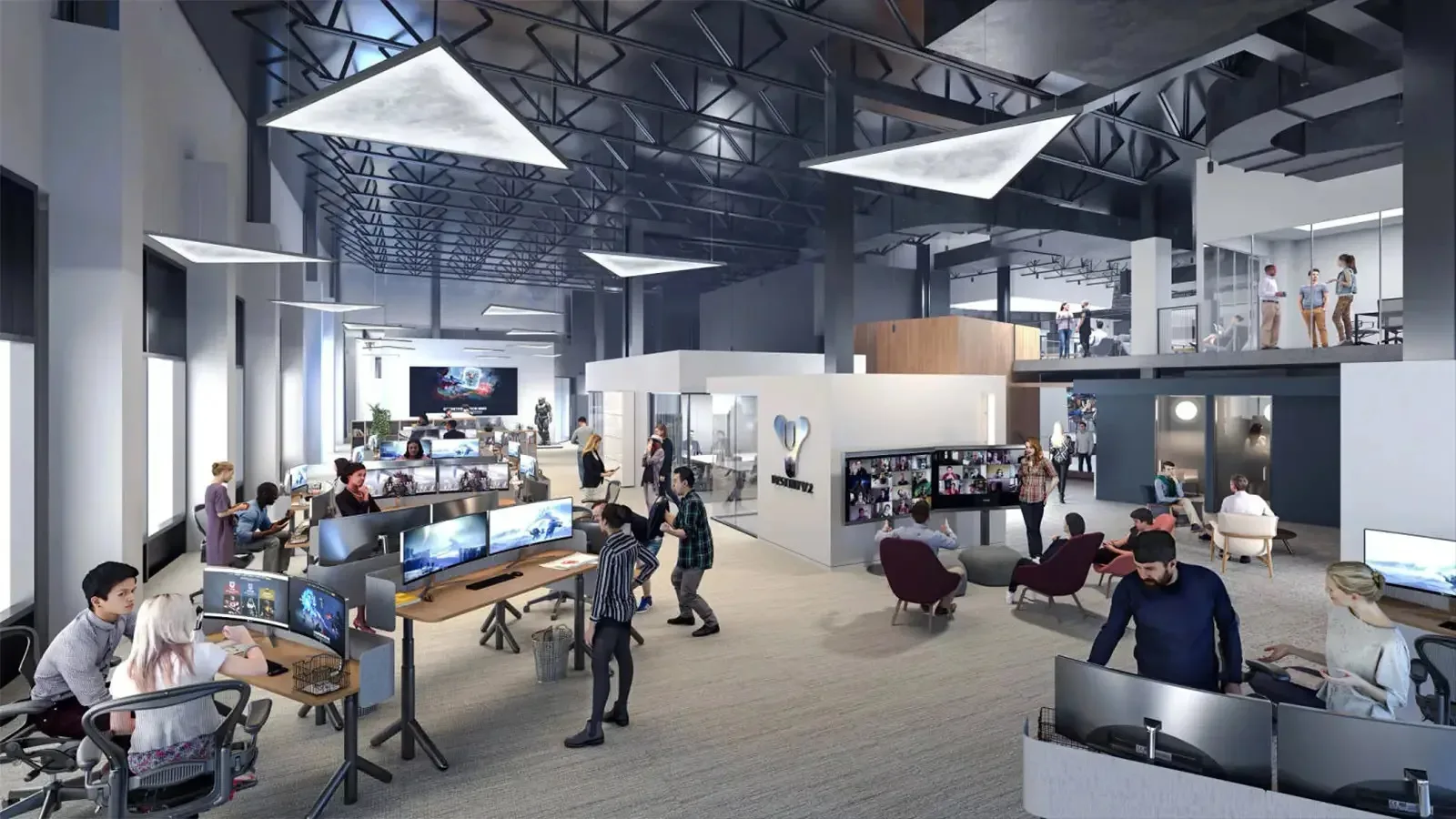
Bungie is exploring whether to sublease portions of its large Bellevue, Washington campus, signaling another substantial change for the PlayStation-owned studio following several years of layoffs, project cancellations, and a transition toward more remote-friendly work. A Bungie spokesperson confirmed that the company is considering options for the site, while emphasizing that the studio does not intend to leave Bellevue entirely.
The move concerns the headquarters space Bungie dramatically expanded in 2021, when the company more than doubled its footprint amid the pandemic-era strength of Destiny 2 and ambitious plans to develop multiple projects at once. The campus is reported to total 210,984 square feet, a scale that reflected a period when Bungie was investing in the continued growth of its long-running shooter, stories set in the Destiny universe, and entirely new intellectual property.
"Bungie is exploring options to sublease its campus in Bellevue, Washington," a studio spokesperson said. "The studio transitioned to a digital-first model several years ago, and this move reflects the team's evolving workplace needs and the effectiveness of its remote collaboration. Bungie will continue to maintain a physical office presence in Bellevue."
That statement does not establish how much space could be subleased, when a deal might happen, or whether a tenant has been identified. It does, however, make clear that the company's current requirements are far different from those envisioned when the enlarged campus was announced five years ago.
For useful background on this topic, read Lexar 32GB microSD Three-Pack Drops to $36 in Labor Day Storage Deal.
A headquarters built for expansion
Bungie's Bellevue facility was designed as more than a conventional office. The expanded studio was equipped to support major game production across multiple teams, with specialized areas that reportedly include a motion-capture studio, streaming facilities, audio and Foley rooms, capture spaces, editing suites, playtest areas, and other production infrastructure. Descriptions of the campus have also included employee amenities such as a workout area and climbing wall.
In 2021, this kind of investment made strategic sense within Bungie's public plans. Destiny 2 had remained a major live-service game, and the studio was talking about a long-term future that extended beyond one franchise. Its expansion announcement at the time connected the physical growth of the Bellevue operation to continued Destiny development, additional stories in that universe, and the creation of new worlds outside it. The redesigned space was intended to accommodate several project teams, including groups not working on Destiny.
Those plans arrived during a unique moment for the games industry. The pandemic drove enormous engagement across many games, while companies throughout the business increased hiring, expanded internal teams, and committed to projects that assumed sustained demand. For Bungie, the timing also overlapped with an expectation that it could operate as a larger multi-project developer while maintaining the costly, ongoing content pipeline behind Destiny 2.
But the industry changed quickly after that growth period. Rising development costs, slower growth in the live-service market, and broad layoffs throughout gaming have forced publishers and studios to reassess staffing and physical office needs. Bungie's potential sublease is part of that wider pattern, though its scale is particularly noticeable because the company's Bellevue expansion was so closely tied to a previous phase of optimism.
Layoffs have transformed the studio's size
Bungie had more than 1,500 employees at its pandemic-era high point. Since then, the studio has gone through major layoffs in 2023, 2024, and 2026. Across those rounds, at least 600 jobs were cut. That figure does not include normal departures or positions that were transferred into other areas of the PlayStation organization, making a precise current headcount difficult to determine from public information alone.
Reports have suggested that Bungie may now be closer to a 500-person studio. The company has not publicly confirmed a current total in the information surrounding the potential Bellevue sublease. Even so, a workforce of that approximate size would naturally require a very different office arrangement than a campus planned around a company of well over 1,000 people and multiple active incubation teams.
The human consequences matter beyond the real-estate math. Each layoff round has removed experience from a studio known for operating one of gaming's most complex persistent online shooters. It has also altered the internal structure built to support projects beyond Destiny 2. For employees who remain, a smaller physical footprint may be practical, but it is also a visible reminder of how much the company's plans and resources have changed since 2021.
Digital-first work changes the equation
Bungie's explanation centers on its "digital-first" workplace model. Like many technology and game-development companies, the studio has adopted practices that make remote collaboration a regular part of its work rather than a temporary exception. That can reduce the need for desks and meeting rooms designed around daily attendance by the entire workforce.
Remote and hybrid arrangements do not eliminate the value of a game studio office. Development teams still need places for hands-on playtesting, motion capture, audio work, hardware and build testing, team meetings, and other work that is easier to perform in person. Bungie's pledge to maintain a physical Bellevue office reflects those needs. Its production facilities may remain especially valuable as the studio continues development on major games.
At the same time, remote hiring allows a studio to recruit from a wider area rather than relying entirely on candidates willing to live near Seattle. Bellevue is among the more expensive real-estate markets in the United States, so reducing unused space could also lower costs. For a company seeking a more sustainable operating model, retaining specialized facilities while finding tenants for excess square footage is a straightforward business consideration.
Still, the announcement invites questions about whether the expansion was too aggressive in the first place. Bungie's prior growth was built around a considerably broader future: a large Destiny operation, multiple internal projects, and a workforce capable of sustaining all of them. The studio's present circumstances show how difficult it is to convert an ambitious multi-project roadmap into stable long-term growth, particularly in an increasingly crowded live-service market.
From new projects to a narrower slate
The company's direction has narrowed considerably since the expansion was first unveiled. Sony acquired Bungie for $3.6 billion in 2022, positioning the studio as an important part of PlayStation's broader plans in live-service gaming. Bungie brought expertise in operating a long-running online title and was expected to contribute knowledge across Sony's portfolio.
Yet several of the studio's bets outside Destiny have not reached the market. Most of the non-Destiny concepts once being developed were canceled. One project, commonly known as Gummy Bears and described as featuring "frog-like" action, was moved under the broader PlayStation organization rather than remaining at Bungie.
Destiny 2, meanwhile, remains central to Bungie's identity, even as its long-term trajectory has faced significant scrutiny. The studio has built years of expansions, seasonal content, and community support around the game, but the earlier ambition to turn Destiny into a far larger cross-media business has not materialized in the way many observers expected. Reporting has also indicated that Sony has chosen to sunset Destiny 2, though the full practical meaning and timing of that decision have not been detailed here.
That leaves Marathon as Bungie's most prominent upcoming focus. The extraction shooter carries considerable weight for the studio because it represents both a new direction and a test of whether Bungie can successfully launch another major online game in a competitive genre. It also enters a market where player attention is difficult to win and even harder to retain. The game's prospects remain uncertain, regardless of the talent and history associated with the Bungie name.
A practical move with symbolic weight
Subleasing part of a campus is not inherently a sign that a company is in immediate danger. Businesses frequently adjust their office footprints after shifts in staffing or work habits, and Bungie's statement frames the plan as an assessment of evolving workplace needs. Keeping a Bellevue presence means the studio still sees value in its headquarters and in the specialized development resources housed there.
But the timing gives the decision broader symbolic importance. A campus that was expanded to house a growing, multi-team game developer is now being evaluated for surplus space after hundreds of jobs were eliminated. The contrast captures a turbulent half-decade for Bungie and for the wider games industry.
For players, the most consequential questions remain tied to the games themselves: what the future holds for Destiny 2, how Bungie will support its community through any transition, and whether Marathon can establish a successful new chapter. The Bellevue sublease exploration does not answer those questions. It does show that Bungie is reshaping its physical operation to match a smaller workforce, a digital-first strategy, and a more focused development slate than the one envisioned in 2021.

Community
Discussion
Start the conversation.
No comments have been posted yet.