

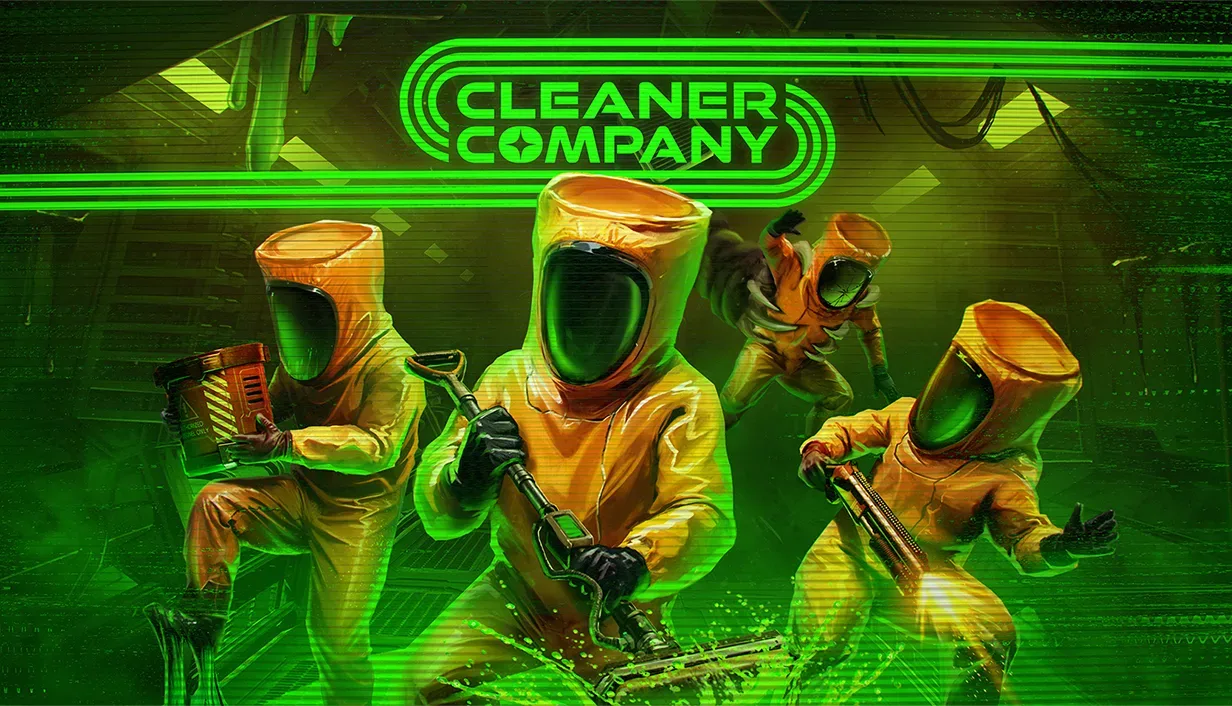
Cleaner Company, the science-fiction horror co-op cleaning simulation from developer Wildflame Studio and publisher Mythwright, will launch on January 28, 2027. The game is confirmed for PC through Steam and the Epic Games Store, where players will take on the role of Star Wipers: a crew assigned to make catastrophically messy corners of the galaxy presentable again.
The premise puts a deliberately unusual spin on spacefaring work. Rather than arriving at a moon base, restaurant, laboratory, or station as a soldier, explorer, or scavenger, players arrive after the disaster. Their task is to clean, decontaminate, sort, and clear the aftermath using a collection of retro-styled futuristic tools. The jobs may be practical, but the places being cleaned are not necessarily safe. Environmental hazards, altered gravity, unstable debris, and hostile creatures can turn routine sanitation into a more chaotic kind of shift.
Cleaner Company supports solo play as well as online co-op for one to four players. Its structure appears designed around completing contracts, earning money, and using that income to improve a cleaner's capabilities before moving on to new assignments and locations. The result is a game that combines the satisfaction of putting a wrecked space back in order with the tension of working somewhere that may still be actively dangerous.
A cleaning crew for the galaxy's worst jobs
Players join the Star Wipers, a cleanup operation dispatched to disaster sites scattered across sci-fi settings. The announced locations include devastated space stations, ruined research facilities, orbital restaurants, and moon bases, with more scenarios implied by the game's contract-driven setup. Every environment provides a different setting for the same broad mission: remove the evidence of a cosmic calamity and leave the site in a usable state.
For useful background on this topic, read The Last Caretaker's The Jump Update Opens a Frozen New Frontier.
That focus gives Cleaner Company a different perspective on familiar science-fiction spaces. Research labs and orbital facilities are often settings for experiments gone wrong, invasions, and emergency evacuations. Here, they are also workplaces left behind for a cleanup team. The game's horror angle means the reason a building needs decontamination may be unsettling, while the cleaning-sim foundation asks players to concentrate on the physical work of dealing with whatever was left there.
The available equipment includes cosmic vacuums, trash grinders, powerwashers, and other retrotech devices. These tools are intended for collecting debris, removing contamination, and dealing with the clutter spread across a site. The game emphasizes tactile, physics-based interactions, so the cleanup is not described as a simple checklist of spots to interact with. Players will be able to stack objects, spill items, and clear the results, while the state of the environment can change in more unpredictable ways.
That emphasis on physics should make organization an important part of each contract. A pile of debris may need to be managed before it can be removed, and a careless action can create more work. In a cooperative session, that could turn into a division of labor, with one person operating the washer while another manages waste or handles the more awkward objects. It can also create the familiar co-op problem of several workers trying to solve the same mess at once.
Gravity, hazards, and physics-based chaos
Cleaner Company's cleaning jobs are complicated by dynamic physics chaos and gravity shifts. Those mechanics suit a setting in which spaces may have been damaged, abandoned, or otherwise disrupted before the crew arrives. Rather than cleaning a stable floor in a normal building, Star Wipers can be dealing with an environment where objects do not remain where they were placed and where moving through the location can become part of the challenge.
The game also includes environmental threats and hostile creatures. This is where its sci-fi horror identity comes to the foreground: workers are not merely tidying an unusual location, but doing so while responding to dangers inside it. The combination may appeal to players who enjoy games in which a mundane objective becomes stressful because the setting refuses to cooperate.
Importantly, the creature threat is optional. Cleaner Company will let players toggle monsters off for a calmer, non-horror experience. That option means the game's core cleaning mechanics are not restricted to people looking for scares. A group that wants to focus on cleaning, equipment, and physics mishaps can remove one major source of pressure, while players seeking the full horror-flavored version can keep the danger enabled.
This choice could be especially useful in co-op. Friends with different comfort levels can decide what kind of session they want before starting a contract. It also establishes that horror is an adjustable layer rather than the only reason the game exists. The central loop remains cleaning difficult locations, even if those locations can be made much less relaxing when creatures and hazards are part of the job.
Contracts fund upgrades and new destinations
Progression in Cleaner Company is tied to finishing cleaning work. Completing contracts earns money that can be spent on equipment upgrades and stat improvements, while new gear and locations become available as players advance. The structure suggests an ongoing climb from basic cleanup jobs toward more demanding assignments across a broader set of science-fiction environments.
Upgrades are an appropriate fit for a game built around tools. Better equipment and improved stats can give players reasons to revisit the core tasks of vacuuming, grinding, washing, clearing, and managing debris. The announced progression also gives co-op groups a shared objective beyond completing a single location: improve the crew's resources, unlock more possibilities, and prepare for the next difficult contract.
The range of locations should help keep the work from feeling too uniform. An orbital restaurant and a ruined research facility may both need cleaning, but they imply very different kinds of spaces and disaster aftermath. Cleaner Company's concept depends on that contrast. The act of cleaning is intentionally grounded and repetitive in a satisfying way, while the surrounding space-horror scenarios provide variety, hazards, and a reason for each mess to look unlike the last one.
For solo players, the progression system offers a route through the game without requiring a regular crew. For co-op players, it provides a framework for shared sessions that can be either orderly or completely unplanned, depending on how the team handles physics, gravity changes, and potential threats. The game's one-to-four-player support makes both approaches part of the same overall package.
Steam Next Fest demo offers a cosmetic reward
A demo for Cleaner Company is currently available as part of Steam Next Fest. It gives prospective players a chance to try the game's cleanup loop before launch and includes a reward that carries into the full release. Players who clean The Flying Canteen during the demo will unlock the fashionably fishy top hat cosmetic for the complete game.
The demo reward is cosmetic, so it is framed as a commemorative extra rather than an advantage within the progression system. It also gives players a specific goal while trying the preview: complete the cleaning assignment at The Flying Canteen and secure an unusual piece of headwear for their Star Wiper.
With its blend of hazardous space workplaces, hands-on cleaning tools, optional monster encounters, and four-player co-op, Cleaner Company is positioning its janitorial work as more than a background task. The galaxy may be full of ruined facilities and contaminated wreckage, but somebody has to deal with it. On January 28, 2027, PC players will be able to decide whether that somebody is a carefully coordinated team of professional cleaners--or a crew creating nearly as much chaos as it removes.
Community
Discussion
Start the conversation.
No comments have been posted yet.