

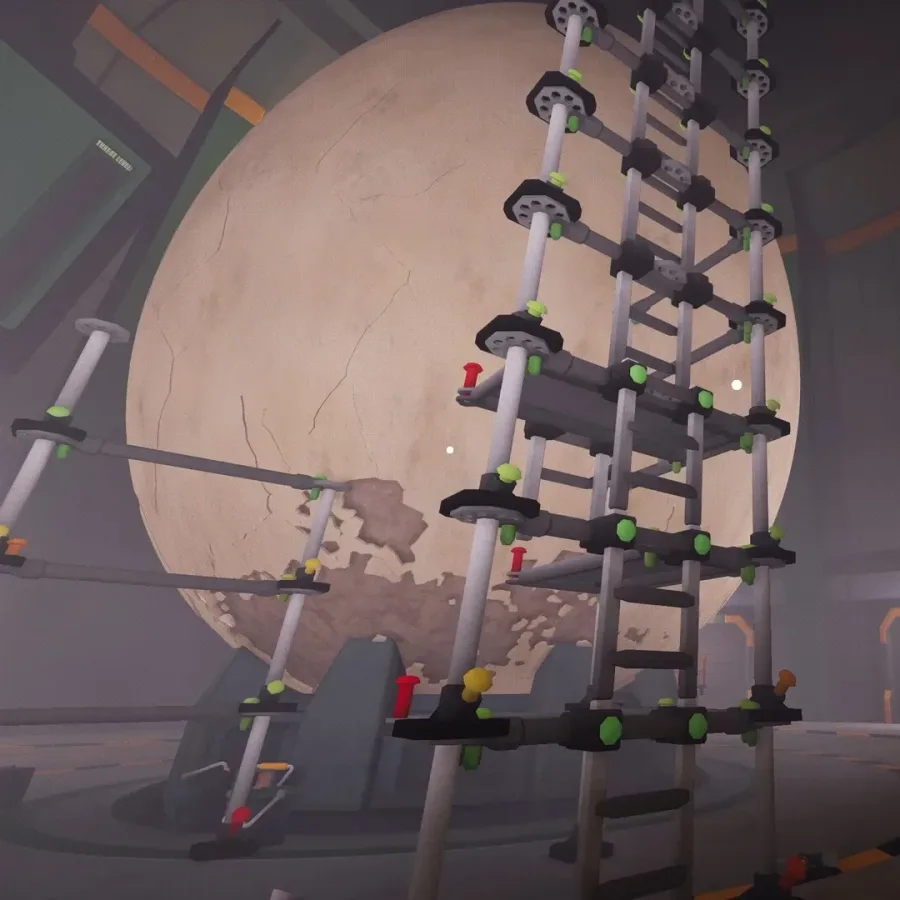
There are games built around saving kingdoms, winning wars, driving supercars, or surviving impossible worlds. Then there is Crack, a co-op game with an admirably direct objective: players are put in a laboratory with an enormous egg and told to break it open.
The premise is simple enough to explain in a sentence, but the game is not positioning the egg as a disposable prop. It is the entire mystery, the centrepiece of the laboratory, and apparently something that will respond to the way players treat it. Nobody knows where the egg came from. Nobody knows what it contains. What players do know is that they have tools, instructions, and a very large shell standing between them and an answer.
Crack is scheduled to launch on Steam on October 26. Its concept sounds deliberately ridiculous at first glance, but its systems suggest a more elaborate co-op incremental adventure than a one-note physics joke. Players will begin with practical equipment including pickaxes and chisels, then move toward far more destructive options such as dynamite. The laboratory also holds stranger tools, secret spaces, building possibilities, and a currency loop tied directly to the debris left behind by the team's efforts.
A Giant Egg With a Reaction to Everything
The developers describe Crack as an "incremental adventure," a label that points to progression rather than a single session of repeatedly swinging a pickaxe until an ending appears. Every blow against the egg is part of an expanding process. Breaking shell creates pieces that can be converted into currency, that currency supports further progress, and better equipment allows players to approach the massive object in new ways.
For useful background on this topic, read The Elder Scrolls Online Looks Beyond Combat With a New Focus on Secrets and Exploration.
Early tools are exactly what a group of people might reasonably use when told to open a giant egg: pickaxes and chisels. Eventually, however, restraint appears to become optional. Dynamite is among the escalation tools mentioned for the game, while "other weird tools" are said to be scattered through the laboratory. That wording leaves plenty of room for surprises, especially in a game whose central premise is already difficult to take at face value.
Scaffolding will also be part of the experience. That detail matters because it implies the egg is not just something players hit from ground level. Teams may need to construct routes and platforms around it, potentially turning the laboratory into a changing worksite as they seek access to different parts of the shell. A giant egg creates a wonderfully odd sense of scale: something normally fragile and handheld becomes an environmental obstacle that requires infrastructure.
There are secret rooms to discover as well, adding another layer to the game beyond brute-force destruction. The laboratory is not merely a blank arena designed to hold an egg. It is a location with hidden spaces and, presumably, clues or rewards connected to the task at hand. The mystery is therefore not limited to whatever may be inside the shell.
The egg has secrets, and it reacts to players' actions.
That is the most intriguing part of Crack's setup. A reactive egg could mean many things, and the game has not spelled out precisely how those responses work. It could alter the environment, change its behaviour, reveal new paths, resist particular methods, or create consequences for a team that gets too enthusiastic with explosives. The uncertainty is doing a great deal of work here. If the egg is simply a progress bar made of shell, the gimmick may wear thin. If it is an active, unpredictable part of the world, every new tool could carry a little tension alongside the comedy.
Co-Op Makes the Premise Better
Crack's co-op format is a natural fit for its strange project. Breaking open a colossal egg in a laboratory is funny on its own; doing it alongside other players creates space for coordination, experimentation, accidental chaos, and competing ideas about the safest way to proceed. One player may be carefully working with a chisel while another has already decided the answer is dynamite. Someone can focus on building scaffolding, someone else can search the building for secrets, and another can collect shell fragments to fuel the team's next upgrade.
That division of attention is important in games based on incremental loops. The basic action needs to be satisfying, but players also need reasons to look away from the primary task. In Crack, the shell fragments becoming currency provide a resource-management layer, while hidden rooms and unusual equipment offer opportunities for exploration. Construction adds another collaborative function. Rather than every player simply taking turns hitting the same object, teams can make simultaneous contributions to a shared, bizarre undertaking.
It is also easy to imagine the egg becoming a conversation piece within a group. Because the game's mystery is so concentrated, players are likely to develop theories about the object, its origin, and its contents as they progress. Is the lab studying it? Containing it? Trying to hatch it? Did the people who left behind all these tools understand what they were dealing with? Crack's setup does not answer those questions yet, but it gives players a reason to keep moving deeper into its systems.
The Appeal of a Completely Focused Weird Idea
Steam has become a particularly fertile place for games that take one unusual activity and commit to it with complete sincerity. Sometimes the hook is intentionally mundane: organizing shelves, cleaning spaces, managing a repetitive task, or looking for an impossibly small object in an enormous place. Sometimes it is absurd enough that the elevator pitch becomes the entire attraction. Crack clearly belongs in the latter camp, but it also has the structure to make its silliness feel purposeful.
There is a difference between a joke premise and a game that understands how to build around a joke premise. "Smash a giant egg" is a memorable starting point. "Smash a giant reactive egg with friends, use its shell for currency, discover secret rooms, build scaffolding, unlock new equipment, and decide whether dynamite is a terrible idea" is a game loop. The latter is why Crack could capture attention beyond the first trailer or screenshot.
The project also arrives at a time when players have shown substantial appetite for focused experiences built around surprisingly tactile chores. Games about cleaning, sorting, restoring, collecting, and organizing have found audiences partly because their actions are easy to understand and their progress is visible. Crack applies a more surreal coating to that same satisfaction. A pickaxe impact removes a piece of shell. Shell pieces become resources. Resources unlock possibilities. The laboratory changes. The unanswered question at the centre gets closer.
Of course, the game's eventual impact will depend on whether that loop remains interesting after the novelty has settled. Incremental progression can be compelling when each stage offers a meaningful new decision rather than merely demanding larger numbers. Crack's list of tools, construction options, secrets, and reactive behaviour suggests it is aiming for variety, but players will need to see how those pieces connect once it is available.
A Mystery That Needs a Better Ending Than Gaming's Most Famous Container
Any game that asks players to spend significant time breaking into a giant sealed object invites comparison with Curiosity: What's Inside the Cube?, Peter Molyneux's famous experiment. That project revolved around players collectively chipping away at a cube to reveal what was at its centre. The eventual reward was intended to be life-changing: the winner would receive a share of revenue from Molyneux's game Godus.
The outcome became a cautionary tale. By 2017, Godus had not made a profit, meaning there was no revenue to distribute. For Crack, that history is a reminder that a sealed-object mystery can generate enormous curiosity, but its conclusion matters. The game does not promise a real-world windfall, which may be for the best. Its appeal is instead grounded in the act of opening the egg, the discoveries made along the way, and whatever strange response the laboratory's central object has in store.
That is a healthier foundation for the mystery. Players are not being asked to believe a single revelation will transform their lives. They are being invited to participate in a shared, escalating experiment. The egg is compelling because it is bizarre, because it seems to be alive or at least responsive, and because the methods available for cracking it open appear to become steadily less sensible.
What to Expect on October 26
Crack will arrive on Steam on October 26 with its giant laboratory egg, cooperative play, progression-focused structure, destructible shell economy, scaffolding, secret rooms, and an arsenal that ranges from hand tools to explosives. It is a premise that sounds like it should have been exhausted after one line, yet the details keep making it more appealing.
For players who enjoy offbeat co-op games, tactile destruction, or mysteries with a deliberately silly outer layer, Crack is worth keeping on the radar. The key question is not simply what is inside the egg. It is how much trouble a group of friends can cause before they get there.
Community
Discussion
Start the conversation.
No comments have been posted yet.