

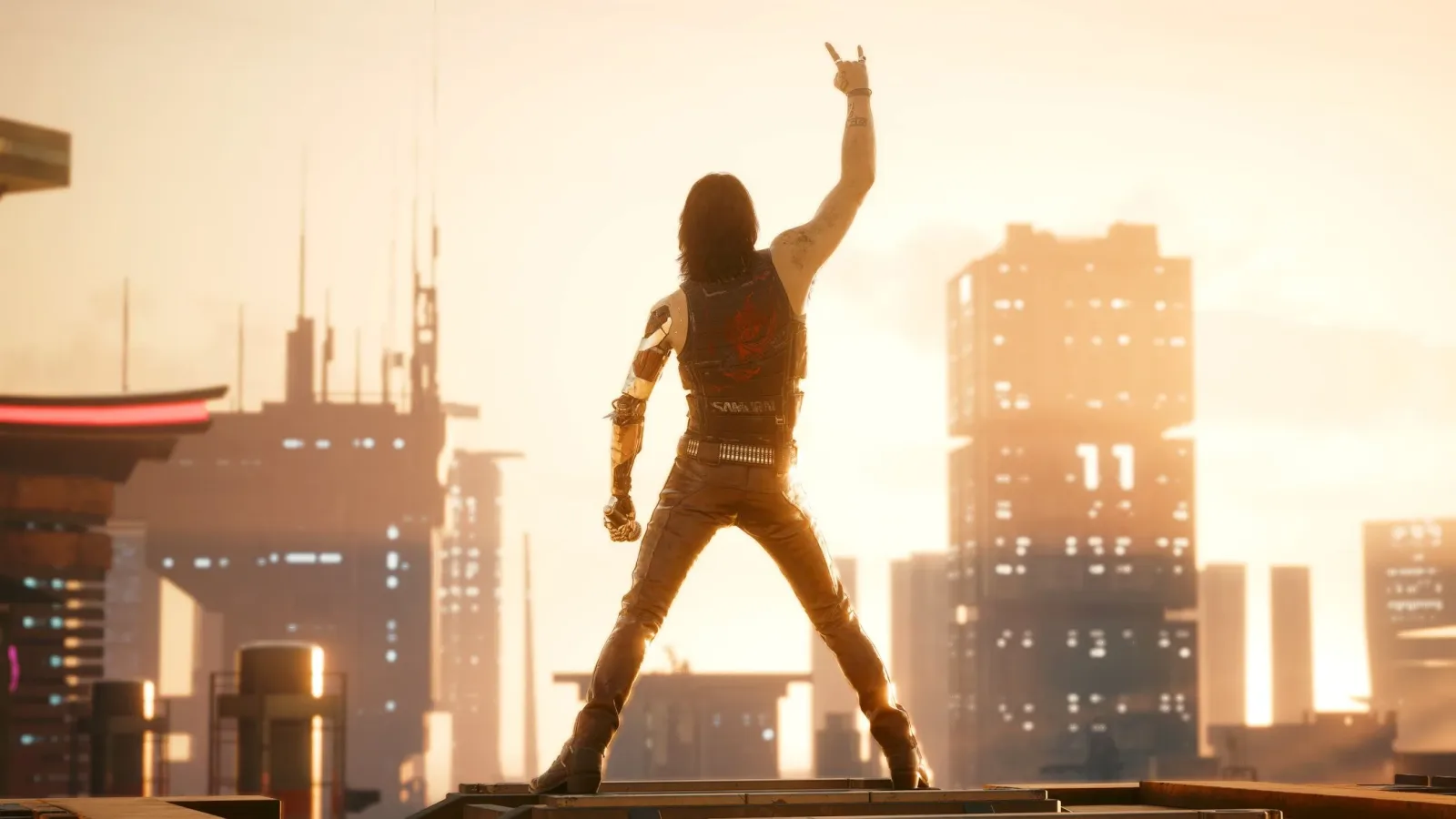
Cyberpunk 2077 gives players enormous latitude to decide who V is. Players can choose V's appearance, background, romances, combat specialties, dialogue responses, and much of their personal attitude toward Night City's inhabitants. Yet there is a deliberate limit to that ownership, and it is one of the game's most important storytelling tools.
Quest lead Pawel Sasko has addressed a small but revealing character detail that players have continued to notice long after the game's release: V can express a dislike of smoking earlier in the story, only to smoke later as Johnny Silverhand's presence becomes more deeply entwined with their mind. The shift is not meant to indicate that V simply changed their mind or developed a new habit off-screen. It is intended as a quiet sign that Johnny is beginning to affect the protagonist in ways the player cannot entirely prevent.
That lack of full control may be uncomfortable for some role-playing game fans. Sasko's point is that it should be. Cyberpunk 2077 uses the conventions of an RPG not only to let players inhabit a character, but also to communicate the terror of slowly losing part of that character to a condition they never chose.
A Small Habit With a Larger Narrative Purpose
At first glance, smoking might seem like a minor animation or an incidental piece of V's presentation. In a game as dense as Cyberpunk 2077, Night City is full of gestures, repeated lines, environmental details, and character tics that can easily blend into the background. But V's changing relationship with cigarettes carries particular weight because it speaks directly to the game's central conflict.
For useful background on this topic, read Path of Exile 2's Early Access Momentum Draws Major Praise Ahead of Free-to-Play 1.0.
Johnny Silverhand is not merely a companion with opinions, a conventional RPG party member, or an optional personality that players can ignore. The digitized engram of the rocker and anti-corporate revolutionary is lodged in V's head through the Relic, gradually overwriting V's consciousness. The arrangement starts as an antagonistic and frightening intrusion. Johnny is hostile, V is desperate to survive, and both understand that the situation may end with only one of them remaining.
Over time, however, the dynamic can become considerably more complex. Depending on player choices, V and Johnny may develop trust, affection, mutual respect, regret, or a difficult form of empathy. Their relationship can still be volatile, but it is not static. The smoking detail is one of the subtler ways Cyberpunk 2077 illustrates that development while also emphasizing the danger underneath it.
Sasko praised the player observation, explaining that the moment was intended to show Johnny's personality gradually blending with V's through modest actions. In that reading, the cigarette is less about nicotine and more about identity. A behavior associated with Johnny surfaces through V, making the boundary between the two people a little less certain than it was before.
Why an RPG Would Take Control Away From the Player
The idea can sound counterintuitive. Role-playing games are often built around agency: players expect to define their character, influence the plot, establish relationships, and shape the moral direction of the story. Cyberpunk 2077 delivers many of those freedoms, but its premise also places V in a situation where agency is fundamentally compromised.
V's condition is not voluntary. The protagonist is facing a terminal problem tied to the Relic and the engram embedded within it. There is no clean menu option that allows the player to opt out of the core crisis. That is precisely why moments that clash with a player's imagined version of V can matter so much. They communicate that V is not completely stable, self-contained, or safe from outside influence.
As Sasko put it, the discomfort is part of the intended effect. The game uses RPG mechanics and player expectations to portray a form of illness and deterioration. A player may have decided that their V would never smoke, would never talk a certain way, or would never share Johnny's instincts. Seeing those boundaries blur forces the player to confront the fact that V's body and mind are under pressure from an invading presence.
That is a very different narrative approach from a game in which every action is treated as a pure expression of player intent. Cyberpunk 2077 wants players to make consequential decisions, but it also wants them to feel the limits of their power. The Relic storyline would lose much of its emotional force if Johnny were only audible when convenient and incapable of leaving a trace on V's behavior.
Headcanon Meets a Fixed Protagonist
The debate around the detail also highlights a familiar tension in RPG storytelling. Players often build strong headcanons for customizable protagonists. Even when a game provides a named hero with a defined history, fans can fill in the unseen spaces: personal routines, values, flaws, tastes, boundaries, and motivations.
V invites that kind of interpretation. The three lifepaths offer different starting contexts, and the game's dialogue choices can produce versions of V who are compassionate, cynical, pragmatic, idealistic, reckless, corporate-minded, street-smart, or some combination of all of those traits. It is natural for players to feel protective of their version of the protagonist.
But V is not a blank slate in the strictest sense. The character has a name, a voiced performance, established ambitions, relationships that exist before the player arrives, and a central predicament that governs the story. Cyberpunk 2077 is therefore closer to a hybrid model: V is highly personalized, but remains a written character whose journey has themes and constraints that cannot be entirely rewritten.
Johnny's influence makes that hybrid quality especially visible. When the game briefly works against a player's preferred interpretation of V, it is not necessarily dismissing role-play. Instead, it is using the friction between player ownership and authored storytelling to reinforce the threat at the heart of the narrative.
For players who see their V as distinctly separate from Johnny, an unexpected shared mannerism can feel invasive. That emotional reaction mirrors V's own circumstances. The moment succeeds because it does not ask the player merely to observe a loss of control from a distance; it gives them a small taste of it through a protagonist they have spent hours shaping.
The Value of Details Players Keep Finding
It is notable that this particular detail is still being discussed years after Cyberpunk 2077 first launched. The game has received extensive post-launch work, including major patches, the Phantom Liberty expansion, and updates tied to the world of Cyberpunk: Edgerunners. Those additions have prompted players to return to Night City, start new characters, revisit quests, and inspect familiar scenes with a different perspective.
Yet the smoking observation concerns a narrative flourish rather than a newly added mechanic or quest. It reflects the lasting appeal of densely authored games: players can return with more knowledge of a character, a plot twist, or a later outcome and notice how earlier scenes were quietly preparing them for it.
Cyberpunk 2077's main story is built around that kind of recontextualization. At the beginning, Johnny can seem like an unpredictable and even monstrous obstacle. As the story unfolds, players learn more about his history, his failures, his relationships, and the mythology surrounding his reputation. None of that removes the threat he poses to V. Instead, it makes the conflict more emotionally tangled. Johnny is simultaneously an intruder, a possible ally, an echo of a violent past, and a person capable of change.
Small behavioral overlap between him and V supports that ambiguity. It suggests that the two are not simply sharing space like roommates in an apartment. Their connection is far more intimate and alarming: memories, instincts, attitudes, and fragments of personality can cross a line that neither side can fully control.
Looking Toward Cyberpunk 2
Cyberpunk 2077 is now largely narratively complete, even as its community continues to examine the choices and details within it. That makes discussions about V and Johnny especially valuable as attention gradually turns toward the next Cyberpunk game in development.
There is no need for a future protagonist to repeat V's exact story. In fact, the power of the Relic arc came partly from how personal its stakes were. Still, Cyberpunk 2077 demonstrates how effectively the series can use player agency alongside authored vulnerability. Night City is a setting built around technologies that alter bodies, memories, status, and identity. A role-playing game set there is well positioned to ask not only what players choose to become, but what happens when systems far larger than them begin making those choices in return.
V's cigarette is a small example of that idea, but it captures the broader theme with unusual precision. The player may recognize the action as something they would not have selected. V may have once rejected it as well. That gap is the point: Johnny is there, the Relic is working, and the person the player thought they completely understood may no longer be entirely alone inside their own head.
For an RPG, that can be an unsettling proposition. For Cyberpunk 2077, it is also one of the clearest expressions of what the story has been trying to say all along.
Community
Discussion
Start the conversation.
No comments have been posted yet.