

Dark Souls has built its reputation on turning danger into dark comedy. A chest turns out to have teeth. A harmless-looking path sends the player tumbling into an ambush. A victory can be followed immediately by a misplaced step, a lethal fall, or an enemy attack that arrives at precisely the worst possible moment. Its world is oppressive, but it is also frequently hilarious in the sheer audacity of its traps and punishments.
That combination is why players keep returning to Lordran, even after years away. The game can be cruel, yet its cruelty is often memorable because every disaster becomes a story. A disastrous run through a hostile area is never merely lost progress; it is a new lesson, a new grudge, or a fresh reason to laugh at the game's timing. But every Dark Souls player eventually finds a particular stretch of the map that stops feeling funny. For one returning adventurer pushing through Anor Londo, that place is not the legendary Ornstein and Smough arena. It is the deceptively ordinary room immediately before it.
The player had previously reached the Gaping Dragon before abandoning an earlier playthrough upon arriving in Blighttown. This time, the journey has lasted much longer, reaching deep into Anor Londo and nearly completing the area. That progress has reinforced why the original remains such a celebrated action RPG: its hostility is deliberate, its spaces are memorable, and its threats demand attention. Yet it has also led to a painfully specific nightmare involving a room filled with three enemies and one very important summon sign.
The boss run has a hidden complication
Ornstein and Smough are among the game's most famous bosses, a punishing duo encounter that asks players to manage two radically different threats at once. Ornstein is swift and aggressive, closing distance with spear attacks and sudden charges. Smough is a towering hammer-wielder whose slower attacks cover huge areas and can crush anyone who gets careless. They are a major wall for many players, and the pair's reputation is thoroughly earned.
For useful background on this topic, read 9 Halloween 2026 Events Bringing Spooky Rewards to Major Games.
But the boss fight itself is not the central issue here. There is confidence that Ornstein and Smough can be beaten after a few stronger attempts. The problem is getting into the arena under the preferred conditions: with Solaire of Astora summoned as an ally.
Solaire is one of Dark Souls' most beloved NPCs, an upbeat warrior associated with the game's iconic "Praise the Sun" gesture. Bringing him into a difficult battle offers more than practical assistance. He can help divide a boss's attention, create attack openings, and make the encounter more manageable, but he also gives the battle a feeling of camaraderie that is rare in Lordran's lonely, ruined world. For a player who wants that experience, simply sprinting through the boss fog alone is not an appealing compromise.
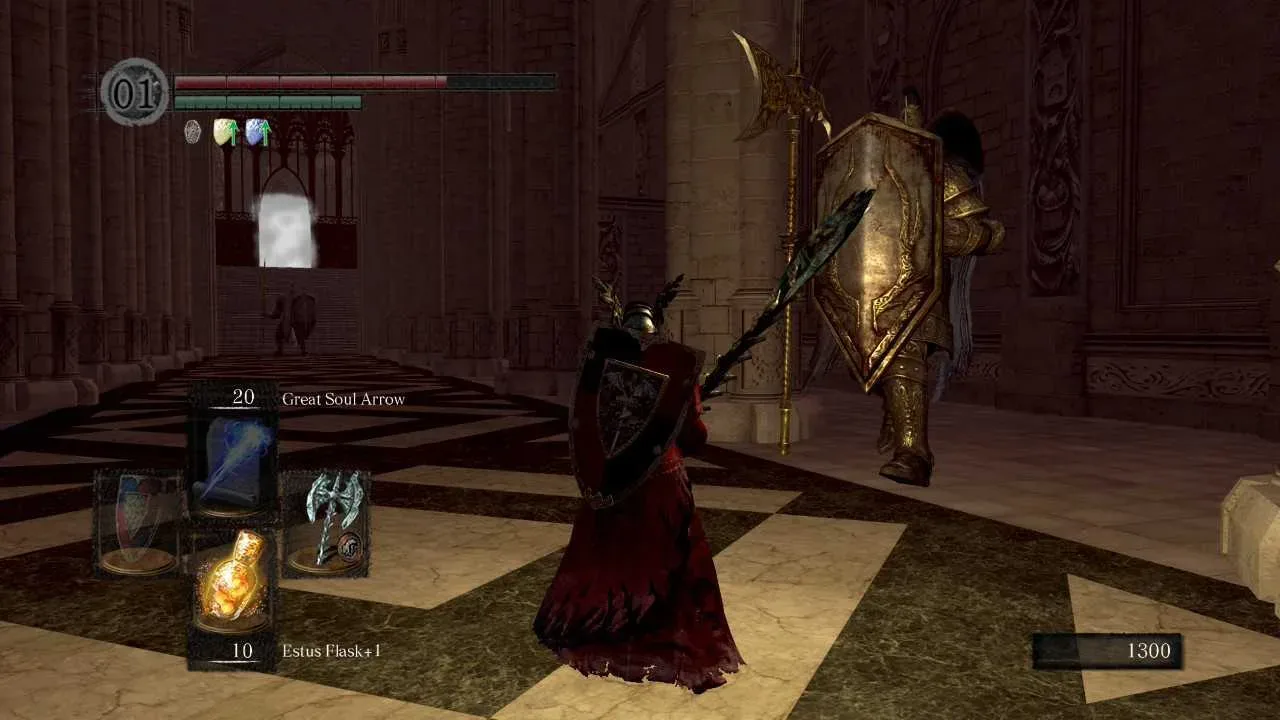
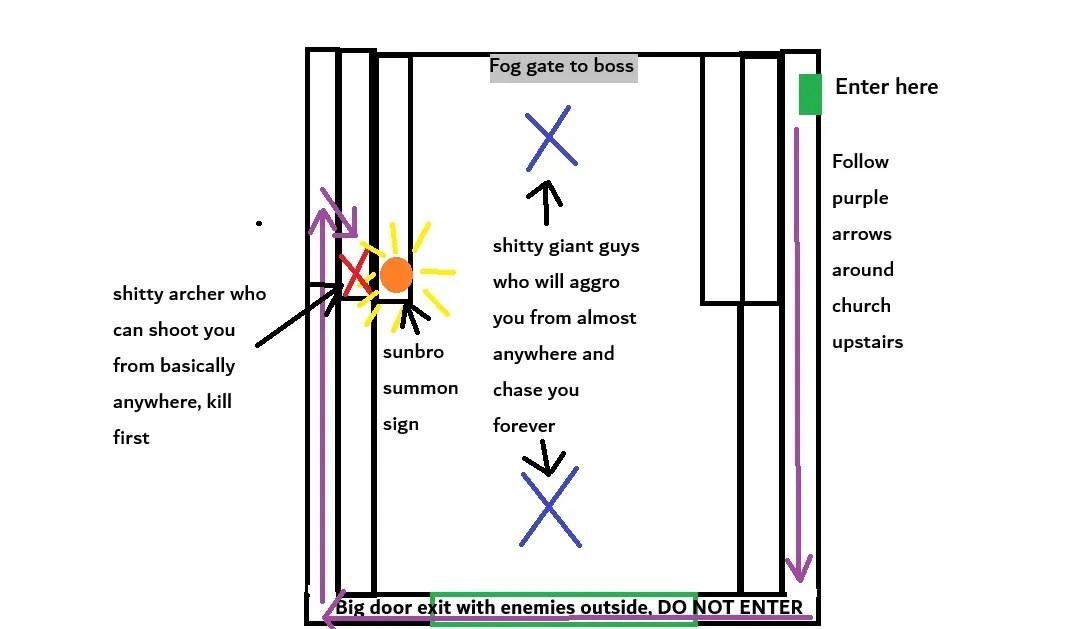
Unfortunately, Solaire's summon sign is positioned on the far side of a hostile chamber before the fog gate. Reaching it means traveling through the room, waiting through the summoning animation, then successfully escorting Solaire back through the same space and down to the boss entrance. That would be simple if the enemies in the chamber could be ignored. They cannot.
A basic room becomes a personal dungeon
The approach to Ornstein and Smough already involves a lengthy trip from the nearest bonfires. One route is comparatively clear but ends with two heavy knights that cannot easily be avoided. Another contains multiple Silver Knights, though they can mostly be outrun. Neither option is ideal, but both are survivable. The real bottleneck comes at the end, in the room that separates the player from both Solaire and the boss.
Inside are an archer and two bulky, shield-bearing enemies. The archer is the least troublesome part of the equation. Sprinting toward him can limit the threat from his arrows, and a powerful axe can finish him in two swings under favorable circumstances, or three if the damage roll is less kind. Once he is gone, however, the two larger enemies downstairs become the real obstacle.
They are slow enough that they seem manageable on paper. Their attacks are telegraphed. Their weapons are visible. Their defensive weakness is clear: attacks from the front are absorbed by their shields, so the player needs to circle behind them and land repeated hits. In theory, this should make them a routine cleanup task before the boss. In practice, it becomes a draining duel of positioning, patience, and accumulated frustration.
These enemies can hop backward to escape pressure, use a forceful spell to knock an attacker away, and restore their own health. They can also punish a mistaken read with a shield slam that hits hard in a surprisingly large area. Being knocked down is especially dangerous. Dark Souls is unforgiving about recovery animations, and a player slowly getting back to their feet can be immediately met by a spear thrust before they are fully able to respond.
The result is a room that consumes healing, weapon buffs, time, and concentration before the actual headline fight even starts. Great Magic Weapon charges may be spent just to make the room safer. Estus flasks may disappear because of one bad dodge. A successful clear can still feel terrible if it leaves the player depleted before Ornstein and Smough are even on screen.
Why leaving enemies alive does not work
There is a tempting shortcut: run to Solaire's sign, summon him, and rush to the fog gate before the room's defenders can cause trouble. The design of the encounter makes that unreliable. The enemies have an enormous aggro range, apparently able to notice the player from nearly anywhere in the chamber outside its uppermost section. Once they are active, Solaire is liable to engage them rather than follow immediately toward the boss.
That introduces several possible failures. Solaire might fight the enemies long enough to take major damage, then eventually head for the fog gate in poor shape. He might become occupied in the room and remain there, refusing to join the intended battle. Or the player might try to leave him behind, enter the boss arena, and discover that their sun-loving ally never arrives. For someone deliberately using the summon sign, that is not a satisfying solution.
Repeated attempts to find a route that loses enemy attention have not produced a consistent answer. The summoning process itself also takes long enough that it cannot simply be performed at full sprint. That leaves a grim conclusion: to ensure Solaire reaches Ornstein and Smough in useful condition, the room needs to be cleared first.
It is an excellent example of how Dark Souls creates difficulty beyond raw enemy strength. The archer and shielded guards may not be more mechanically demanding than the area's infamous Silver Knight archers on the ramparts. In fact, the player considers those celebrated archers far easier than this room. The misery comes from repetition. Every failed Ornstein and Smough attempt turns the chamber into mandatory pre-fight labor. Every error there creates a choice between proceeding weakened or starting over.
The psychological damage of a repeated runback
At some point, a manageable enemy encounter becomes harder because the player expects it to go badly. That is the trap at work in Anor Londo. The two shielded enemies have been defeated many times without trouble. Their moves are known. Their pace is slow. Their vulnerable angles are understood. Yet after enough runs, small errors begin to snowball. A mistimed dodge burns healing. A shield slam causes panic. A failed attempt to get behind one target allows the other to interfere. What should be simple starts consuming attention better saved for the boss.
Long boss runbacks are one of the original Dark Souls' most divisive design traits. They amplify victory when the player finally prevails, but they can make practice feel expensive. Modern games in the Soulslike genre more commonly place checkpoints near major bosses, allowing repeated attempts to focus directly on the central encounter. Dark Souls often asks for a toll first. In this case, the toll is a three-enemy room that becomes more aggravating than the duo waiting behind the fog.
There is another cost to summoning Solaire: Humanity. The player must restore their human form at a bonfire to call upon him, requiring a Humanity item each time. If the room kills them before the summon is completed, that resource is effectively spent with nothing to show for it. After enough failed attempts, the supply has run dry.
That forces an even more frustrating detour. To gather more Humanity, the player plans to leave Anor Londo, cross back through Sen's Fortress, and return toward Firelink Shrine to upgrade the Estus Flask and farm resources. In classic Dark Souls fashion, even the recovery plan turns into another trek through dangerous territory.
There is no easy answer when the goal is jolly cooperation
The obvious strategic advice would be to stop insisting on summoning Solaire, conserve Humanity, and enter the Ornstein and Smough fight alone. That is a perfectly valid approach, and many players have done exactly that. Yet Dark Souls is not only about the most efficient route to a win. It is also about personal goals, favorite characters, and the stories players choose to create inside its severe systems.
For this run, the objective is not merely to defeat two famous bosses. It is to do so alongside Solaire. That makes the ordinary room before the arena matter enormously. The archer, the shields, the healing enemies, the long corridors, the spent Estus, and the dwindling Humanity are all part of the price of bringing a sunbro to the fight.
It may not be the room most players name when recalling Anor Londo's horrors. It lacks the spectacle of the boss chamber and the immediate infamy of the rooftop archers. But Dark Souls is full of places like this: unremarkable rooms that become unforgettable because they happen to be standing between a player and the exact victory they want. Sometimes the hardest enemy in Lordran is not Ornstein, Smough, or even Blighttown. Sometimes it is one room, three stubborn guards, and the refusal to leave Solaire behind.
Community
Discussion
Start the conversation.
No comments have been posted yet.