

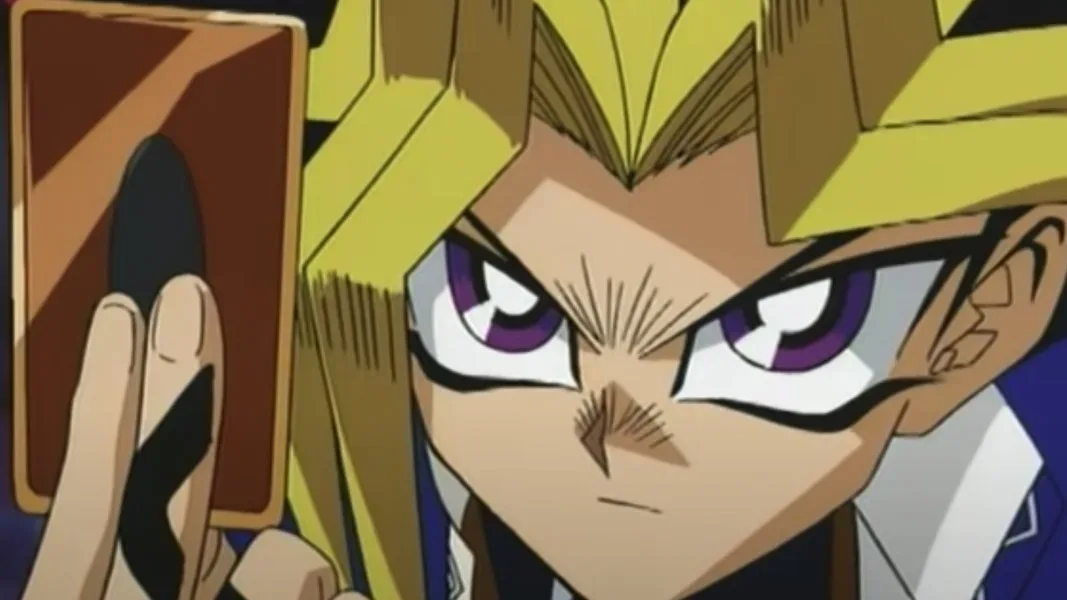
It is easy to look at Yu-Gi-Oh! now and assume its success was inevitable. The series became a defining trading-card phenomenon, an enduring video game property, and one of the most recognizable anime brands of its generation. Yet its path to the version remembered by millions was apparently far less straightforward. A recollection from anime production planner Yoshiro Kataoka describes a 1999 rights dispute in which the future of a new Yu-Gi-Oh! television adaptation was caught up in an unusually high-stakes negotiation.
The decisive pressure point, Kataoka said in a multipart university interview translated by Otaku Mantra, was not Yu-Gi-Oh! itself. It was Dragon Ball. Weekly Shonen Jump editor-in-chief Kazuhiko Torishima reportedly warned Toei Animation that its secondary usage rights for Dragon Ball could be revoked if it would neither make another Yu-Gi-Oh! anime nor allow the property to move to another production arrangement. Toei ultimately relented, clearing a route for the television series that became Yu-Gi-Oh! Duel Monsters.
For anime and gaming fans, the story is a reminder that major franchises are often shaped as much by licensing negotiations and corporate relationships as by creative momentum. Without that apparent turning point, Yu-Gi-Oh!'s multimedia history--including the card game's global explosion and the extensive console and handheld game catalogue built around it--could have looked very different.
The Yu-Gi-Oh! Before Duel Monsters
Kazuki Takahashi's Yu-Gi-Oh! manga began serialization in Weekly Shonen Jump in 1996. It had enough traction to receive an anime adaptation relatively quickly, but it had not yet reached the extraordinary level of cultural and commercial visibility associated with the franchise later on. The earliest television version arrived in 1998 as a 27-episode production involving TV Asahi and Toei Animation.
For useful background on this topic, read Solo Creator Says Jackbox's Debate and Switch Resembles His Board Game.
That series is frequently called "Season 0" by fans, though that was not its formal title. The nickname largely helps distinguish it from the later and much more widely known Yu-Gi-Oh! Duel Monsters. The 1998 adaptation was never given an English-language dub, making it substantially less familiar to international audiences who first encountered Yugi, Kaiba, and the card battles through later broadcasts.
Its tone is also notably different. Before the franchise became tightly associated with Duel Monsters as the central game and dramatic engine, Yu-Gi-Oh! had a broader and stranger premise. The manga featured an array of games, punishments, supernatural confrontations, and darker morality tales. The early adaptation reflected more of that material, creating what can feel like an alternate version of the franchise for viewers raised on the card-focused era.
By Kataoka's account, the 1998 anime did not perform well enough to continue. Concrete viewership data has not been established in the account, but the production was reportedly cancelled after its 27 episodes. That would ordinarily have been the end of an unsuccessful adaptation. The manga, however, was beginning to find a much stronger footing, and its publisher saw reason to pursue another anime project.
A Rights Dispute at a Crucial Moment
The unusual complication was that Toei Animation reportedly had no interest in producing a second Yu-Gi-Oh! season, while also refusing to return the relevant anime rights in a way that would enable another company to take over. That position put Shueisha, the publisher behind Weekly Shonen Jump, in a difficult spot. The publisher wanted a new adaptation, but the existing rights situation could prevent it from happening.
Kataoka, whose production work includes anime such as Hunter x Hunter and Gunslinger Girl, recalled a meeting in 1999 where the issue came to a head. In his retelling, Toei made it clear it would not surrender the Yu-Gi-Oh! rights. Torishima then invoked Dragon Ball as the counterweight.
"Are you sure you want to say that?" Kataoka recalled Torishima saying. "If that's how you want to play ball, then here's my trump card: I'll revoke all secondary usage rights for Dragon Ball."
The phrase "secondary usage rights" is important because it points beyond the basic act of broadcasting an anime. Major properties generate value through a wide range of uses, from merchandising and promotional activity to international business arrangements and other licensed extensions. The precise scope of the rights involved is not detailed in Kataoka's recollection, but the core message was unmistakable: holding up Yu-Gi-Oh! could endanger Toei's ability to benefit from Dragon Ball.
That was an especially formidable threat at the time. Dragon Ball was already a massive franchise, and Dragon Ball Z was becoming enormously important outside Japan as well. FUNimation's English dub of Dragon Ball Z began airing on September 13, 1996, and its run did not conclude until April 2003. In other words, the reported 1999 confrontation occurred amid a period when Dragon Ball's international footprint was expanding dramatically.
Why Duel Monsters Changed Everything
Toei reportedly backed down, allowing the next Yu-Gi-Oh! anime project to proceed. The result was the TV Tokyo-produced Yu-Gi-Oh! Duel Monsters, the adaptation that established the visual identity, character dynamics, rivalries, and card-game storytelling that became synonymous with the franchise around the world.
It is difficult to overstate how much that version mattered to Yu-Gi-Oh!'s eventual standing in games. The franchise's real-world trading card game had already begun in Japan in the late 1990s, but the anime created an accessible, serialized showcase for its rules, monsters, strategies, and personalities. Cards were not merely merchandise connected to a show; they were treated as the focal point of duels with emotional stakes, elaborate comebacks, and recurring tactical language.
That feedback loop between animation and play helped turn Yu-Gi-Oh! into a durable game brand. New sets, iconic monsters, and changing mechanics could be introduced through the show, while players could seek out physical cards and digital recreations of the dueling experience. Over time, the property reached consoles, handhelds, PC, mobile devices, and arcade-style platforms through a vast range of games.
The connection is particularly clear in the older handheld library. Games based on the series gave players ways to build decks, duel anime characters, and experiment with card pools that were often difficult to assemble in real life. Titles across Game Boy, Game Boy Advance, Nintendo DS, PlayStation, and other systems became an essential part of how many fans learned Yu-Gi-Oh! rules and discovered cards. The later anime's success supplied the recognizable foundation those games depended on.
That does not mean a different adaptation could never have produced a successful card-game franchise. Counterfactual history is impossible to settle. Still, the version that actually arrived--Duel Monsters--was uniquely suited to make card battles feel like appointment viewing. Its format gave the game a stable center, which helped translate a manga with a wider premise into a focused global brand.
The Strange Legacy of "Season 0"
The earlier Toei series has gained a special place among long-time fans precisely because it feels so disconnected from the Yu-Gi-Oh! most people know. It presents familiar characters in a more unsettling world and emphasizes the franchise's earlier supernatural, thriller-like edge. For viewers who only know the polished duel-arena drama of Duel Monsters, it can be surprising to see how far the source material's initial identity extended beyond the card game.
Its accessibility has also improved over time. The complete 27-episode run has been available to watch for free on YouTube for close to a decade. It remains an intriguing archival piece rather than a replacement for Duel Monsters: an adaptation of Yu-Gi-Oh! from a moment before the property fully settled into the form that would make it internationally famous.
There is a broader lesson in the reported 1999 dispute. A franchise can be commercially promising without every adaptation landing immediately. Yu-Gi-Oh!'s first anime did not become the breakout hit. Its later version did, and it did so at the exact point when the card-focused identity of the manga was becoming the property's greatest strength.
A Franchise-Shaping Negotiation
Kataoka's account should be understood as a participant's retrospective recollection, rather than a complete public record of every contractual detail. Even so, it offers a remarkable glimpse behind the scenes of an entertainment business decision that had far-reaching consequences. The key facts of the story are striking: an early anime adaptation ended after 27 episodes, the rights became an obstacle to a successor, and Dragon Ball's licensing power was reportedly used to break the deadlock.
For fans of retro anime, trading cards, and licensed games, that makes the tale more than industry trivia. It helps explain why the Yu-Gi-Oh! that became a worldwide gaming fixture was not simply the inevitable next season of a successful show. It was the product of a second chance--and, apparently, a negotiation where one of manga and anime's biggest properties became the deciding leverage.
Community
Discussion
Start the conversation.
No comments have been posted yet.