

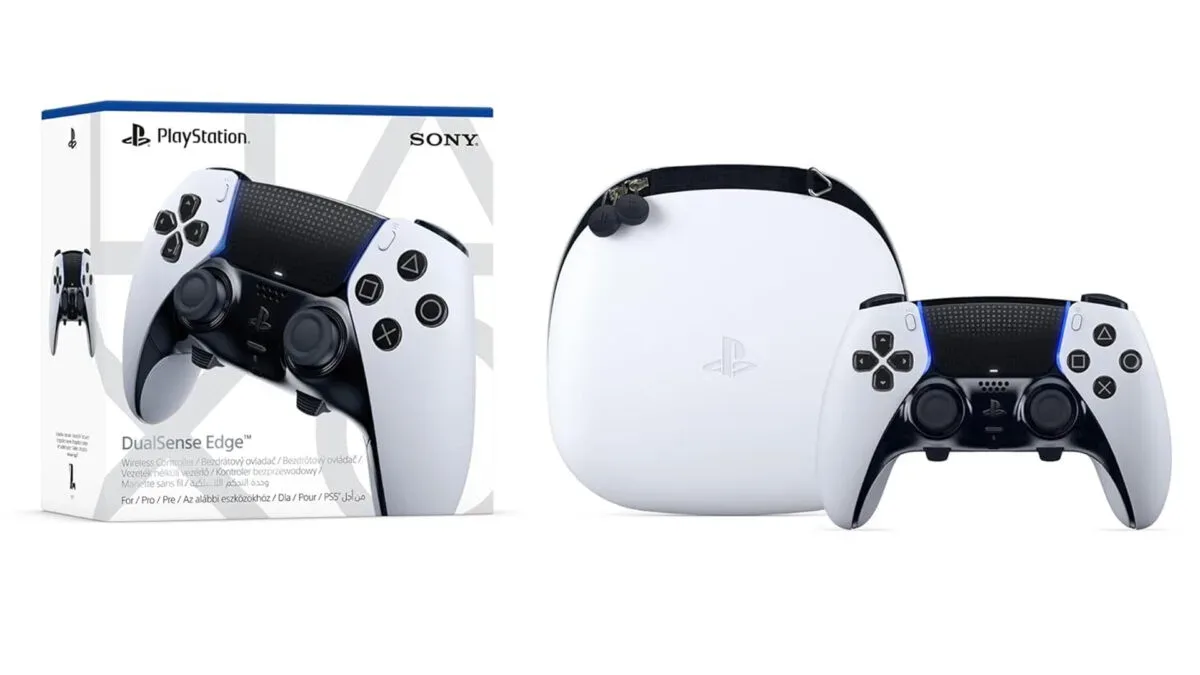
Sony's DualSense Edge is one of those PlayStation 5 accessories that has always made a strong first impression, then run into a familiar obstacle: its premium price. The controller brings pro-style features to the PS5 ecosystem, including remappable rear inputs, adjustable triggers, customizable stick behavior, and replaceable analog stick modules. But at $199, it has generally been a purchase aimed at players who know exactly why they need those extra options.
That calculation is a little easier ahead of the Black Friday weekend. Amazon has listed the Midnight Black DualSense Edge for $169, down from $199. The $30 reduction does not turn it into an inexpensive controller, but it does meaningfully narrow the gap between Sony's standard DualSense pad and its enthusiast-focused alternative.
For PS5 players who have been waiting for a sale before upgrading, the appeal is less about a radically different controller layout and more about having greater control over the familiar one. The DualSense Edge retains the core features that define the regular PS5 controller while adding hardware and software options intended for competitive games, long sessions, and players dealing with the eventual wear that comes with heavily used analog sticks.
A Familiar DualSense, Built for More Adjustment
The DualSense Edge uses the same fundamental shape and control arrangement as the standard DualSense. That means players still get PS5 features such as haptic feedback, adaptive triggers, and the controller's built-in microphone. Anyone already comfortable with Sony's default pad should not need to relearn where the sticks, face buttons, touchpad, or shoulder controls are located.
For useful background on this topic, read Logitech G920 Racing Wheel Drops to $199 for Black Friday.
The difference is that the Edge gives users more ways to tailor those controls to their preferences. Rather than being a separate controller concept with an unusual layout, it is an expanded version of the DualSense approach. That makes it especially relevant for people who enjoy the standard controller's feel but want more flexibility in shooters, action games, racers, fighting games, or any title where quick inputs and personal configuration matter.
At $169, the Midnight Black edition also becomes a more appealing option for players who have been considering a second PS5 controller. It remains a substantial upgrade in cost compared with a basic pad, but its added components and customization can make more sense for a controller that will be used as a primary device over a long period.
Back Buttons Keep Thumbs on the Sticks
The feature many players will notice first sits on the rear of the controller. The DualSense Edge includes two mappable back buttons, positioned for use beneath the middle fingers. These can be assigned to other inputs, allowing actions normally handled by face buttons to move to the back of the controller.
For another perspective on this story, read Midnight Black DualSense Edge Was Listed at $169 Ahead of Black Friday Weekend.
In practice, that can be useful in games where removing a thumb from the right stick creates a brief but costly loss of camera control. A player could assign jump, crouch, reload, a melee action, weapon switching, or another frequently used command to a rear button. The exact benefit depends on the game and the player's habits, but the goal is clear: make important actions available without interrupting aiming or movement.
Sony includes two rear-button shapes in the box. There are half-dome buttons and lever buttons, letting players choose the option that feels more natural with their grip. That flexibility matters because rear controls can be highly personal. Some players prefer a smaller contact point that is harder to press accidentally, while others may favor a lever-like design that is easier to find quickly during hectic moments.
Back buttons are not automatically essential for every kind of game. Narrative adventures or slower-paced games may not benefit much from them. In competitive shooters, fast action titles, and games with busy control schemes, however, they can be the kind of addition that becomes difficult to give up after enough use.
Trigger Stops Offer Faster Inputs When Needed
The DualSense Edge also changes how its triggers can behave. Each trigger includes a three-step trigger stop, which allows users to reduce the distance the trigger needs to travel. A shorter pull can be valuable in games where rapid firing or quick repeated trigger presses are important.
For a competitive shooter, minimizing trigger travel can make the controls feel more immediate. For a racing game, though, a player may prefer the full range of trigger movement for finer acceleration and braking control. The Edge is designed to accommodate both preferences rather than forcing a single setup across every game.
That context-specific flexibility is a major part of the controller's value. The most useful configuration for a first-person shooter is not necessarily the best one for a driving game, sports title, or third-person action game. The Edge gives players tools to adapt rather than asking them to compromise on one all-purpose control feel.
Profiles and Stick Settings Add More Control
Beyond the physical parts, the DualSense Edge provides PS5-level customization for its inputs. Players can adjust stick sensitivity, configure dead zones, alter trigger response behavior, and save multiple profiles. These settings can help refine aiming behavior, compensate for individual preferences, or establish different control arrangements for different genres.
Profiles are particularly useful for someone who moves between several games with very different demands. One configuration might prioritize reduced trigger travel and rear-button assignments for a shooter. Another could use a different stick response and full trigger travel for a racing game. Instead of rebuilding settings each time, users can save setups and move among them as needed.
The controller's function buttons, located beneath the analog sticks, are intended to make that process less disruptive. They allow players to switch profiles and access adjustments without backing all the way out to PS5 system menus. That may sound like a small quality-of-life feature, but it supports the broader purpose of the Edge: settings should be usable during real play rather than buried behind a lengthy setup process.
Replaceable Stick Modules Address a Common Controller Concern
Perhaps the most distinctive practical feature of the DualSense Edge is its use of replaceable analog stick modules. Analog stick drift remains one of the most frustrating issues controller owners can face. When a stick begins registering movement without input, a controller can become unreliable even if its buttons, triggers, and shell remain in good condition.
With many controllers, persistent drift can mean replacing the entire device or pursuing a repair. The Edge is built around a different approach: the analog stick modules can be swapped out. If a heavily used stick eventually develops problems, the controller itself does not necessarily need to be discarded.
That design does not mean stick wear disappears, and buyers should remember that replacement modules are a separate consideration when they are needed. Still, the ability to replace the affected part is an important advantage for a premium controller expected to see years of regular use. It gives the Edge a more repair-minded design than the typical all-in-one gamepad.
Sony also includes three sets of stick caps: standard caps, high-dome caps, and low-dome caps. Changing stick height and shape can alter leverage and comfort. A taller cap, for example, may appeal to a player looking for a different aiming feel, while a lower option may better suit someone who favors quicker, more immediate movement.
What Comes in the Box
The DualSense Edge package includes more than just the controller and interchangeable controls. Sony ships it with a hard carrying case, providing a dedicated place to store the controller and its extra components. This is especially welcome for an accessory designed around removable caps and back buttons, since loose pieces are easy to misplace.
A braided USB-C cable is included as well. Its locking connector is designed to help keep the cable attached during play, reducing the chance of a connection coming loose in the middle of a session. It is a functional inclusion rather than a headline feature, but it fits the premium, utility-focused design of the package.
The discounted version is the Midnight Black model. Beyond matching black PS5 console covers for owners who use them, the darker finish has a simple everyday advantage over the original white controller color: it is generally less likely to show fingerprints and minor visible marks.
Who the Deal Makes Sense For
The DualSense Edge is still a high-end purchase at $169, so it will not be the right controller for every PS5 owner. Players happy with the standard DualSense and uninterested in remapping, trigger stops, or detailed sensitivity adjustments may be better served by Sony's regular controller.
But for players who spend significant time in competitive games, want rear inputs without moving to a third-party controller, or value a controller with replaceable stick modules, this pre-Black Friday price cut makes the Edge easier to justify. It also has appeal for PS5 owners who have experienced stick drift before and would rather replace a component than an entire premium controller.
As with many Black Friday-period offers, availability and pricing can change. For now, the Midnight Black DualSense Edge's drop from $199 to $169 gives prospective buyers a chance to pick up Sony's most customizable PS5 controller at a lower-than-usual cost before the holiday shopping weekend gets fully underway.
Community
Discussion
Start the conversation.
No comments have been posted yet.