

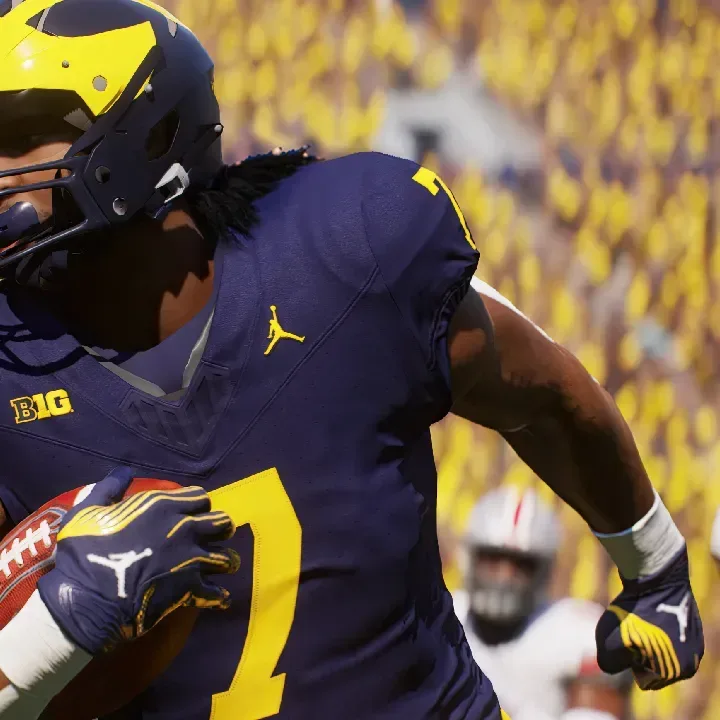
EA Sports' revived college football franchise has enjoyed a remarkable return, but concerns are reportedly growing among some of the people working on or around the series. Despite the enormous excitement surrounding its 2024 comeback and continued plans for new games in the near term, some developers fear the financial demands of keeping the games alive could eventually threaten their future.
The worries center on a difficult combination: sales that have declined after the franchise's blockbuster reintroduction, rapidly increasing costs for athlete name, image and likeness rights, and the challenge of generating more ongoing revenue without alienating the community that waited more than a decade for college football to return.
Not everyone connected to the franchise reportedly shares that pessimistic outlook. There are still people who see a healthy long-term opportunity for EA Sports College Football. But the concerns offer a reminder that a hit game can still face difficult business pressures, especially when it depends on a vast collection of player, university, event and branding agreements.
A massive return created enormous expectations
EA Sports College Football arrived in 2024 after a 14-year gap following the final NCAA Football game. The older series had been a staple through the 2000s and early 2010s, but legal issues surrounding the use of college athletes' identities brought the annual franchise to an end.
For useful background on this topic, read War for Roshar Kickstarter Passes $1 Million in Its First Day.
Its return therefore carried years of pent-up demand. Fans who had missed the series embraced the new game in huge numbers, helping College Football 25 become the second best-selling game in the United States during 2024. That performance demonstrated that the appetite for a modern college football game was still substantial, and it gave EA a major sports-game success beyond its established Madden NFL and FC businesses.
However, the scale of that launch also made it hard to repeat. A revival after 14 years is a rare event, and the first game benefited from the excitement of players who had been waiting for a new entry across multiple hardware generations. Reportedly, sales have fallen with each subsequent annual release, even though the franchise continues to perform strongly by most standards.
College Football 26 was the seventh best-selling game in the United States in 2025. College Football 27, meanwhile, is currently ranked 10th for the year. Those are still meaningful placements, but they indicate that the franchise has not sustained the extraordinary commercial momentum of its debut.
That pattern is not necessarily surprising. Annual sports series commonly experience a large initial surge when a dormant brand returns, followed by a more conventional audience in later years. Yet a normalization in sales becomes more serious when the cost of making and licensing the game is escalating at the same time.
NIL expenses have reportedly risen sharply
One of the biggest financial changes involves the college athletes represented in the game. In 2024, EA reportedly paid each participating player $600, which added up to about $7 million in total. The per-player payment has since risen to $1,500, pushing the reported cost of NIL rights for the latest game to roughly $20 million.
That is a major increase before accounting for the ordinary expense of producing a large annual sports title. Developers must still create and update stadiums, uniforms, teams, player likenesses, commentary, presentation packages, gameplay systems, online infrastructure and modes such as Dynasty. An annual release also means the team has limited time to make improvements while keeping current with a changing college football landscape.
Player rights are only one part of the equation. EA also has to secure licenses for universities, bowl games and other recognizable college-football elements. Those agreements are essential to the authenticity that makes the series attractive, but they mean substantial spending is committed simply to obtaining the rights needed to portray the sport and its institutions.
The result is a franchise with potentially huge revenue but also unusually heavy fixed costs. A game can sell well and still face pressure if licensing obligations keep climbing faster than the audience or the amount each player spends after purchase.
Single-player monetization remains a sensitive issue
That pressure reportedly contributed to EA's attempt to monetize key parts of College Football's single-player experience. Earlier in the summer, players reacted strongly to systems they believed encouraged spending in order to play single-player content more efficiently.
The backlash was severe enough that EA reversed course. The company said it would rework the options and bring them back in future entries rather than continuing with the approach that had prompted the community response.
For a franchise attempting to establish a durable annual audience, the episode highlights a difficult balance. Players want robust modes such as Dynasty to feel like complete experiences supported by their initial purchase. Meanwhile, a publisher facing higher costs may see recurring spending as one way to stabilize a series whose sales are increasingly concentrated in one annual launch window.
One concern voiced by a person familiar with the situation is that microtransactions are expected to return to future College Football single-player games. The fear is that another push in that direction could drive away fans instead of retaining them, particularly if players feel that progression or convenience is being sold back to them in modes traditionally enjoyed offline or solo.
There is a clear risk in treating a passionate sports audience as a guaranteed source of extra spending. The college football community's enthusiasm helped make the revival possible, but that enthusiasm was closely tied to the return of beloved modes, traditions and authenticity. If fans conclude that the annual games are becoming too aggressive about monetization, they may skip entries or spend less time in the ecosystem.
Why the comparison with Madden and FC matters
Internally, the franchise is reportedly viewed differently from EA's biggest sports properties. Madden NFL has an established annual audience tied to the NFL, while EA Sports FC has broad international appeal and a global player base. College football is popular, but its commercial reach is much more heavily centered on the United States.
That does not make College Football a small franchise. Its launch success proved the opposite. But it does affect how much room the series has to absorb climbing costs, shifting consumer habits and the intense expectations surrounding yearly sports releases.
A person familiar with the team's concerns reportedly summarized the fear bluntly: College Football does not generate the kind of money associated with FC or Madden, and there is anxiety that EA could eventually focus on a narrower selection of its most dependable franchises. From that perspective, the question is not merely whether the game can remain popular. It is whether it can become sufficiently profitable and sustainable in an environment where development and licensing are becoming more expensive.
That concern extends to the end of the decade. While College Football games are planned for the next several years, some people working close to the series reportedly worry that a game may not exist by 2030 if the franchise cannot find a better way to retain players and generate revenue.
The franchise is not reportedly doomed
It is important to separate concern from certainty. The reported fears do not mean EA Sports College Football has been canceled, nor do they establish that EA has decided to end the brand. Games are still planned, and some sources connected to the project reportedly believe the series has a strong future.
The franchise also retains advantages that should not be dismissed. College football has distinct traditions, rivalries, schools and atmospheres that differentiate it from professional football. Its return demonstrated that fans will turn out in force for a licensed, feature-rich representation of that world. A seventh- or 10th-place annual sales ranking is not evidence of irrelevance; it is evidence that the games still occupy a notable position in the market.
What remains uncertain is whether EA can manage the economics without undermining what players value. Cutting back on authenticity could weaken the game's appeal, while adding too much monetization to core single-player modes could provoke another community backlash. Keeping every license, every athlete and every feature intact becomes harder if costs continue to rise.
For now, the future of EA Sports College Football appears to be a question of adaptation rather than an immediate ending. The next few releases may determine whether the revived series can transition from an event-sized comeback into a stable, sustainable annual franchise. Its biggest challenge may be proving that the excitement of 2024 can be converted into lasting support without asking its fans to compromise on the experience they spent 14 years waiting to get back.
Community
Discussion
Start the conversation.
No comments have been posted yet.