
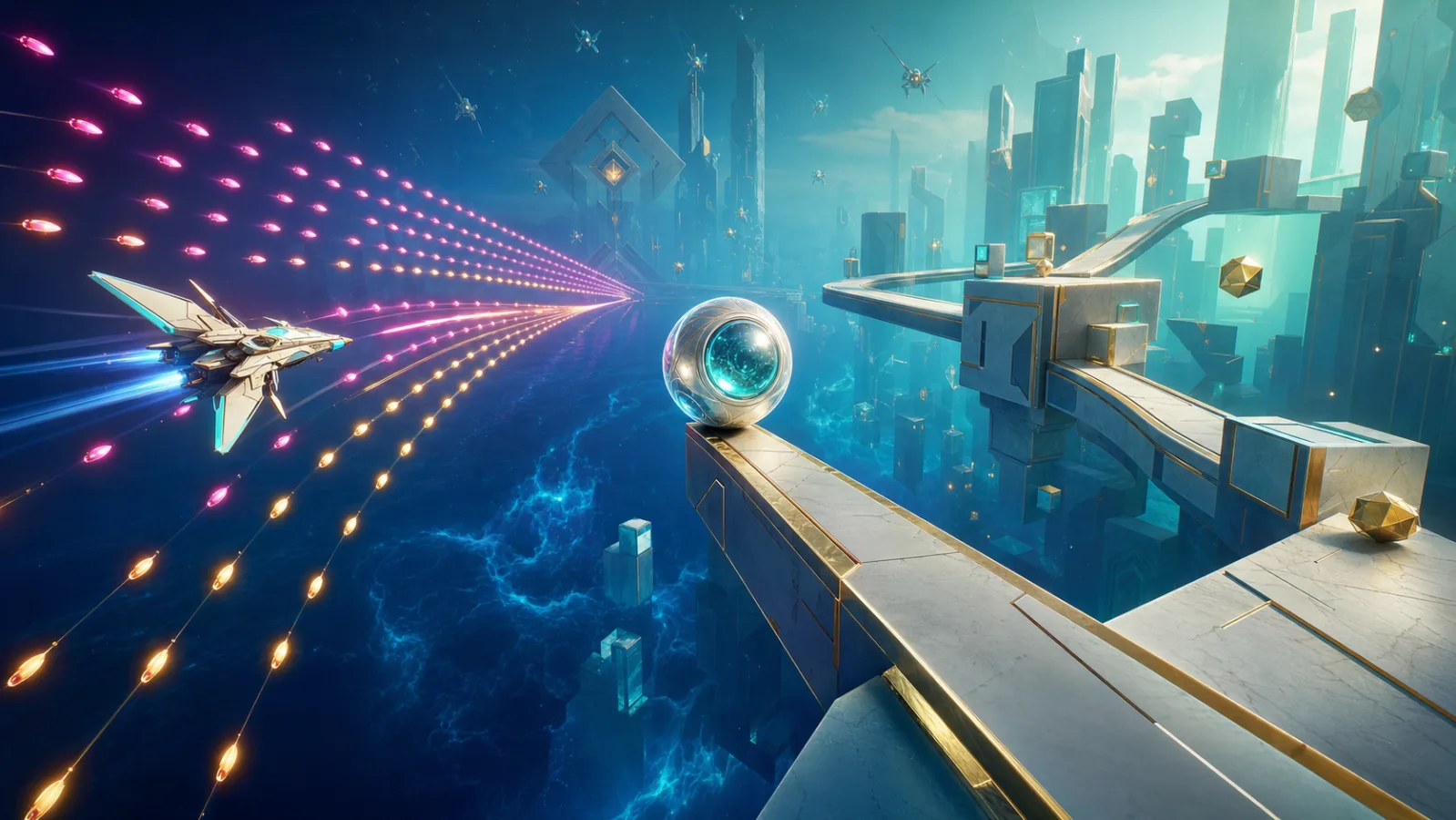
Espgaluda II and Equilibrio have almost nothing in common at first glance. One is a manic vertical shooter set in a damaged fantasy world, with armored-winged Galuda characters navigating dense enemy fire. The other is a puzzle game about gently tilting a playfield to guide a fragile ball around traps and toward an exit. One asks players to make quick decisions under extreme visual pressure; the other asks them to slow down, regulate movement, and respect momentum.
Yet they make an unexpectedly useful comparison for mobile-minded players. Both are fundamentally games of precision. Both turn a simple input into a demanding test of awareness. Both can be enjoyed in short stretches while also offering reasons to return and improve. The major difference is where their tension comes from. Espgaluda II creates intensity through speed, incoming threats, firing patterns, and the need to keep moving. Equilibrio creates it through balance, level geometry, a vulnerable ball, and the knowledge that a careless tilt can end an attempt.
The best choice is not a question of which game is universally better. It is about whether you want a focused arcade challenge that tests reactions or a controlled puzzle experience that tests patience. Espgaluda II is the pick for players who enjoy learning systems under fire. Equilibrio is the pick for players who prefer deliberate progress through compact obstacle courses. Here is how they compare across gameplay, platform fit, long-term appeal, and the kinds of players most likely to enjoy each one.
The essential difference: action at speed versus control at rest
Espgaluda II is a vertical shooter from Cave, built in the tradition of arcade games that fill the screen with enemies, shots, and constant movement. Its story takes place three years after the Great Shinra War has devastated Soma and stripped much of its plant life away. In that harsh aftermath, the alchemist Hiodoshi leads Project Espgaluda, which grants selected youths artificial armored wings. Ageha and Tateha, known as Galuda, escape the project and live in hiding with their mother until they are discovered.
That premise gives Espgaluda II a dramatic foundation, but its identity is defined by its moment-to-moment action. This is a shooter in which spatial recognition matters every second. Players are not simply trying to defeat an enemy at the far end of a stage. They are continuously reading the screen, finding safe routes, reacting to danger, and maintaining the control needed to survive a highly active battlefield. Its challenge is immediate and kinetic.
Equilibrio is almost a mirror image in rhythm. Its goal is easy to explain: guide a ball to the exit of each level by tilting the playfield. The ball can break if it falls too far, and hazards including spikes and acid pools punish imprecise movement. Rather than attacking, dodging projectile fields, or pushing forward through a scrolling stage, players assess a puzzle space and decide how much motion is safe.
The Wii design makes this physical distinction especially clear. Equilibrio supports a horizontally held Wii Remote for tilting the board and also supports the Wii Balance Board. These control options suit a game about balance because they ask the player to embody the careful shifts happening on screen. On iOS, the same core design becomes a compact mobile puzzle concept: a game centered on directing a ball through hazards with attentive, incremental control.
Neither pace is inherently more demanding. Espgaluda II tests whether you can remain composed while events accelerate. Equilibrio tests whether you can resist rushing when the safe answer is restraint. The first demands confidence in motion. The second demands discipline over motion.
Gameplay comparison: reading bullet patterns or reading level geometry
Espgaluda II rewards awareness under pressure
Vertical shooters have an elegant core language. The player has limited space, threats arrive from multiple directions, and firing is only one part of the job. Survival depends on knowing where the danger is, where it will be next, and where a route through it remains open. Espgaluda II leans fully into that language as a manic shooter. It is made for players who find satisfaction in turning an initially overwhelming screen into a solvable map of movement.
That makes every session feel active. The player must process enemy placement, incoming fire, their own location, and the pressure of maintaining forward progress. Even when an approach is familiar, execution still matters. A small mistake can become decisive, so there is a compelling connection between concentration and results.
Espgaluda II is therefore strongest for players who enjoy repetition with purpose. Returning to a difficult sequence is not just retrying; it is an opportunity to recognize a pattern sooner, choose a cleaner line, and respond with more confidence. The game's core pleasure lies in the gradual transformation of chaos into understanding.
Equilibrio makes simple movement feel consequential
Equilibrio's levels are smaller, quieter problems, but they are not passive. Tilting a playfield sounds straightforward until momentum, drops, and environmental hazards enter the equation. Every route asks the player to judge how far to lean, when to correct course, and how to avoid turning a minor adjustment into a fall. Because the ball can break after falling too far, the game makes elevation and edge placement meaningful.
Its 64 levels provide a clear puzzle framework, while 25 goals, adaptive difficulty, special balls with distinct behaviors, and individual high scores for every level create several ways to engage with that framework. A player can aim simply to reach exits, pursue objectives, learn how different ball behaviors change the problem, or revisit a particular level to improve a personal score.
Where Espgaluda II asks, "Can you process all of this now?" Equilibrio asks, "Can you make exactly the right adjustment?" That is a critical distinction. Equilibrio's challenge is often easier to pause mentally and examine. Players can look at the hazards, consider the angle, and make a controlled attempt. It is still possible to fail quickly, but the failure tends to come from misjudged physics and route management rather than from being flooded by hostile activity.
Difficulty and accessibility
Players sometimes confuse a slower game with an easier game, and this comparison proves why that assumption does not hold. Equilibrio can be immediately understandable, but the details of balance can be demanding. A player who repeatedly uses broad, impatient tilts may struggle even on levels whose objectives are obvious. The game is welcoming to anyone who likes clear rules, but it rewards a specific temperament: careful, observant, and willing to make small corrections.
Its adaptive difficulty is especially relevant for a game designed around controlled learning. Rather than presenting balance purely as a fixed test, the game includes a system intended to respond to the player's experience. Combined with special balls that behave differently, this gives Equilibrio room to vary how it presents its core challenge without abandoning its central idea.
Espgaluda II is more immediately intimidating because manic shooters communicate urgency from the start. A busy screen can make a newcomer feel as though they are supposed to react perfectly to everything. The better mindset is to treat the game as a skill-building arcade experience. It rewards attention, practice, and incremental recognition. A player does not need to understand every on-screen event at once; they need to keep learning what matters and develop steadier movement.
For newcomers to shooters, Espgaluda II is best approached as a game where improvement is the goal, not flawless first-run performance. For newcomers to puzzle games, Equilibrio is best approached with a willingness to slow down and let the ball's behavior teach the limits of each stage. In both cases, frustration becomes much less likely when players accept that precision is learned through repeated attempts.
Platform fit: where each game's design makes the most sense
Espgaluda II appears on Arcade, Android, iOS, Nintendo Switch, and Cave. Its arcade origins are central to understanding its appeal. Arcade shooters are designed for immediate engagement: clear action, dramatic danger, and a constant invitation to improve on the next attempt. That structure also makes sense on Android and iOS, where players may want a concentrated action game that can deliver a memorable burst of intensity without requiring a long setup.
Nintendo Switch is also a natural conceptual fit for a vertically scrolling shooter. A shooter benefits from a dedicated screen and focused controls, especially when safe positioning and quick reactions are fundamental. Whether playing in a brief handheld session or settling in for a longer practice run, the game's score-chasing, pattern-learning mindset suits a platform associated with flexible play.
Equilibrio is available on iOS, WiiWare, and Wii. Its platform story is defined by control methods more than visual scale. The Wii version can be played with a horizontally held Wii Remote or the Wii Balance Board, both of which reinforce its central mechanic of tilting. The control method becomes part of the experience: the player's physical adjustment is mirrored by the movement of the level.
On iOS, Equilibrio's focused, stage-based structure makes sense for mobile play. Individual levels offer contained goals, and the game's hazards establish a quick, readable reason to stay engaged. The format lends itself well to taking on a single level, attempting a high-score improvement, or working through several puzzles in a calmer session.
Neither game should be reduced to a platform label. Espgaluda II is not only an arcade-style game because its challenge remains compelling wherever players want concentrated action. Equilibrio is not only a motion-control curiosity because its level design, goals, and special ball behaviors provide the substance. Still, platform preference can easily decide this matchup. Players who value responsive, direct action on Android, iOS, or Switch will gravitate toward Espgaluda II. Players who specifically enjoy tactile tilting ideas and Wii control experimentation will find Equilibrio especially distinctive.
Longevity: mastery runs versus puzzle completion
Espgaluda II and Equilibrio both offer lasting value, but they do so through very different player motivations. Espgaluda II has the kind of longevity associated with arcade mastery. The more a player learns about managing dense action, the more each future run becomes meaningful. Improvement may come from reading an attack pattern earlier, moving more economically, surviving a difficult stretch more consistently, or simply remaining calm when the screen becomes intense. The game keeps giving players a reason to ask whether they can perform better than before.
This form of replayability suits competitive personalities, even when they are competing only with themselves. It also suits players who enjoy a compact game that can grow with their skill. The basic objective remains recognizable, but the player's understanding changes dramatically over time.
Equilibrio has a more structured form of longevity. There are 64 levels to complete, plus 25 goals and individual high scores for every level. The special balls add behavioral variation, which means that mastery is not strictly about performing the same maneuver in the same way every time. There is also a natural loop between finishing stages and returning to refine results.
That makes Equilibrio the stronger fit for players who like a visible checklist of progress. Completing a level is a concrete accomplishment. Pursuing a goal or high score gives a reason to revisit it. The game's replay value is not based on surviving escalating on-screen chaos; it comes from understanding a stage's layout and then executing the route with greater care.
Choose Espgaluda II if you want a game that can become a long-term mechanical practice. Choose Equilibrio if you want a game that breaks its challenge into a broad collection of discrete balance puzzles with score-based reasons to revisit them.
Theme and atmosphere
Espgaluda II has a serious, high-stakes setting. Soma bears the aftermath of war, the natural world has been badly damaged, and Project Espgaluda has altered the lives of young people through artificial armored wings. Ageha and Tateha's history adds a personal dimension to the larger conflict. Even for players who come mainly for shooting action, the premise gives the game a sense of consequence and identity beyond a generic enemy invasion.
Equilibrio is more abstract in its storytelling emphasis. Its drama comes from the immediate relationship between ball, board, hazards, and exit. Spikes and acid pools create readable danger, while the possibility of a breaking ball gives each movement a fragile quality. It is not a game built around the narrative stakes of a war-torn setting. It is built around the clean tension of navigating a physical problem.
This affects how each game feels during a session. Espgaluda II is theatrical and urgent. Equilibrio is concentrated and methodical. Players looking for action with a defined fantasy conflict should favor the shooter. Players who value uncluttered puzzle tension should favor the balance game.
Who should choose Espgaluda II?
- Fans of vertical shooters: Its manic shooter identity is the central attraction, offering sustained action and a strong focus on survival through dense threats.
- Players who enjoy mechanical mastery: The appeal is in developing better awareness, cleaner movement, and greater consistency over repeated attempts.
- Arcade-minded players: Its arcade background and immediate action suit anyone who likes games that are easy to begin but difficult to truly master.
- Players seeking intensity in short sessions: A shooter can create a complete burst of focus quickly, making it well suited to players who want their game time to feel energetic.
- Anyone drawn to dramatic science-fantasy premises: The Galuda characters, Project Espgaluda, and damaged world of Soma offer a more story-driven atmosphere than a purely abstract score challenge.
Who should choose Equilibrio?
- Puzzle players who prefer thoughtful execution: Success depends on judging movement, momentum, hazards, and safe routes rather than reacting to a crowded battlefield.
- Fans of motion-based control concepts: Wii Remote and Wii Balance Board support make the game particularly appealing to players interested in physical input.
- Completion-focused players: Its 64 levels and 25 goals provide a clear structure for working through the game over time.
- High-score improvers: Individual high scores for every level encourage players to revisit particular challenges and refine their performance.
- Players who want calmer mobile sessions: The pace is deliberate enough to suit a player who wants a focused problem to solve rather than a rapid-fire test of reactions.
Final verdict: choose the pressure you enjoy
Espgaluda II and Equilibrio are both precision games, but they turn precision into two entirely different experiences. Espgaluda II is the better choice for players who want momentum, danger, visual intensity, and the lasting satisfaction of learning to survive a manic vertical shooter. Its strength is the thrill of maintaining control when the screen suggests that control should be impossible.
Equilibrio is the better choice for players who want a measured puzzle game where every tilt matters. Its 64 levels, adaptive difficulty, goals, special balls, and level-by-level high scores give the balancing concept depth, while its Wii control options make the central mechanic unusually tactile. Its strength is making a small movement feel important.
If your ideal challenge is finding a path through a storm of threats, play Espgaluda II. If your ideal challenge is guiding a delicate ball through a hazard-filled course without overcorrecting, play Equilibrio. The real winner depends on whether you want to sharpen your reactions or steady your hands.
Community
Discussion
Start the conversation.
No comments have been posted yet.