

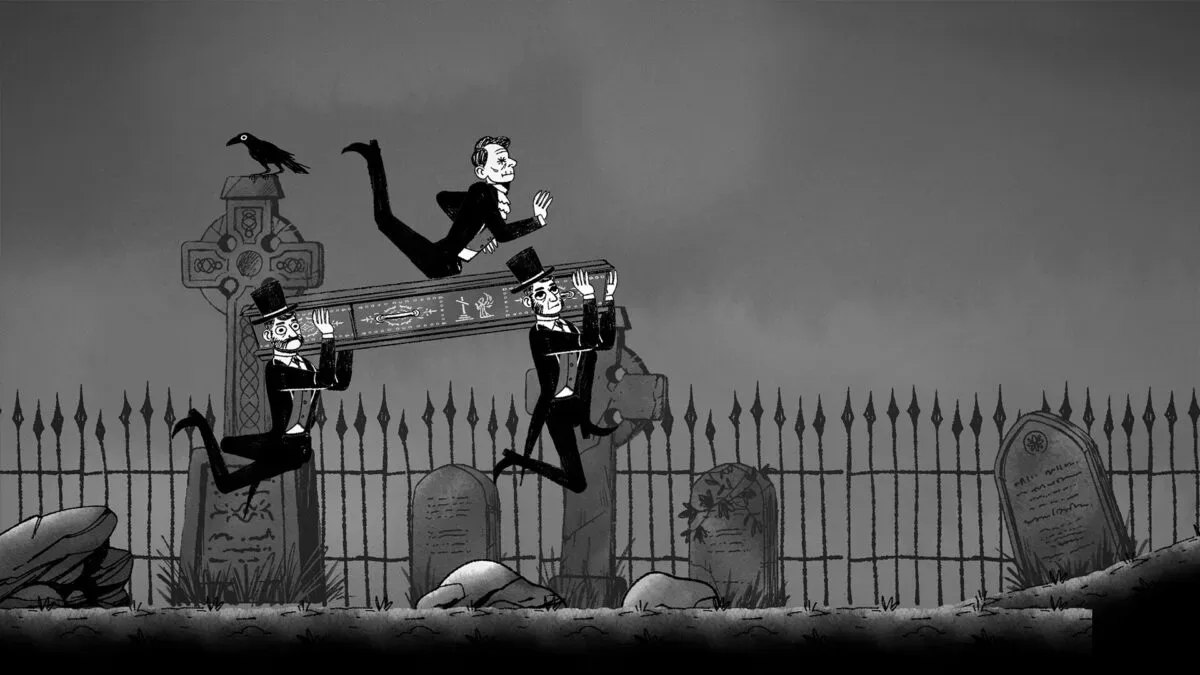
Steam Next Fest is built around discovery, but discovery can be a daunting prospect when an enormous number of demos arrive at once. It takes only a few minutes of browsing to find a game with a striking premise, however, and Fallbearers has one that is immediately understandable: get a coffin from a hearse to a grave without dropping the body inside it.
That simple objective becomes much more complicated once players take control. Fallbearers is a darkly comic, physics-driven game set on Victorian-era streets, where one or two players guide a pair of pallbearers through uneven routes, busy hazards, sharp slopes, open manholes, and even hostile dogs. The men walk automatically, but their pace, jumps, and the height at which they hold the coffin are all in the player's hands. Keeping the coffin stable is the job. Failing to do so is the punchline.
Its current Steam Next Fest demo is notably brief, yet it makes a strong case for a game designed around a wonderfully specific kind of chaos. Fallbearers turns an ordinarily solemn ritual into an awkward balancing act, with the tension escalating every time the coffin tilts toward a problem in the road.
A funeral procession with QWOP-style instability
The easiest comparison is to games that turn deliberately awkward movement into the central challenge. Fallbearers does not appear to be interested in making basic movement smooth or effortless. Instead, it asks players to understand how several moving parts work together while the environment actively makes that task worse.
For useful background on this topic, read Aleksib Faces Proposed Suspended Prison Sentence in Finnish Tax Case.
The two pallbearers move forward on their own, which sounds helpful until the road starts fighting back. Players must decide how quickly the procession advances, when the carriers should jump, and whether the coffin needs to be raised or lowered. Those individual decisions matter because the coffin is not merely decorative cargo. It is a precarious object that reacts to bad timing, rough terrain, and misjudged obstacles.
That makes each small stretch of road feel like a compact problem to solve. A low obstruction might require adjusting the coffin height. A gap or uneven patch might demand a well-timed jump. A steep incline can test whether the pair are positioned correctly enough to stop their load from shifting. The objective remains clear throughout, but the route ensures that accomplishing it is anything but automatic.
The premise has an intentionally absurd edge, particularly when a coffin slips and the situation spirals into disaster. Still, the humor works because the game seems committed to making the underlying challenge readable. Players are not simply watching slapstick unfold; they are responsible for preventing it.
The corpse is the real fail state
Fallbearers allows a limited number of failures depending on the selected difficulty, offering at least some room to learn its unusual controls and obstacle patterns. But there is a hard line the game does not forgive: if the corpse falls out of the coffin, the run ends.
That rule gives the game's comic concept genuine stakes. A bumped coffin or a messy route can create a moment of panic because the player is not just trying to arrive quickly. They are trying to preserve enough control to make sure the occupant remains where they should be. It is a macabre condition for failure, but one that neatly defines what separates a recoverable mistake from a complete collapse.
There is also a useful contrast between the game's outward silliness and the practical attention it demands. A player may laugh at the image of Victorian pallbearers struggling through the street, but every obstacle requires concentration. The best physics comedy games make players feel just competent enough to believe they can master the next attempt, then introduce a fresh complication that exposes a new weakness. Fallbearers' demo appears to understand that rhythm.
Solo play offers control, co-op promises confusion
Fallbearers can be played alone or with a friend, and those formats should produce very different kinds of challenge. Playing solo means one person is responsible for both sides of the coffin. That may initially sound overwhelming, but it also gives one player complete authority over every movement. Learning the relationship between speed, height, jumping, and terrain can be more manageable when no communication delay is involved.
Co-op, on the other hand, is where the premise could become especially memorable. Two people attempting to coordinate a procession under pressure are likely to encounter a different obstacle: each other. Timing a jump, deciding when to lift, responding to a sudden hazard, and avoiding an unstable tilt all become shared decisions. Even a short lapse in coordination could turn a careful run into a catastrophe.
That is not a criticism of the mode. It is exactly the kind of friction that can make a co-op physics game entertaining. Successful runs should feel like a small triumph of communication, while failed ones have the potential to become stories players repeat afterward. The coffin is simultaneously the team's shared responsibility and the object most likely to reveal that the team has no plan.
The Victorian setting also helps the concept stand apart. Rather than presenting generic obstacle courses, Fallbearers frames its hazards around a funeral journey through period streets. Hearses, graveyards, sloping paths, and urban hazards give the action a setting-specific identity, making the mechanics feel tied to the premise rather than placed in an arbitrary test chamber.
More terrain is planned beyond the demo
The demo provides only a small taste of what the full game intends to offer. More varied terrain is planned, including snowy areas where the pallbearers will need skis. That detail suggests Fallbearers is not content to repeat the same street-level balancing challenge across increasingly difficult versions of one route.
Snow and skis could substantially alter how players approach motion and stability. Slippery surfaces are a natural fit for a game already centered on unreliable balance, while skis imply momentum may become a bigger factor. A coffin that is difficult to keep level on cobbles could become even harder to control when the carriers are gliding downhill. The result could push players to account for terrain conditions as well as fixed obstacles.
Expanding into distinct environments would also give the game more room to develop its central joke without exhausting it. The core idea is strong, but physics games benefit from situations that force players to reinterpret familiar controls. New surfaces, new route layouts, and new environmental threats could keep the challenge surprising while retaining the immediately recognizable sight of two pallbearers trying desperately to do their job.
An appealing antidote to endless demo browsing
The most valuable thing about a festival demo is often clarity. Players have limited time, and a compelling demo should communicate both its central idea and the reason to keep playing quickly. Fallbearers succeeds on that front because its goal is legible before a run even begins. Carry the coffin. Avoid the hazards. Do not let the corpse spill out.
From there, the game's depth comes from execution. The challenge is not buried under a complicated explanation, nor does it depend on a large progression system to become interesting. Its appeal is in the uneasy coordination between two carriers, their fragile burden, and a route designed to make every decision questionable.
That focus makes the short demo feel like an effective introduction rather than a complete statement. It leaves room for the full game to add environments and escalate its ideas, especially in co-op, while already demonstrating why the concept works. Fallbearers is silly in the right way: it has a ridiculous hook, but treats the mechanics seriously enough that the resulting disasters feel earned.
There is currently no release date announced for Fallbearers. For now, its Steam Next Fest demo offers PC players a compact chance to test their balance, coordination, and ability to maintain professional composure during a very unprofessional funeral procession.
Community
Discussion
Start the conversation.
No comments have been posted yet.