

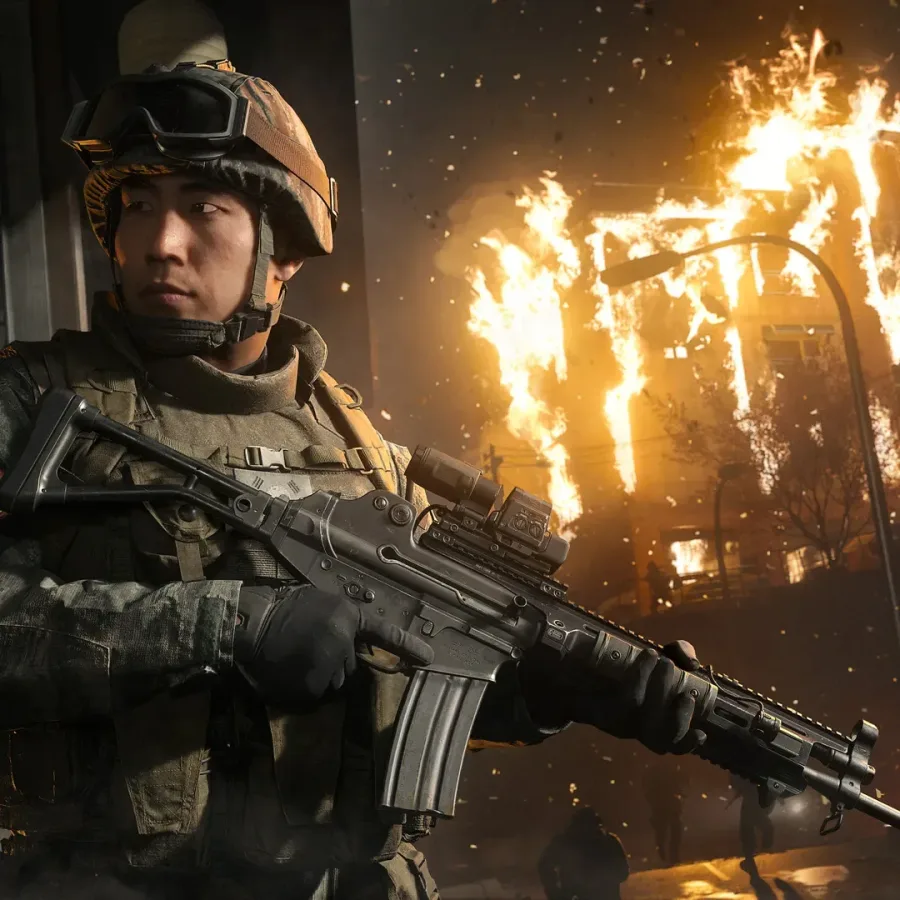
Families who lost loved ones in Seoul's 2022 Halloween crowd crush have called on Activision to remove real footage of the disaster from Call of Duty: Modern Warfare 4. The footage appears briefly within the game's opening montage, where it is presented with heavy visual filtering and effects as part of a sequence introducing the title's fictional conflict.
The request concerns images of rescue efforts following the Itaewon tragedy, in which nearly 160 people died. Relatives of those killed say the use of those real scenes in an entertainment product is distressing and inappropriate, particularly because the footage depicts citizens attempting CPR and victims lying in the street during the emergency.
Activision has responded by saying that the material was used to establish the game's fictional narrative, and that it was not intended to reference, trivialize, or exploit the Itaewon disaster. The company did not directly say whether it would remove or alter the footage in response to the families' demand.
Real disaster footage in a fictional opening sequence
Call of Duty: Modern Warfare 4, developed by Infinity Ward, places players in a fictional scenario involving a North Korean invasion of South Korea. Its opening cinematic uses some real-world news coverage as part of a montage intended to set the tone and context for that imagined military crisis.
For useful background on this topic, read LEGO's November 2026 Lineup Brings Venice, Dragon Ball and Its Biggest Set Yet.
Among that material is video from the response to the Halloween crowd crush in Itaewon, Seoul. Although the footage is not presented plainly and is altered by filters and other effects, the families' objection is not limited to how visible it is. Their concern is that an unmistakably real moment of trauma was repurposed for a game designed as commercial entertainment.
In a statement, bereaved relatives said they were appalled that scenes of chaos and desperation at the site had been used to construct a sequence for a video game. They specifically pointed to the efforts of people who tried to save others with CPR, as well as the sight of victims on the cold street, arguing that such imagery should not become background material for fictional drama.
The families said that using the event as material for entertainment was senseless and highly inappropriate. They asked for corrective action without delay, saying that a developer showing even a minimum degree of courtesy and empathy toward the victims should remove the material.
What happened in Itaewon
The crowd crush occurred during Halloween celebrations in the Itaewon district of Seoul in 2022. Mostly young people had gathered in the area, with an estimated 100,000 people filling its narrow and sloping streets. It was among the first Halloween periods in three years to take place with virtually no restrictions following pandemic lockdowns.
The density of the crowd became catastrophic. Witness accounts described difficulties controlling the influx of people, and emergency scenes from the aftermath showed members of the public and responders attempting to help those who had collapsed. Almost 160 people died in the disaster.
For families and survivors, the event remains a recent and personal tragedy rather than historical footage available for fictional reinterpretation. That distinction is central to their request. The video used in the game is not simply generic reporting from a distant event; it depicts the immediate consequences of a disaster in which real people died and others tried urgently to save them.
The objection also arrives at a time when the disaster continues to be publicly mourned and remembered in South Korea. Families gathered at the site of the tragedy in Seoul in October 2025 for its third anniversary, underscoring that the grief surrounding the event remains active and deeply felt.
Activision says it approached the material with care
Activision said it approached the subject matter of Modern Warfare 4 with care and respect. In its statement, the company described the opening cinematic's use of real-world news coverage as a means of establishing a fictional narrative, rather than an attempt to invoke a specific tragedy.
"It is not intended to reference or trivialize the Itaewon disaster or any other real-world tragedy in any way, shape or form," Activision said.
That explanation addresses intent, but it does not resolve the families' central request. The company did not state that it planned to pull the clip, replace it, patch the opening montage, or otherwise change how the sequence appears in the game.
The difference between intent and impact is likely to remain at the heart of the controversy. A montage can be designed to establish scale, geopolitical instability, or a sense of crisis in a fictional story. Yet when the footage used to create that atmosphere comes from a specific mass-casualty event, people directly affected by that event may experience its inclusion very differently from viewers who encounter it only as part of a game's cinematic introduction.
A familiar question for games built around real-world conflict
Military shooters regularly draw from real places, political tensions, weapons, news imagery, and the visual language of broadcast conflict coverage. That approach can make fictional stories feel immediate. It can also create difficult ethical questions when games borrow material connected to loss, war, terrorism, disasters, or other real suffering.
The question is not merely whether a game names a tragedy directly. In this case, Activision says the sequence was not intended as a reference to Itaewon. But the footage itself is tied to the disaster, and the families' statement makes clear that they believe the real-world context cannot be separated from its use in a fictional entertainment setting.
There is also a difference between depicting a broad fictional emergency and incorporating identifiable images from a real emergency. Fictional storytelling gives creators broad room to establish a dramatic scenario. Real footage carries the history of the people and moment captured in it. Editing, filters, and montage techniques may change the presentation, but they do not necessarily erase that connection for victims' relatives or for audiences familiar with the event.
For a series as prominent as Call of Duty, the issue receives additional attention because opening cinematics and promotional narratives are seen by a large audience. Even a short clip can become significant if it is incorporated into a work played and discussed around the world.
South Korea setting also prompts criticism
The game's fictional premise has attracted criticism from some people for another reason: it centers on a conflict involving North Korea and South Korea, a subject with obvious real-world sensitivity for Koreans. The setting is fictional, but it draws on a region shaped by an unresolved division and longstanding security concerns.
Call of Duty chief marketing officer Tyler Bahl responded to that criticism by saying, "We have to understand this is entertainment." That position reflects the game's framing as fiction, but it also highlights why the use of actual disaster footage has become such a sharp point of contention. Families affected by Itaewon argue that real suffering should not be folded into the same entertainment framework.
Fictional conflict settings have long been part of games, films, and television. The dispute here is more narrowly focused on the decision to include authentic rescue footage from an event that occurred only four years earlier. The families are not simply criticizing an imagined storyline; they are asking that a real visual record of people in distress be removed from that storyline.
What happens next
At present, Activision has acknowledged the criticism and explained its stated purpose for using real news footage, but it has not committed to any change. The families' demand is direct: remove the Itaewon material from Call of Duty: Modern Warfare 4.
Whether the company chooses to alter the montage will determine the next stage of the situation. A removal or replacement could address the specific footage identified by the families, while leaving the game's broader fictional narrative intact. If no change is made, questions about how major game makers handle real tragedies in cinematic storytelling are likely to continue.
For now, the controversy is a reminder that the realism sought by modern blockbuster games can have consequences beyond visual authenticity. When a fictional world is built partly from real news imagery, the people connected to that imagery may ask who gets to decide how it is reused, what context is lost in the process, and whether entertainment can ever adequately account for the pain behind a clip on a screen.
Community
Discussion
Start the conversation.
No comments have been posted yet.