

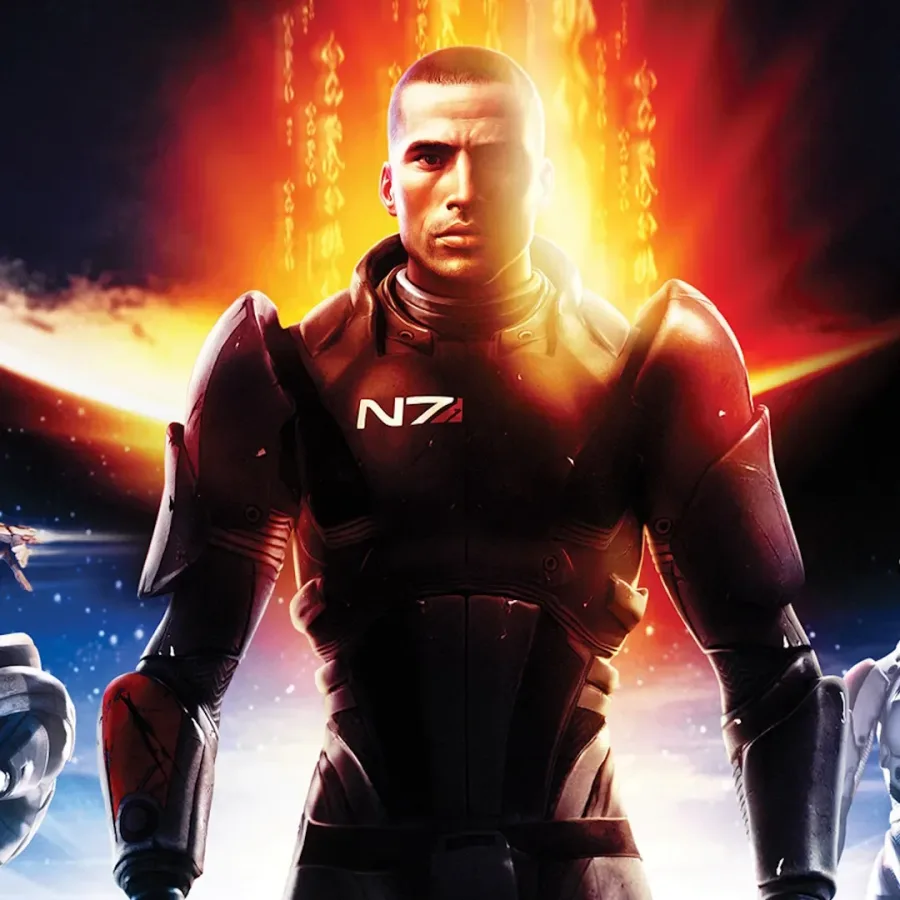
The conversation around Mass Effect has shifted sharply from anticipation to preservation. Following EA's decision to close BioWare and cancel the in-development Mass Effect Universe project, former developers and fans have been weighing a difficult question: could the space-opera RPG series return without requiring the kind of enormous AAA investment that increasingly makes projects difficult to approve?
Former BioWare lead programmer and designer Christina Norman believes the answer may be yes. Pointing to the success and reported production scale of Clair Obscur: Expedition 33, Norman argued that another Mass Effect could be produced for substantially less than the $200 million-plus figure recently discussed by BioWare co-founder Trent Oster.
Her proposed ballpark is around $50 million, or roughly five times the reported budget of the French-made RPG. It is an estimate rather than a confirmed plan or a budget attached to an active Mass Effect production, but it has become a notable counterpoint to the idea that a new installment would inevitably need one of the industry's biggest development budgets.
A smaller-budget case for Mass Effect
Oster had previously suggested that finishing a new Mass Effect at the level fans would expect could have required development spending of at least $200 million. He described that number as a rough estimate based on comparable modern productions and stressed that such an upfront commitment demands a larger commercial strategy around the intellectual property.
For useful background on this topic, read Shrek 2 Remastered Launches to Mixed Steam Reviews Amid Epic Account and AI Texture Concerns.
That assessment reflects the reality of contemporary blockbuster games. High-end character animation, cinematic performance capture, large environments, fully voiced branching dialogue, accessibility features, quality assurance across several platforms, marketing, and extended post-launch support can all push costs upward. For a series remembered for squadmates, galaxy-spanning choices, and cinematic storytelling, fans may reasonably expect a huge scope.
Norman's view is that scope and quality do not have to be synonymous with maximum spending. Responding to discussion of Clair Obscur: Expedition 33, whose overall budget has been pegged at under $10 million, she called it an example of why another Mass Effect could be built for well below $200 million. In her estimation, five times that amount should be enough, provided the project is shaped by a clever, focused team rather than an assumption that every feature must scale to the largest possible level.
"You can always spend more but clever small teams can get it done," Norman wrote in her public comments.
That is not a promise that a $50 million Mass Effect would look exactly like a massive, modern open-world blockbuster. Nor does it establish that such a project could recreate every ambition associated with the canceled Universe concept. Instead, it presents a different development philosophy: define the core of Mass Effect, concentrate resources on the elements that matter most, and resist expanding the project simply because the franchise has AAA history.
Why Norman's perspective carries particular weight
Norman worked at BioWare for more than six years during the original trilogy era. She was the lead programmer responsible for the franchise's conversation system before becoming lead designer on Mass Effect 2 and Mass Effect 3. Her work included efforts to strengthen gameplay across the latter two entries, giving her experience across both the dialogue-driven role-playing side of the series and its moment-to-moment action.
That background matters because Mass Effect's identity has never rested on graphical scale alone. The series is especially associated with player decisions, memorable crew members, conversations that can affect relationships and outcomes, lore, exploration, and a strong sense of momentum through a science-fiction adventure. A more contained game could potentially preserve those priorities while reducing the number of expensive systems, locations, or content branches required.
After BioWare, Norman worked at Riot Games and at a startup she co-founded. She is now a full-time machine-learning engineering consultant focused on LLM-directed character conversations. Her current work naturally invites questions about whether artificial intelligence tools could reduce the cost of dialogue-heavy games.
However, there is no indication that Norman's lower-budget Mass Effect argument depends on LLM technology. The point she made was about disciplined production and the capabilities of smaller, effective teams, not a proposal to replace writers, performers, or traditional development processes with generative systems. That distinction is important for a franchise whose best-regarded strengths are often its authored characters and player-facing narrative choices.
Clair Obscur's lesson is focus, not imitation
Clair Obscur: Expedition 33 is not a Mass Effect-style game, and a future Mass Effect would not need to copy its setting, mechanics, or format. The comparison is useful because it demonstrates that a game can draw significant attention and affection without a budget on the scale typically associated with the largest publishers' tentpole releases.
For Mass Effect, applying that lesson could mean making difficult decisions early. A new game might focus on one region of space rather than attempting an enormous galaxy-wide sandbox. It could prioritize a smaller squad with deeper interactions over a broad cast spread across countless quests. It could use carefully selected hubs and missions rather than a huge collection of planets designed primarily to advertise scale. It could also build on strong art direction and writing rather than pursuing technical spectacle in every scene.
Those choices would bring trade-offs. Mass Effect fans have broad and varied expectations after several major releases, and a scaled-down entry would face intense scrutiny. A smaller game still needs exceptional writing, reliable combat, meaningful choices, polished presentation, and a clear reason to exist beyond nostalgia. Lower cost does not automatically mean lower risk, particularly when the name carries so much history.
Still, Norman's argument suggests that a franchise's survival may sometimes depend on redefining what success looks like. The alternative to a smaller, tightly managed project may not be an unlimited-budget sequel. It may be no new game at all.
The rights issue may be harder than the budget
Oster has also acknowledged that a new Mass Effect could be made more cheaply than $200 million. But he cautioned that a cheaper version would not be the same as the Universe concept the team had been developing. More fundamentally, he identified ownership as the major roadblock: EA retains the rights to Mass Effect and may have no interest in transferring them, even if it is not actively producing a flagship game in the series.
That reality limits what former BioWare developers, outside studios, and fans can do. Enthusiasm alone cannot create an official sequel, and a workable lower-budget pitch does not matter unless the rights holder chooses to commission a project, develop one internally, or arrange for another team to do so. In that sense, the financial debate is only one part of the larger situation.
There is, however, still evidence that Mass Effect retains cultural value. A television series based on the franchise remains in development, indicating that the universe continues to have life beyond games. The annual N7 Day celebration also recently saw members of the Normandy cast and crew appear in a video message asking fans to help Save Mass Effect.
Fan support has become increasingly visible since the cancellation. Footage and details related to Mass Effect Universe have appeared online, while a petition asking EA to reconsider the decision has surpassed 325,000 signatures. In Canada, a politician has also launched a government petition focused on saving BioWare. None of those efforts guarantees a new game, but they underscore the attachment players still have to the series and the people who made it.
What a realistic revival could look like
There is no announced replacement for Mass Effect Universe, no confirmed studio attached to a new entry, and no indication that EA plans to sell or license the property. Any discussion of a $50 million Mass Effect therefore remains hypothetical.
Yet the debate has clarified a meaningful possibility. The next Mass Effect does not necessarily have to chase the scale of every major blockbuster release to justify its existence. A project built around a defined vision, a talented compact team, disciplined scope, and the series' strongest role-playing foundations could offer a route back--if the franchise's owner decides that route is worth taking.
For now, Mass Effect's future remains uncertain. Norman's comments do not solve the ownership issue or reverse the studio closure. They do, however, challenge the assumption that saving the series would require an impossible financial gamble. In a changing RPG landscape, that may be the most important idea fans and decision-makers can carry forward.
Community
Discussion
Start the conversation.
No comments have been posted yet.