

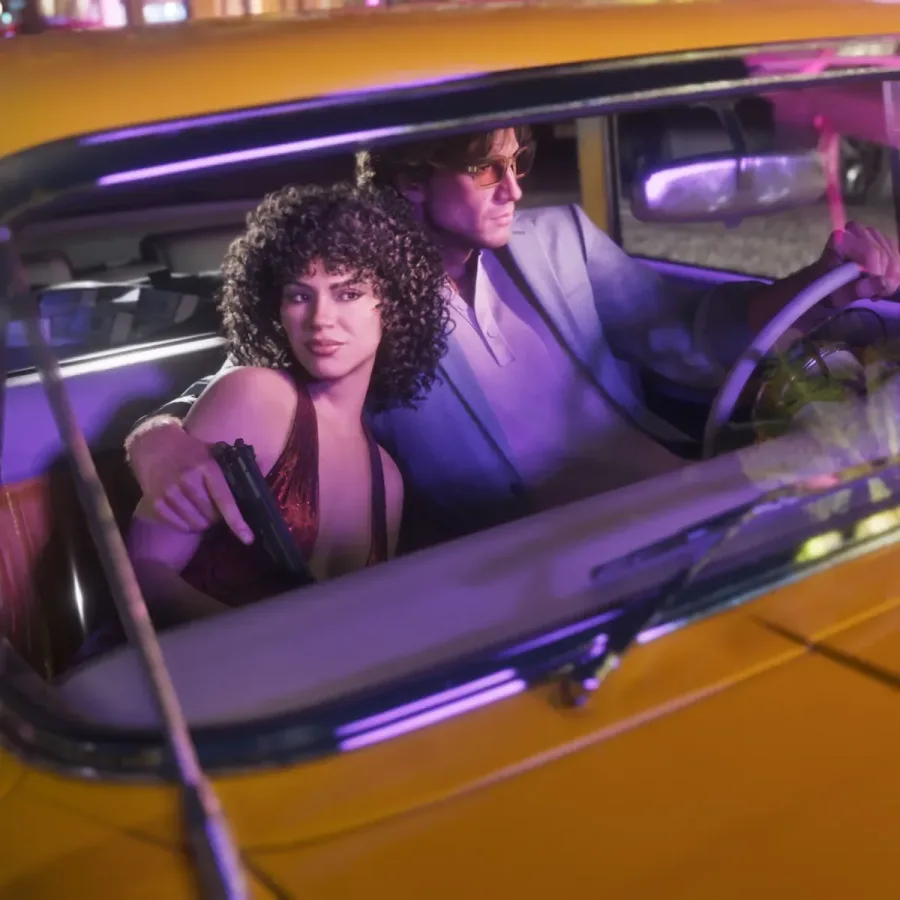
Grand Theft Auto 6 puts enormous emphasis on the feeling of getting behind the wheel, and one contributor to that effort has a background in competitive virtual motorsport. Lewis Bentley, a former Gran Turismo World Series competitor, has said that he worked with Rockstar's vehicle physics team for roughly three years, contributing to the driving behavior of the enormous variety of cars found across Leonida.
Bentley revealed his involvement in a YouTube video that has since been removed. In the footage, filmed while he was seated in his Lotus Elise, Bentley joked that the team had "put the auto in the Grand Theft Auto." His name also appears in the game's credits as part of the physics department, lending weight to his account of a long-term role on the project.
The news helps explain why GTA 6's vehicles do not simply feel like cosmetic variations of a standard handling template. The game's cars are fictional and unlicensed, following the longstanding Grand Theft Auto approach of parodying or echoing recognizable real-world manufacturers and models. But their inspiration is reflected in more than silhouettes, badges, and bodywork. The handling can also communicate a vehicle's layout, character, limitations, and intended use.
The Ganado's awkward charm is part of the point
One of the clearest examples is the Ganado, the small pickup associated with Jason early in the game. Some players have found it difficult to keep settled, particularly when pushing through corners or trying to correct a slide. Its rear can step out unexpectedly, making the truck feel less composed than many of the more conventional road cars available later on.
For useful background on this topic, read Baldur's Gate 3 Gortash romance mod Is Bringing New Choices to Act 3.
That behavior is not necessarily an accident or a sign that the vehicle has been poorly tuned. The Ganado draws inspiration from the Ford Ranchero, the North American car-based pickup produced from 1957 through 1979. Rear-wheel-drive vehicles with a relatively light rear end can be prone to losing traction under throttle or abrupt weight transfer, especially when compared with a more modern, planted passenger car.
GTA 6 does not use licensed Ford branding or reproduce a Ranchero directly. Still, the design influence is easy to recognize, and the driving model appears to carry through the same basic idea. A vehicle that looks like a vintage rear-driven utility car should not necessarily react like a contemporary all-wheel-drive performance machine. That slightly unruly personality can make the Ganado frustrating during a tense escape, but it also gives the vehicle a clearer identity.
It is a meaningful distinction in an open-world game where players spend a vast amount of time driving. If every sedan, truck, muscle car, and sports car accelerated, turned, and broke traction in nearly identical ways, the visual diversity of the traffic would only go so far. Differences in balance and responsiveness make choosing a car matter beyond appearance.
For another perspective on this story, read A Gran Turismo Sport competitor helped tune GTA 6's driving.
A competitive racing background meets an open-world sandbox
Bentley is known for reaching the final of the GT Sport World Tour event held alongside the Nürburgring 24 Hours in 2018. Competitive Gran Turismo is a very different discipline from building an open-world crime game, but the overlap is obvious: both require a close understanding of vehicle behavior, racing lines, grip management, braking, and how small setup or physics changes affect a driver's confidence.
That does not mean GTA 6 is attempting to become a strict circuit simulator. Grand Theft Auto's driving has always had to serve a broad range of purposes at once. Cars need to be approachable enough for newcomers, expressive enough for high-speed chases, flexible enough for chaotic stunts, and readable enough that players can react amid traffic, pedestrians, weather, missions, and police pressure.
Yet simulation-minded knowledge can still improve that broader arcade-open-world formula. A skilled physics team can make a vehicle feel lively without making it inaccessible, and make a rear-driven pickup feel notably different from a front-heavy compact or a powerful exotic without requiring players to study telemetry. The best result is often not absolute realism. It is a consistent internal logic: drivers should be able to learn why a car behaves as it does, then adapt their inputs accordingly.
"Everyone on the physics team's amazing," Bentley said in the deleted video, while discussing his time on the project.
That recognition is important because vehicle behavior is rarely the work of a single person. Physics programmers, handling designers, audio specialists, vehicle artists, testers, mission teams, and animation staff all influence the final sensation of driving. Bentley's experience is one component of a larger effort, rather than a suggestion that one competitor alone defined GTA 6's road feel.
Rockstar's racing interests extend beyond the game
Rockstar North's interest in motorsport also appears to reach outside development. The studio has an in-house racing team that won a team-based 24-hour Nürburgring event in 2022. That achievement does not directly reveal how the studio built individual GTA 6 vehicles, but it does show that members of the organization take real-world endurance racing seriously.
That kind of culture can be useful when a game includes a large driving component. People who regularly race, whether in real cars or high-level simulation competition, understand the appeal of a corner that rewards patience, the difference between braking hard and braking well, and the way a car's balance can change under acceleration. Those lessons do not automatically translate one-to-one into game design, but they provide valuable reference points when deciding how cars should communicate weight, traction, and speed to players.
They can also inform the game's racing content. GTA 6 introduces Gellhorn International Raceway, a closed asphalt circuit that brings together corner styles and racing lines inspired by famous tracks. Rather than being a simple improvised route through city streets, the circuit gives the game a dedicated environment where the finer details of vehicle control can be more visible.
Gellhorn International Raceway gives the handling model room to breathe
Street races remain central to the energy of Grand Theft Auto, but they are often dominated by obstacles. Traffic, intersections, curbs, scenery, uneven roads, and collisions all add spectacle, while also masking subtler differences in chassis behavior. A purpose-built circuit changes that equation. It gives players repeatable corners, more reliable braking points, and the opportunity to compare how multiple cars respond over the same sequence of turns.
Gellhorn International Raceway can therefore function as more than another location on the map. It can be a showcase for the game's vehicle physics. Players who want to test whether a car understeers on entry, rotates under trail braking, struggles for rear traction, or remains stable through high-speed direction changes have a better setting in which to do so.
The track's blend of recognizable corner concepts also fits GTA's broader approach to fictionalized reality. Just as the game's cars are altered versions of familiar automotive ideas, the circuit appears to assemble echoes of real motorsport landmarks into a new destination within Leonida. It gives Rockstar the freedom to create a track designed around its own game systems while still drawing on the visual language and rhythm of famous racing venues.
Why individualized cars matter in GTA 6
For many players, a Grand Theft Auto vehicle is first and foremost a tool. It is transportation, a getaway machine, a mission objective, a stunt platform, or an object to be borrowed from the nearest curb. But the more convincingly each vehicle expresses its own strengths and weaknesses, the more stories that tool can produce.
A loose, tail-happy pickup might make a routine drive feel like a small challenge. A stable sports car can invite players to carry more speed through a familiar route. A heavy vehicle may be useful when brute force matters more than agility. Those distinctions create memorable preferences and frustrations, which are often exactly what make a virtual garage feel personal.
They also make the world more believable. Leonida is not just a map populated by differently shaped traffic props if a battered utility vehicle drives like it has a different mechanical character from a luxury coupe. The road network becomes a place where the player continually judges risk, grip, momentum, and the suitability of the vehicle they have chosen--or stolen.
Bentley's reported contribution, combined with Rockstar North's wider racing enthusiasm and the addition of Gellhorn International Raceway, points to a GTA 6 driving experience built around more than sheer speed. The Ganado may not be everyone's favorite ride, and its willingness to swing its rear end can be inconvenient when a mission turns chaotic. But that inconvenience is also evidence of a game trying to give its cars personality. In a series defined by automobiles as much as mayhem, that attention to the way vehicles move may be one of GTA 6's most important details.
Community
Discussion
Start the conversation.
No comments have been posted yet.