

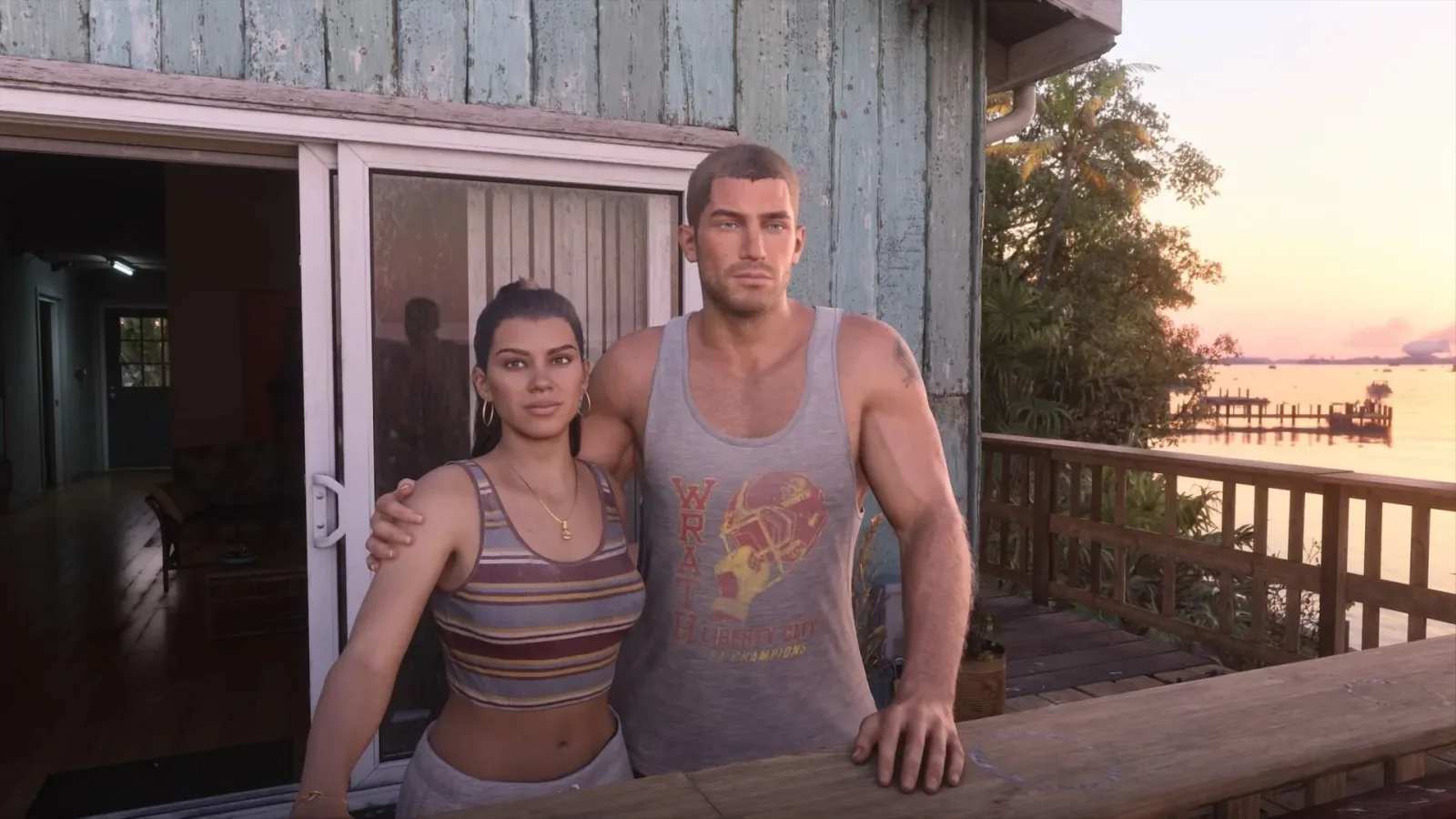
Grand Theft Auto 6 may be Rockstar's newest technical showcase, but one former environment artist who worked on both it and Red Dead Redemption 2 believes the older Western still has an advantage in a handful of carefully observed natural-world details.
David O'Reilly, who worked at Rockstar until 2023, recently spent time exploring parts of GTA 6's Leonida setting, including Mount Kalaga, a national-park area to which he contributed. His overall assessment was overwhelmingly positive: O'Reilly described the new game as "almost flawless." At the same time, he identified a subtle shift in environmental focus when compared with Red Dead Redemption 2, particularly in forests, wilderness spaces, and flowing water.
That is not a simple case of one game looking better than another. Instead, O'Reilly's observations underline how dramatically different the two Rockstar worlds are. Red Dead Redemption 2 is built around vast stretches of countryside, wetlands, rivers, forests, and open terrain. GTA 6, by contrast, must sell the density, complexity, and activity of a modern American state full of roads, homes, businesses, high-rises, vehicles, and urban infrastructure.
The result is a comparison that says as much about artistic priorities as it does about raw graphical fidelity.
For useful background on this topic, read GTA 6's Optional Lucia Dialogue May Reveal Jason and Mandy's Past.
A modern world demands different environmental priorities
O'Reilly's central point is that GTA 6 appears to scale back some of the fine-grained attention given to the natural environment in Red Dead Redemption 2. He characterized the change as a "slight paring back" in GTA 6's wilderness, while also noting that the newer game provides substantially more detail in its urban spaces.
That trade-off makes sense when considering the games' respective settings. Arthur Morgan's journey takes place more than a century before GTA 6's contemporary world, and its map contains comparatively few built-up settlements. Towns and cities are important landmarks in Red Dead Redemption 2, but the experience is primarily defined by the land between them. Players ride through woodland trails, cross open plains, move through swamps, fish in rivers, hunt animals, and watch ecosystems operate across enormous natural regions.
In that context, small details become vital. The quality of tree cover, the density of vegetation, the shape of riverbanks, water movement, wildlife behavior, mud, rock formations, and the layering of ground materials all carry much of the burden of making the world feel convincing. A wilderness-focused game has to make its open spaces interesting even when there are no traffic jams, storefronts, pedestrians, or towering skylines competing for the player's attention.
GTA 6 faces an almost opposite challenge. Its world is described as a systems-driven modern urban environment that also contains rural and natural areas. That means the game needs to manage an immense number of moving parts associated with city life: roads full of vehicles, dense neighborhoods, interiors and exteriors, crowds, commercial districts, architecture, lighting, signage, and the unpredictable interactions that players expect from a Grand Theft Auto sandbox.
For a game set in a contemporary state, the natural world is still important, but it does not need to serve exactly the same role it did in Red Dead Redemption 2. Leonida's countryside is part of the fantasy, yet much of GTA 6's identity depends on the friction between urban development and the spaces around it. The roads, buildings, traffic, beaches, waterways, and neighborhoods are not merely scenery; they are the foundation for the game's moment-to-moment chaos and exploration.
Mount Kalaga offers a close look at the contrast
O'Reilly focused his exploration on Mount Kalaga, a scenic national-park region situated amid Leonida's wider urban sprawl. It is a particularly useful place to study the comparison because it represents the side of GTA 6 that comes closest to Red Dead Redemption 2's environmental territory.
National parks, forests, and more remote landscapes naturally invite players to slow down and look at the surroundings. In a Grand Theft Auto game, they can also function as a break from the noise and visual density of the city. Yet O'Reilly's perspective suggests that even impressive rural zones in GTA 6 may not pursue the same degree of natural detail that Red Dead Redemption 2 did across its wilderness.
That should not be mistaken for a claim that GTA 6's outdoor areas are weak. O'Reilly repeatedly framed his criticisms as minor observations inside a technically remarkable game. The distinction is one of emphasis: Red Dead Redemption 2 had more reason to devote extraordinary attention to ecosystems because wilderness was its dominant environment. GTA 6 has a wider assortment of environmental obligations.
There is also a practical artistic reality behind this comparison. Every open-world game has finite resources, even those made by a studio with Rockstar's scale and experience. More environmental detail in one area can mean a greater need for optimization elsewhere. A contemporary city can require unique challenges in simulation, geometry, animation, pathfinding, lighting, traffic flow, and asset variety that a sparsely populated frontier does not demand in the same way.
Rivers remain a standout strength for Red Dead Redemption 2
Water was one of O'Reilly's most specific points of comparison. As someone who specializes in rivers, he said that Red Dead Redemption 2's streams are, on balance, a little better than the ones in GTA 6. He also felt that GTA 6's rivers appear somewhat slow when set beside the water systems in the 2018 Western.
Again, the context matters. Rivers were a major part of Red Dead Redemption 2's world. They were not simply decorative boundaries on a map. Waterways shaped travel routes, landscapes, activities, wildlife habitats, weathered terrain, fishing locations, and the visual character of entire regions. Players spent a great deal of time near water, crossing it, following it, using it as a navigational landmark, or simply stopping beside it while exploring.
That prominence gave Rockstar a strong incentive to make rivers feel dynamic and individually characterized. The motion of water can have a surprisingly large effect on a game world's credibility. Speed, direction, surface texture, reflections, debris, bank erosion, sound, and the interaction between water and vegetation all help communicate whether a stream feels like a living part of an ecosystem or a static visual feature.
In GTA 6, rivers are apparently a less central component of the overall experience. Leonida's waterways still contribute to the state's identity, especially in a setting where coastal and humid environments are likely to be visually significant, but they do not need to carry the same environmental storytelling weight as they did in Red Dead Redemption 2.
O'Reilly's criticism is therefore a narrow one, and one rooted in professional familiarity with the discipline. It is also the sort of detail that many players may only notice after spending long periods examining how a game's environment behaves rather than simply racing through it at high speed.
Why the comparison is a compliment to both games
It is tempting to turn any side-by-side discussion into a verdict, especially when two games share a developer and one arrives years after the other. But O'Reilly's comments offer a more useful conclusion. GTA 6 and Red Dead Redemption 2 are attempting different kinds of world-building, and each appears strongest in the areas that best support its setting.
Red Dead Redemption 2's natural spaces remain an exceptional benchmark because they had to. The game's mood, pacing, story, and exploration were inseparable from the wilderness. Its forests and rivers were not background decoration; they were the stage on which nearly everything happened.
GTA 6, meanwhile, is being recognized for its modern urban detail and the density of its simulated setting. That is a substantial achievement of its own. Creating a convincing city is not just about placing more objects on the screen. It requires a believable relationship between public spaces, transport networks, architecture, crowds, traffic, and the countless smaller systems that give a contemporary place its energy.
From that perspective, the slight reduction O'Reilly sees in wilderness detail is less a failure than a sign of GTA 6's changed priorities. The game is trying to make a sprawling modern state feel alive, while Red Dead Redemption 2 was trying to make a frontier landscape feel alive. Both ambitions are enormous, but they require different forms of attention.
A small critique amid significant praise
O'Reilly's remarks ultimately land as praise for Rockstar's body of work rather than a major indictment of GTA 6. Calling the new game almost flawless while identifying modest advantages for Red Dead Redemption 2's natural environments makes the distinction clear: GTA 6 is an accomplished technical and artistic production, but its predecessor retains specialized strengths.
It is also possible that environmental behavior could continue to be refined over time. O'Reilly suggested that Rockstar may eventually improve GTA 6's rivers, though there is no indication of any announced update or specific plan. For now, his assessment gives Red Dead Redemption 2 a narrow win in the areas where it was always designed to excel.
For players, the takeaway may be simple. GTA 6's Leonida can be celebrated for its bustling, detailed modern world without diminishing the accomplishment of Red Dead Redemption 2's quieter landscapes. One game makes urban life and contemporary systems the centerpiece; the other makes forests, fields, swamps, and waterways feel unusually alive. Rockstar's strongest work may be found not in choosing between those approaches, but in showing that each can define an open world in its own way.
Community
Discussion
Start the conversation.
No comments have been posted yet.