

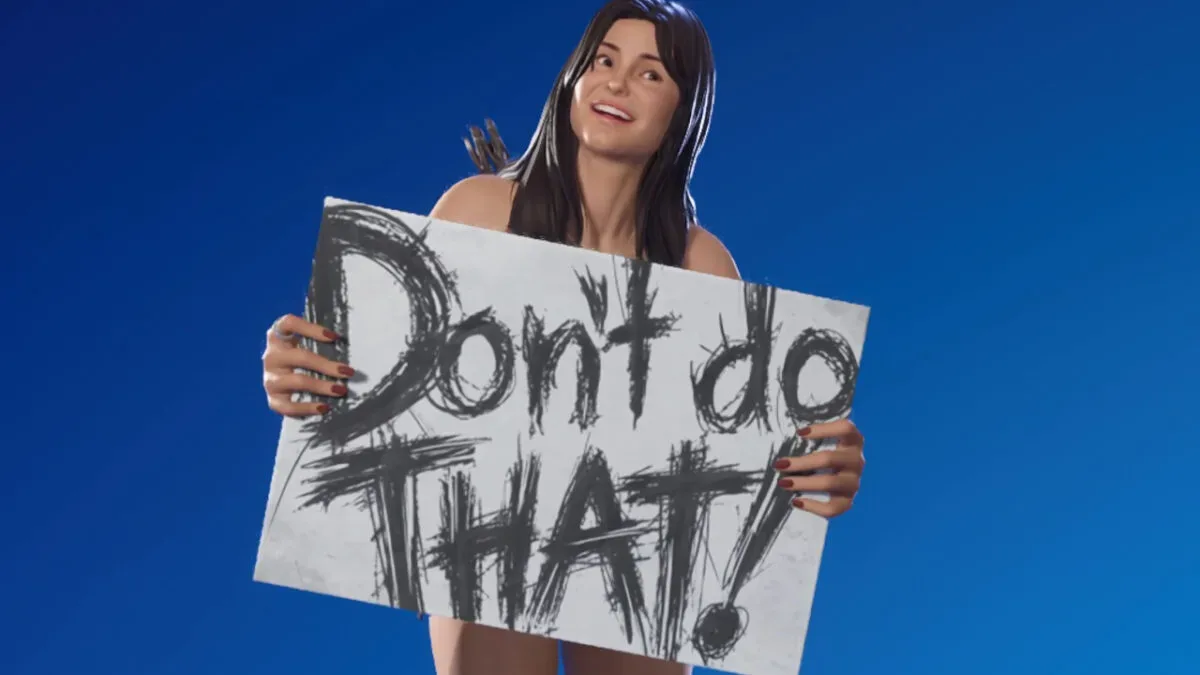
Fortnite has built an entertainment empire by turning recognizable characters into playable icons. Superheroes, musicians, horror villains, cartoon mascots, and game protagonists can all arrive on the island, wield a pickaxe, deploy from the Battle Bus, and celebrate a victory with the same deliberately absurd emotes. That formula is central to the game's enormous crossover appeal. But a reported collaboration involving Obsession and its character Nikki is prompting a different kind of reaction: not excitement over another unexpected guest, but unease over whether the character can be separated from the story that made her memorable.
Nikki is expected to enter Fortnite as part of an Obsession tie-in, with leaked promotional material and cosmetics pointing to a version of the character inspired by the horror film's most disturbing imagery. The issue for many viewers is not that horror has a place in Fortnite. Horror has been part of the game's crossover catalogue for years, and its inherent theatricality often makes it especially easy to adapt into skins and accessories. The concern is more specific. Nikki is not simply a masked killer or a supernatural monster whose visual identity can be lifted into a multiplayer game with few complications. Her appearance, behavior, and suffering in Obsession are bound directly to a story about agency being taken from her.
That distinction changes how the crossover reads. What might otherwise be a routine Halloween-season-style addition can instead look like an example of a serious narrative being reduced to its most shareable images: a bloody look, a recognizable prop, a dramatic line, and an unsettling facial expression. In Fortnite, those elements become collectible objects and competitive-game accessories. The questions raised by that transformation are uncomfortable precisely because they echo the film's own concerns about whether Nikki is seen as a person or as something to be possessed and controlled.
Embedded X/Twitter post
Why Nikki's role in Obsession matters
Obsession follows Nikki, a young woman who wants to become a writer and leave behind her job at a local music store. There she meets Bear, a man who is drawn to her but cannot meaningfully connect with her as an equal. His feelings curdle into entitlement. After breaking a One Wish Willow toy, Bear makes an angry wish for Nikki to love him more than anyone else in the world, only to discover that the wish has real consequences.
For useful background on this topic, read Fallout 4's Verified Creations Lineup Adds FEVer Dreams, Command Override and Fathomless.
Nikki's resulting fixation is not a conventional romance, even if Bear repeatedly attempts to frame it in those terms. Her behavior escalates into violent and frightening extremes, but the film makes clear that she is acting under the effect of a wish she did not choose. Her identity and ability to decide for herself have been compromised. The horror is not just that she becomes dangerous; it is that Bear benefits from and continues to participate in a situation created through the destruction of her autonomy.
That framing makes Bear's role crucial. Though he occupies a protagonist-like position in the story, his attempts to manage, revise, or live with the wish place him at the moral center of the film's ugliness. When Nikki's real self briefly breaks through and asks him to kill her, his response underscores his inability to fully recognize what has been done to her. He remains focused on what being with her might mean for him.
Inde Navarrette's performance as Nikki helped make the character one of the film's most talked-about elements. She has become a potent horror image because the performance moves between affection, terror, need, rage, and visible desperation. Yet the very intensity that made Nikki compelling has also made her easy to turn into a meme. Scenes can be clipped, remixed, quoted, and recast as shorthand for a possessive "crazy girlfriend" archetype, despite that reading overlooking the film's central power imbalance.
A skin can preserve a look without preserving meaning
Fortnite crossovers are not designed to reproduce every theme of the works they reference. They cannot be. A skin is, by nature, an abbreviated adaptation: an outfit, a face, a set of accessories, perhaps an emote or a loading-screen image. Players bring their own context to it, and Fortnite then places that character beside dozens of unrelated cultural figures in a deliberately playful setting.
Usually, that distance is the point. It is why a terrifying slasher can dance after eliminating a brightly colored mascot, or why a character associated with a grim story can become part of a cheerful squad photo. Fortnite's collage-like tone turns pop-culture recognition into a social game. But abstraction has limits. When a character's most recognizable objects are directly connected to coercion, self-harm, and sexual violence, turning them into gear risks making the original context feel optional.
The apparent Obsession cosmetics make that tension especially stark. Nikki's reported set includes cue cards associated with the moment the truth about her condition becomes apparent, the One Wish Willow that robbed her of free will, and a broken bottle connected to her attempt to escape the nightmare she is trapped in. Each object is memorable because of what it represents in the film. Outside that story, however, it can become a back bling, harvesting tool, or visual flourish used in a match against entirely unrelated characters.
Promotional imagery also appears to retain a wound associated with Nikki's attempt to harm herself, though the blood is represented as black fluid rather than realistic red blood. That stylization is consistent with Fortnite's broader visual language, which routinely tones down graphic material while keeping a character recognizable. Even so, changing the color does not erase the scene's significance for viewers who know the film. It may instead make the reference feel more conspicuous: the image is recognizable enough to sell the collaboration, while its emotional stakes have been smoothed into an all-purpose horror aesthetic.
The larger problem of meme-driven interpretation
The Fortnite discussion is also part of a wider argument over what happens to horror films after they become viral phenomena. Popularity gives a story a larger audience, but it can also narrow public understanding of it. A complicated character is transformed into a reaction image. A painful scene becomes an audio trend. A line intended to expose manipulation becomes a catchphrase detached from the manipulation itself.
Obsession is particularly vulnerable to that process because its subject matter invites shallow readings. The film engages with personhood, abusive relationships, rape culture, and the tendency for some men to treat the women they pursue as fantasies rather than as complete individuals. It also deliberately places viewers close to Bear's perspective, which can make its intended critique open to debate. It is reasonable to discuss whether the film handles all of those ideas effectively. What is much harder is having that discussion when the dominant cultural version of the film becomes simply a collection of images about an obsessive woman.
That simplified version is commercially useful. It gives marketers a clean hook, encourages instantly legible social-media posts, and provides a familiar kind of horror branding. But it can reproduce the same flattening that the film is, at least in part, trying to interrogate. Nikki becomes not a person whose mind and body have been commandeered, but a marketable package of danger, desirability, and volatility.
The discomfort surrounding the crossover is not an argument that dark stories should never be adapted, memed, or sold. It is an argument that context matters most when the character's suffering is the product being repackaged.
Fortnite's crossover machine meets a story about control
There is an unavoidable irony in Nikki joining Fortnite. The game's cosmetics system turns characters into controllable avatars. Players choose the outfit, command the movements, select the emotes, and send the character into situations that have nothing to do with their original world. In most cases, this is harmless imaginative play. With Nikki, it echoes the loss of control at the heart of Obsession.
That does not mean every player equipping the skin is endorsing a cruel reading of the movie. Many Fortnite players may be fans of Navarrette's performance, fans of the film, or simply collectors interested in unusual horror collaborations. Others may have no familiarity with Obsession at all. Fortnite is vast, and its crossover audience is never a single audience. The problem lies less with individual players than with the commercial process that selects which parts of a work are worth carrying forward.
It is also impossible from the outside to assign responsibility to one person. Creative approvals for a major crossover can pass through many hands, including rights holders, licensors, marketing teams, game teams, and performers. Nothing about the existence of the collaboration automatically establishes that the film's director, its cast, or any particular participant misunderstood the material. The visible result, however, can still invite criticism regardless of who made each decision.
For Fortnite, the collaboration demonstrates both the power and the risk of being pop culture's biggest meeting place. The game can introduce players to music, movies, and games they may never otherwise encounter. At the same time, its format rewards instantly recognizable surfaces. In an economy driven by attention, the image that survives is often the image that can be understood in a second, not the theme that requires reflection.
What the reaction says about adaptation
Not every adaptation must preserve every layer of its source material. Some of the best crossovers work because they reinterpret characters playfully. But certain stories carry a heavier burden when their imagery is removed from its original setting. With Nikki, the key symbols are not neutral decorations. The One Wish Willow is an instrument of violation. The bottle and the wound are not generic spooky details. The cue cards point toward a revelation about a woman whose voice and choices have been overridden.
Whether the Fortnite release ultimately changes public understanding of Obsession remains uncertain. It may introduce new viewers to the film, and some may engage with its themes more carefully as a result. It may also deepen the version of Nikki already circulating online: an eerie, possessive figure stripped of the circumstances that made her tragedy horrifying in the first place.
That uncertainty is why the crossover has generated more than the usual skin reveal chatter. It asks what happens when an entertainment system built to make everything playable encounters a character whose story is fundamentally about being denied control. Fortnite can make Nikki recognizable. What it cannot automatically carry over is the reason viewers should be troubled by what happened to her.
Community
Discussion
Start the conversation.
No comments have been posted yet.