


Freestyle - Tales of Itch, a new platforming adventure from Mute.Ink, has been released for Commodore Amiga hardware. Built with Earok's Scorpion Engine, the game combines an intentionally old-school action-platforming foundation with hand-drawn comic-book storytelling, a large campaign of more than 50 levels, and a strange central premise involving a villain obsessed with bending kitchen cutlery.
The release is notable not merely because it is a new game for an enduring retro computer platform, but because of its apparent scale. Mute.Ink describes Freestyle - Tales of Itch as an expansive production with changing gameplay styles, dozens of enemy types, a supporting cast, secret characters, and a narrative delivered through 24 illustrated comic pages. It is designed around a "freestyle" structure that aims to give the traditional platformer format a more open-ended feel while retaining the immediate appeal of 1990s-inspired game design.
A New Amiga Game With Comic-Book Ambitions
At its core, Freestyle - Tales of Itch is a platformer, but it is not presented as a single-mechanic trip from left to right. The campaign moves through multiple genres as it progresses, with the challenge becoming more demanding over time. That approach suggests a game built to continually alter the player's expectations rather than relying on one familiar pattern for its full run.
The overall adventure stretches across more than 50 distinct stages. For a newly developed Amiga platformer, that is a substantial figure, particularly alongside the amount of supporting material Mute.Ink says has been included. There are 51 unique enemy variants to encounter, 15 supporting characters involved in the story, and eight bonus characters hidden within the game. Those numbers point toward a campaign that wants players to explore beyond the most direct route and pay attention to the world surrounding its central hero.
For useful background on this topic, read Indie Game Roundup: Forever Ago, Echo Weaver and a Packed Showcase Week.
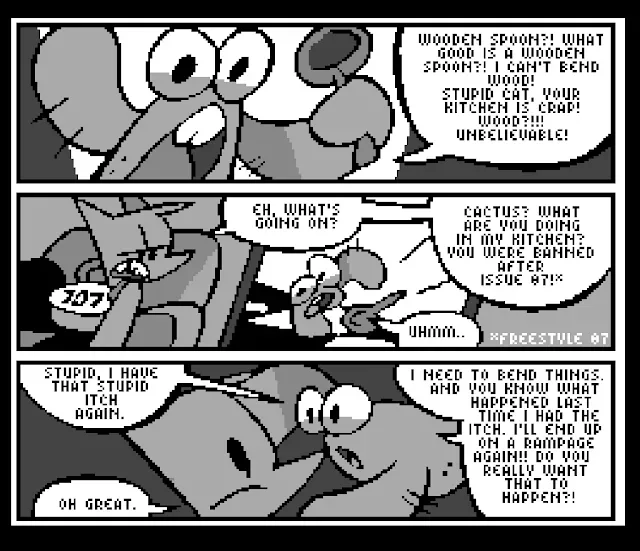
That hero is Stupid Cat, a grumpy feline who is reluctantly pulled into the adventure. The threat comes from Cactus, a fingerless villain whose frustration over his physical condition has led him to an extremely unusual belief: a person's real value is determined by the amount of kitchen cutlery they can bend. With Cactus attempting to impose this silverware-warping logic on the world, Stupid Cat sets out to stop the escalating madness.
It is an absurd setup, but one that fits a project rooted in comic-book presentation. Rather than treating its story as a brief excuse for platforming, Freestyle - Tales of Itch uses 24 hand-drawn pages to carry its narrative. The comic material is intended to tie the campaign together and make the journey feel like a complete illustrated adventure rather than a collection of disconnected levels.
Hand-Drawn Art Meets Scorpion Engine Development
Freestyle - Tales of Itch was developed using the Scorpion Engine, the Amiga-focused development toolkit created by Earok. The engine has become an important part of the modern Amiga homebrew scene because it allows creators to build new projects that can still target classic hardware. Mute.Ink has used it here for a game that embraces the visual language of earlier comic properties while expanding that style into a substantial interactive production.
For another perspective on this story, read Freestyle - Tales of Itch Brings a 50-Level Comic Platformer to Amiga.
The art direction is described as detailed and hand-drawn, an important distinction for a game whose identity is so closely connected to its comic pages. Platformers often use cutscenes as a quick bridge between levels, but the stated focus on 24 illustrated pages makes the story presentation a more central part of the experience. The visual approach may also help distinguish the characters and enemy variants across such a large set of levels.
There is a clear appreciation here for the kind of colourful, personality-driven software associated with the Amiga era. Rather than simply imitating a single classic platformer, Freestyle - Tales of Itch appears to draw on broader 1990s comic sensibilities: exaggerated figures, an offbeat premise, and a campaign that uses visual storytelling as more than decoration.
Music in the game is credited separately. Mark Pursell created everything other than the music, while the soundtrack material is credited to curt_cool through The Mod Archive. That split is another fitting detail for an Amiga release, where tracker music and the wider demoscene-adjacent creative community have long been part of the platform's identity.
Hardware Requirements and Compatibility Notes
Mute.Ink has provided detailed notes about the hardware used to test Freestyle - Tales of Itch. The developer says the game runs smoothly on Amigas upgraded with hardware such as PiStorm or Furia, with testing carried out on Amiga 500 and Amiga 600 systems. The key message for prospective players is that additional RAM and, ideally, a CPU upgrade are recommended for the best experience.
The game has also been tested on an Amiga 600 configuration with 1MB or 2MB of chip RAM and 4MB of fast RAM. On that setup, some slowdown can occur, although Mute.Ink says it does not affect gameplay. This is useful context for owners of less heavily upgraded machines: the game may still be playable, but performance is expected to be more consistent on systems with stronger specifications.
One especially welcome compatibility point is that AGA is not required. AGA, or Advanced Graphics Architecture, is associated with later Amiga models such as the Amiga 1200, and requirements tied to it can limit a new game's audience among owners of older hardware. By avoiding an AGA requirement, Freestyle - Tales of Itch remains relevant to players using earlier Amiga setups, provided they have enough memory and processing power for the preferred experience.
The game has reportedly worked well on a Raspberry Pi 4 and Pi 400-based setup. However, it struggles on the A500 Mini. That distinction is important for players whose first contact with the Amiga library has come through the compact modern device rather than original hardware, FPGA configurations, or emulation. The A500 Mini may be capable of running many older Amiga titles, but Freestyle - Tales of Itch appears to ask more of the system than it can comfortably provide.
An Amiga 1200 test was also planned once the developer's preordered unit became available. No performance result for that machine has been confirmed in the supplied details, so players should not assume a specific outcome beyond the fact that AGA itself is not a requirement.
Why Releases Like This Matter
New software for vintage platforms is no longer a rare novelty, but releases of this apparent size still stand out. The active Amiga development scene includes ports, smaller arcade-style experiments, demos, and entirely new games, yet a project with more than 50 levels, a large enemy roster, extensive comic artwork, and a deliberately structured story represents a more ambitious kind of homebrew production.
Freestyle - Tales of Itch also demonstrates how modern tools can support software made with old hardware in mind. Scorpion Engine does not change the character of the Amiga itself, but it gives developers a practical route to create projects that would otherwise demand far more bespoke technical work. The result can be games that feel connected to the platform's history without being constrained to reproducing only the smallest and safest designs from that era.
For players, the appeal is likely to rest on the blend of personality and breadth. A cutlery-bending antagonist and a reluctant cat protagonist make for an immediately unusual hook, while the shifting genres and large level count suggest that the game is seeking to hold attention over a lengthy campaign. The hidden bonus characters add another reason to revisit stages or investigate areas that may not be essential to completion.
An Offbeat Adventure for the Amiga Library
Freestyle - Tales of Itch arrives as a distinctly eccentric addition to the contemporary Amiga catalogue. Its ingredients are familiar in the best retro sense--platforming, colourful foes, comic-inspired art, secrets, and tracker music--but its structure is much more ambitious than a brief nostalgia exercise. Mute.Ink has positioned the project as a long-form adventure with story pages, gameplay variety, and escalating challenge.
Players with upgraded Amiga 500 or Amiga 600 systems, particularly those using PiStorm or Furia hardware, appear to be among the best-positioned to enjoy the game as intended. Owners of lower-spec configurations may encounter occasional slowdown, while A500 Mini users should be aware that the game currently struggles on that device. Crucially, players do not need an AGA-capable Amiga, making the release accessible across a broader range of classic setups.
With Stupid Cat facing down Cactus and his bizarre campaign of silverware-based self-worth, Freestyle - Tales of Itch brings a full comic-book adventure to hardware that continues to receive surprising and inventive new releases decades after its original era.

Community
Discussion
Start the conversation.
No comments have been posted yet.