

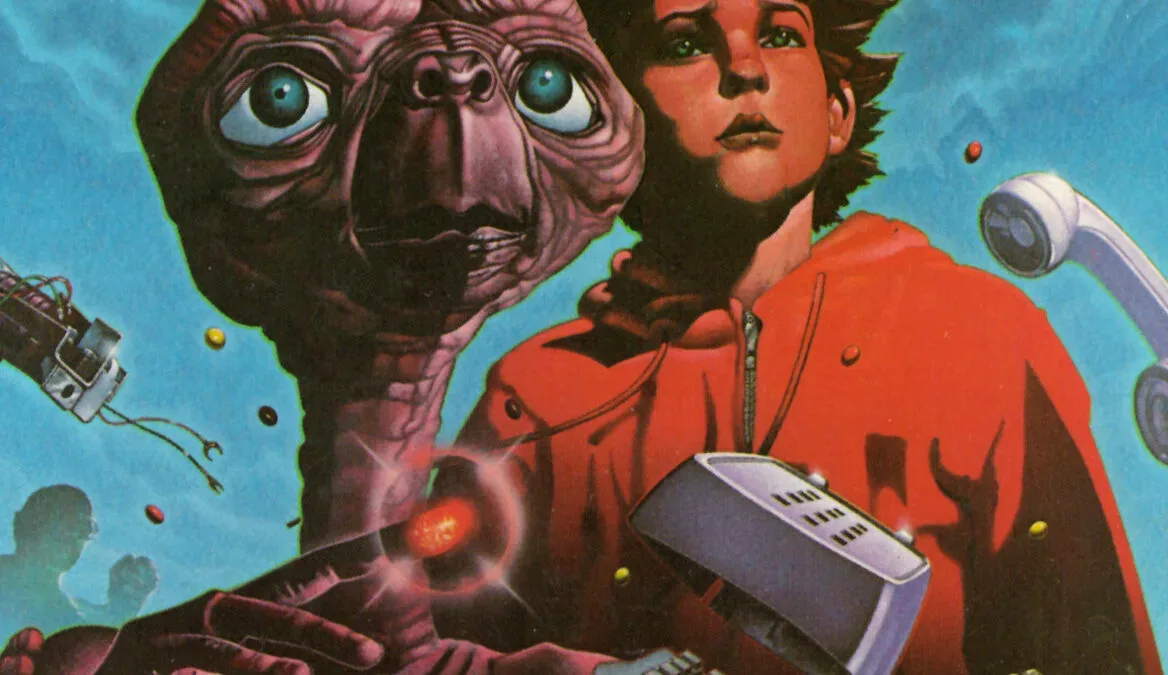
Howard Scott Warshaw, the programmer best known for Atari 2600 titles including Yars' Revenge and the famously troubled E.T. the Extra-Terrestrial, has issued a warning about where artificial intelligence could take the games business. Speaking at the DevGAMM conference in Lisbon, Warshaw argued that AI could help create conditions resembling the North American video game crash of 1983 and 1984--not because the technology itself is inherently bad, but because it may make it far too easy to flood storefronts with low-quality games.
His concern goes beyond a familiar argument about whether AI belongs in game development. Warshaw sees useful applications for it, particularly as a way to accelerate programming work. His fear is instead about volume, visibility, and consumer trust. If digital shops become overwhelmed by automatically produced games with little creative purpose or quality control, players may struggle to locate worthwhile releases at all. In that environment, even strong games can be buried beneath a growing mass of disposable software.
It is a warning from someone permanently linked to one of gaming's most enduring cautionary tales. E.T. the Extra-Terrestrial is routinely invoked as a symbol of the early-1980s crash, though historians continue to debate the precise causes of that industry collapse and how much responsibility any single game deserves. The broader problem was more complicated: an overcrowded market, inconsistent quality, fragmented hardware, confused consumers, and a retail ecosystem that could no longer support the volume of products arriving on shelves.
A lesson bigger than one infamous cartridge
The Atari adaptation of Steven Spielberg's hit film arrived under extraordinary pressure. Atari approached Warshaw after the movie had already become a major success, but the project was intended for the same year's holiday shopping season. That left the developer only a matter of weeks to make the game.
For useful background on this topic, read Breville Barista Express Falls to $495 for Late-Night GTA VI Sessions.
The result became notorious. Rather than delivering the accessible movie fantasy many children expected, the game presented players with opaque objectives, repetitive movement, and mechanics that were difficult to understand. Its reputation worsened over time, especially once the story spread that huge numbers of unsold cartridges had been dumped in Alamogordo, New Mexico. What was long treated as an urban legend was eventually confirmed when cartridges were excavated from the landfill.
Still, framing the crash entirely around E.T. misses the larger story. In the late 1970s and early 1980s, the home-console business had expanded rapidly. Numerous systems competed for attention, publishers released software at a furious pace, and quality varied wildly. Retail shelves filled up. Parents and other buyers often had little reliable information about what was worth purchasing. As disappointment grew, confidence in games as a consumer category weakened.
Warshaw recalled that critics had been eager to dismiss video games as a passing fad even before the crash. When the market contracted, many developers worried that those skeptics had been proven right. The fallout affected investment as well as public perception, with money and faith leaving an industry that suddenly looked unstable.
Today's games business is vastly larger, more technologically sophisticated, and far more culturally entrenched. The idea that games are a fad is no longer a serious mainstream position. Major releases command global attention, consoles have decades of established history, and the audience extends across PC, mobile, subscription services, handheld systems, and more. But Warshaw's argument is that the underlying consumer problem of a market overrun with poor products can return in a new form.
AI lowers the barrier--and raises the volume
Warshaw is not presenting AI as a tool with no place in development. He acknowledged its potential to speed up coding dramatically. Used thoughtfully, it could assist teams with tasks that consume time and allow developers to direct greater attention toward creative decisions. For small teams in particular, efficiency tools can matter enormously.
Yet making production easier also means many more people can release games, including people without the design skill, technical knowledge, or editorial discipline needed to make compelling ones. That is the heart of his comparison to the early 1980s. When the barriers to publishing fall while the mechanisms for filtering quality remain weak, the market can become saturated.
Warshaw's central point was that AI may enable a much larger number of people to make games, including many who cannot make them well, and that storefronts need stronger ways to remove poor releases while elevating genuinely innovative work.
Digital distribution changes the physical details but not necessarily the commercial risk. There are no limited rows of cartridges at a local retailer that must be stocked, returned, or discounted. Online stores can hold a theoretically unlimited number of games. But an unlimited catalogue creates a different bottleneck: attention. Players only have so much time, storefronts only have so much space on prominent pages, and developers only have so many opportunities to reach an audience.
Discoverability has been a major concern for independent developers for years. Even before the current surge in AI-created material, launching on a large storefront did not guarantee that a game would be seen. Developers needed wishlists, social-media momentum, festival placement, community recommendations, press coverage, or an unusual hook to break through. A flood of hastily assembled projects can make that already difficult challenge even worse.
Digital shelves need meaningful filters
Warshaw's description of digital shelves being filled with garbage is blunt, but it captures the practical problem. Players who repeatedly encounter misleading, unfinished, copied, or low-effort games may lose trust in browsing storefronts. Instead of exploring, they may rely exclusively on familiar franchises, major publishers, influencers, or recommendation algorithms. That narrows the opportunity for inventive smaller games--the very projects that broad digital marketplaces once promised to support.
The issue also has financial consequences. A listing that sells virtually nothing does not merely disappear harmlessly into the background. In aggregate, vast quantities of unsellable releases can clutter search results, recommendation systems, new-release pages, and moderation pipelines. If customers find browsing exhausting or unreliable, the storefront itself becomes less useful as a place to discover and buy games.
Steam has traditionally favored a comparatively open model in which market behavior and player interest strongly influence what receives prominence. That approach has helped make it an enormous PC marketplace, but it also means users can encounter a growing amount of conspicuous low-effort material. itch.io, another important platform for independent creators, has faced similar pressure from machine-generated uploads and has taken a more direct stance, reportedly removing more than a terabyte of such content.
Neither situation has an effortless solution. More aggressive curation can reduce spam and protect customers, but it can also introduce gatekeeping, inconsistent enforcement, and added costs for platforms. Fully open submission systems offer access to new creators, but access means little if legitimate projects cannot be found. The challenge is not simply identifying whether AI was used. It is determining what standards should apply to work that is released for sale or distribution, regardless of the tools involved.
Nintendo's post-crash example still matters
The aftermath of the 1980s crash offers a historical contrast. As Nintendo prepared to expand beyond Japan, it paid close attention to the mistakes made by earlier competitors. The Nintendo Entertainment System was designed not only as a machine but also as a more controlled platform. Its VCR-like appearance helped distinguish it from the image of failed consoles, while its cartridge format and licensing policies gave Nintendo substantial oversight over software released for the system.
Those quality-control measures helped rebuild confidence, though they also made Nintendo a powerful gatekeeper and created friction with third-party publishers. The lesson is not that every modern storefront should copy the NES model. The industry, its technology, and its audience are too different. But the underlying principle remains relevant: platforms shape markets through the rules they set, the work they promote, and the standards they enforce.
Warshaw's more hopeful view is that AI could push developers to concentrate on what automated tools cannot supply on their own: distinctive design, artistic judgment, coherent intent, and memorable player experiences. Speeding up production does not automatically create good games. A game still needs someone to decide what it should be, why players should care, and how every mechanic, story beat, interface choice, and visual element serves that goal.
The concern is that those qualities are not always what platforms reward most clearly. Visibility can be driven by trends, volume, advertising, algorithms, familiar intellectual property, and luck. If marketplaces are to avoid becoming increasingly hostile to original work, better filtering cannot be their only priority. They will also need better methods of surfacing games that deserve attention.
Warshaw's warning is therefore less a prediction of an inevitable crash than a call for the industry to learn from its own history. The 1983 collapse was not caused by one cartridge, one creator, or one bad decision. It emerged from a system that allowed quantity to overwhelm trust. With AI accelerating the creation and release of software, digital game platforms face a modern version of that test: preserve openness and experimentation without allowing endless low-quality output to bury the work players and developers actually value.
Community
Discussion
Start the conversation.
No comments have been posted yet.