

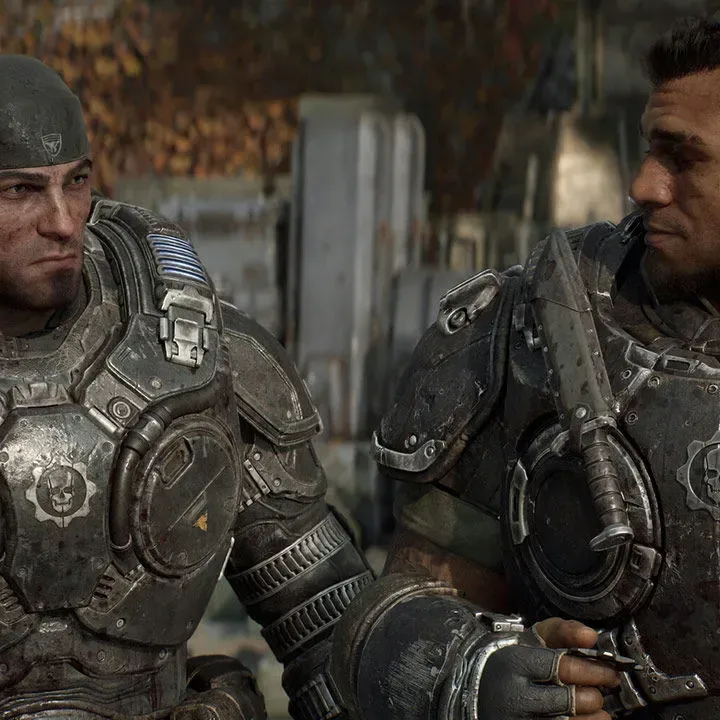
Gears of War: E-Day is built as a major technical showcase for The Coalition, but bringing its high-end visual ambitions to Xbox Series S has required some particularly careful memory management. The studio has described a strategy that uses the console's SSD as an overflow location for selected data when system memory is under pressure, while keeping the most immediately important information in the faster RAM pool.
The approach matters because Xbox Series S has substantially less memory than Xbox Series X. The smaller console includes 10GB of RAM, compared with 16GB in the more powerful machine. For a visually intensive game such as Gears of War: E-Day, that gap can create difficult decisions about image quality, rendering features, asset detail, and the amount of world data that can remain available at any given moment.
The Coalition's studio technical director, Kate Raynor, discussed how the team turned to SSD storage in situations where Series S was running out of memory. It is not a simple matter of treating an SSD as a direct replacement for RAM, however. Storage is dramatically slower than system memory, so indiscriminately pushing active data onto the drive could lead to serious performance problems. Instead, the developer's solution depends on deciding which data can safely leave RAM without interrupting the game's frame-to-frame work.
Why the Series S Memory Limit Is a Major Development Challenge
RAM is where a system keeps data that must be accessed extremely quickly. In a modern action game, that can include geometry, textures, animation information, world-state data, effects, audio resources, and other elements needed to build each scene. When a game has more data to manage than its available memory allows, developers must either reduce what is loaded, stream resources more aggressively, simplify visual features, or find efficient ways to move less urgent information elsewhere.
For useful background on this topic, read Overwatch Players Push Back as Defiled Anthem Cosmetics Remain China-Exclusive.
Computers have long used storage as a backup when memory fills up. On PC, this is commonly handled through a page file: a reserved area on an SSD or hard drive that holds overflow data. The trade-off is speed. Even fast SSDs cannot match RAM latency and bandwidth for the kinds of constant, immediate access demanded by real-time game rendering. Anyone who has watched a PC slow down after exhausting its memory has seen the downside of relying too heavily on that fallback.
That same basic limitation applies to a console. The SSD can provide useful extra room, but only if the software is designed around the difference between data that needs instant access and data that can tolerate a delay. The key is not merely moving information off the RAM budget. It is making sure that the information being moved is unlikely to be required at the exact moment the game is building a frame.
Keeping Frame-Critical Data in RAM
The Coalition's reported method prioritizes data that is not used "in a frame or over a run of frames" for the SSD overflow space. Put more plainly, resources that are continuously required by the active scene remain in RAM, while less time-sensitive data can be shifted to storage when memory becomes constrained.
This distinction is crucial for maintaining responsiveness. If a resource is needed constantly--such as information related to what the player is currently seeing, interacting with, or rendering--it is a poor candidate for slower storage. Sending it out to the SSD only to retrieve it again moments later would create extra work and potentially introduce frame-time instability. A game can appear to run at an acceptable average frame rate while still feeling rough if it experiences regular stalls or uneven frame pacing.
By contrast, data that is not immediately required for the current frame sequence can be managed more flexibly. The SSD becomes a pressure valve rather than a replacement for system memory. This can help the game continue operating within Series S's tighter hardware budget while preserving the resources that have the greatest immediate impact on play and presentation.
There are limits to the technique. Moving data between SSD storage and RAM comes with a cost of its own, and performance can degrade if the page-file-style area must be refreshed too frequently. In other words, it works best when the engine can predict usage well enough to avoid repeatedly shuffling the same data back and forth. A poorly chosen resource, or a part of the game that forces constant turnover, could undermine the advantage.
Visual Compromises Still Play a Part
The storage-backed memory strategy is only one part of the Series S optimization work. The Coalition also dropped Lumen reflections on the lower-specification console. Lumen is Unreal Engine 5's advanced lighting and reflection technology, and scaling back those reflections is a direct way to reduce rendering demands.
That compromise illustrates the reality of supporting a console with less available memory and graphics headroom. A sophisticated memory solution can make a big difference, but it does not eliminate every constraint. Developers must still choose which features are most valuable to preserve, which effects can be reduced, and where the player is least likely to notice a visual downgrade.
For Gears of War: E-Day, the reported balance appears to be aimed at delivering a version that runs well on Series S without abandoning the game's broader visual identity. That is an important goal for a franchise known for its large environments, heavily detailed characters, intense combat scenes, and cinematic presentation. Keeping those elements coherent across Xbox hardware is as much about smart allocation as raw processing power.
A Useful Example for Cross-Platform Game Development
The Series S remains an unusual target in the current console generation. It belongs to the same Xbox family as Series X and shares many architectural traits, but its lower memory capacity means developers cannot simply build for the larger console and expect a straightforward downscale to work in every situation. Games with ambitious use of modern lighting, high-resolution assets, and dense scenes may encounter memory limits before they reach other bottlenecks.
The Coalition's work on Gears of War: E-Day offers a practical example of how engine-level thinking can help address that challenge. Rather than treating memory as a fixed wall, the team has made storage part of a wider resource-management plan. The important caveat is that such a plan must be tailored to the game. It depends on knowing what assets are essential now, what may be needed shortly, and what can remain offloaded long enough to justify the transfer.
Other developers may be able to apply similar ideas, especially as game asset sizes and visual complexity continue to increase. But there is no universal switch that makes SSD-backed overflow memory free. The benefit comes from profiling, prediction, and deliberate content design. Teams have to avoid a situation where the game repeatedly pulls critical resources back from storage, because that would turn the fallback into a source of stutters rather than a solution.
What It Means for Gears of War: E-Day
Gears of War: E-Day entered early access last week, bringing substantial changes compared with previous entries in the series while retaining its place as one of Xbox's prominent exclusives. Its technical profile has drawn attention in part because it is demanding on both Xbox Series X and PC, making the apparent success of the Series S version all the more notable.
For players on the smaller Xbox console, the details behind this optimization may be largely invisible when everything works as intended. That is the point. Good technical compromises are often the ones players do not have to think about during a firefight. If the game maintains smooth play while presenting the core atmosphere, action, and visual character expected from Gears of War, the complicated movement of data between RAM and SSD has done its job.
The larger lesson is that hardware limitations do not always lead to a single blunt reduction in quality. They can also encourage developers to rethink the path data takes through a game engine. In Gears of War: E-Day's case, selectively using the SSD for less immediate memory needs, combined with reduced Lumen reflections, has helped The Coalition make the Series S version viable without placing frame-critical work on slower storage.
As games become more demanding, that kind of careful balancing may become increasingly valuable. Xbox Series S has a fixed 10GB memory budget, and no optimization technique can fully erase the difference between it and Series X. But Gears of War: E-Day shows that thoughtful resource management can stretch that budget further--provided the developer knows exactly what must stay in RAM and what can afford to wait.
Community
Discussion
Start the conversation.
No comments have been posted yet.