

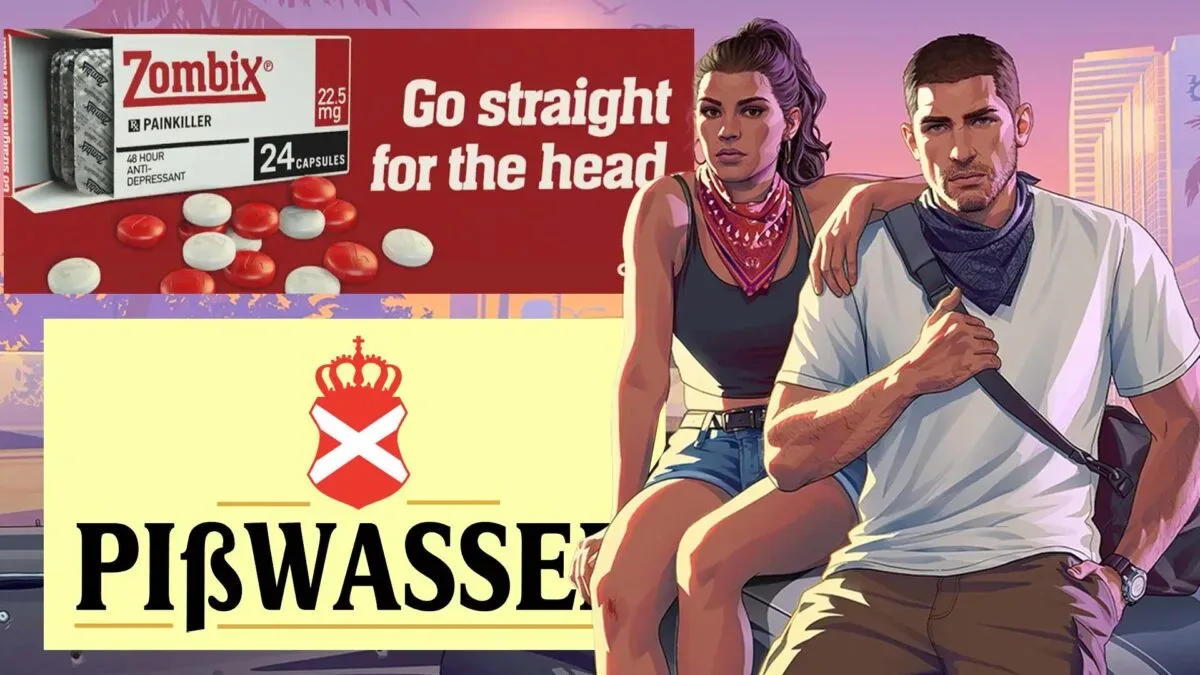
Grand Theft Auto 6 is being discussed not only as another enormous open-world crime game, but as a step forward for one of gaming's most enduring fictional universes. Its character work, dialogue, and broader sense of place have prompted a fresh look at the series' long-established habits. One of the most interesting questions is also one of the smallest on paper: what should Rockstar do with its catalogue of parody brand names?
For decades, Grand Theft Auto has created a version of modern life that feels immediately recognizable without directly reproducing it. Players drive past billboards, visit fast-food restaurants, listen to radio advertisements, scroll through fictional social media, and encounter news broadcasts that all mirror familiar real-world institutions. Fake brands are fundamental to that illusion. They give cities texture, create opportunities for satire, and help distinguish the series from an ordinary real-world sandbox.
Yet not every joke has aged equally well. As the series pursues more emotionally grounded stories and more convincing worldbuilding, some of its broadest product-name gags can feel less like part of the setting and more like leftovers from an earlier comic sensibility. The issue is not that Grand Theft Auto needs to become humorless. Its satire, absurdity, and willingness to mock consumer culture are too important to discard. Rather, the next evolution may be deciding which jokes actually make the world richer.
Parody brands are part of GTA's language
Grand Theft Auto has practical reasons to avoid using the brands people see every day. A world filled with exact corporate names would bring licensing complications, create uncomfortable commercial associations, and potentially distract from the game's fictional identity. It would also weaken a major tool in Rockstar's satirical kit. A made-up chain, product, or media company can communicate a real cultural target while exaggerating its worst traits.
For useful background on this topic, read TCL S55H Soundbar With Wireless Subwoofer Drops to $100 for a Budget Gaming Audio Upgrade.
This approach stands apart from games that embrace real-world partnerships. The Like a Dragon series, for example, has often made recognizable businesses and landmarks part of its urban fabric. That can create a specific kind of authenticity, but it also means the fictional world is partly dependent on agreements beyond the developer's control. When a recognizable landmark or sponsor disappears from such a game, the narrative and environment may have to acknowledge the loss.
Grand Theft Auto's fictional companies avoid that problem. Rockstar can alter, retire, or reinvent them whenever it wants. The important question, then, is not whether parody brands belong in the series. They unquestionably do. The question is whether every returning name deserves to survive simply because it appeared in previous games.
The best fictional brands do more than repeat a pun
At their strongest, Grand Theft Auto's brands work because they operate on several levels at once. Weazel News, the series' stand-in for Fox News, is a clear example. The name signals the target quickly, but it also establishes a personality: slippery, opportunistic, loud, and untrustworthy. It is not merely a word substitution. It tells players what kind of media organization they are dealing with before a broadcast even begins.
Snapmatic similarly succeeds because it immediately evokes Instagram while fitting the series' broader fixation on image, status, surveillance, and performative online life. The name is direct, readable, and useful within the game world. Players understand its function instantly, while the setting gains a fictional platform that can support its own jokes and social commentary.
Other names land because they are simple but pointed. Taco Bomb gets at the aggressive, overproduced marketing language of fast-food chains. ZIP, a counterpart to GAP, is concise and believable enough to look natural on a storefront. These brands can be funny without demanding that the player stop and admire the joke. They feel like companies that might plausibly exist in Grand Theft Auto's heightened America.
That balance matters. Effective satire often works best when it is woven into the scenery. A player can notice it, smile, and move on. The brand name remains useful even after the initial gag has worn off because it continues to support the atmosphere of the city.
Some older jokes now clash with the series' ambitions
The weaker names have a different effect. Pisswasser, the series' beer parody, is memorable and undeniably in keeping with Grand Theft Auto's rude sense of humor. But it is also the kind of joke that can exhaust itself through repetition. Once the name has been heard, its comic mechanism is largely spent. It can still function as a piece of series history, but there is little depth left for it to reveal about the fictional corporation, its customers, or the culture around it.
The problem is more pronounced with names built almost entirely around a juvenile punchline. The Marbles restaurant chain's Big Balls burger is an obvious riff on McDonald's Big Mac, but the joke does not offer much beyond the substitution itself. Likewise, Zombix does not communicate a particularly sharp observation or a convincing identity for the business it represents. These names can feel like gags chosen for speed rather than the product of a carefully imagined commercial landscape.
There is nothing inherently wrong with low comedy. Grand Theft Auto has always mixed serious crime stories with slapstick violence, outrageous radio chatter, bizarre side characters, and intentionally tasteless advertising. A world that parodies modern America should have some stupid billboards. The concern is one of proportion and placement. When a game asks players to invest in nuanced relationships or absorb a more mature dramatic moment, a crude sign or product name can feel oddly detached from the level of craft elsewhere.
That mismatch becomes more visible when the surrounding writing improves. If Grand Theft Auto 6 is capable of presenting compelling characters and detailed worldbuilding, then every major component of the setting invites greater scrutiny. The brands on shop fronts, products in a character's hand, and advertisements on the radio are not background filler anymore. They are part of the storytelling language.
A changing world should include changing companies
Rockstar does not need to preserve every old fictional corporation as a sacred piece of continuity. Real companies close, merge, rebrand, fall out of public favor, or simply vanish. A fictional consumer economy should be allowed to do the same. In fact, brands disappearing between games could make Grand Theft Auto's worlds feel more alive.
There is no reason an old restaurant mascot, beer label, airline, or automotive badge has to appear forever. A new city can retain the broad cultural DNA of the series while introducing brands tailored to its particular time, region, and story. Some returning companies may still be worth keeping because they have become useful institutions within the fiction. Others can fade away without causing any meaningful loss.
This is not a call for aggressive realism or corporate restraint. The ideal replacement for a worn-out joke is not a sterile, generic business name. Rockstar should continue to create brands with attitude, exaggeration, and a willingness to offend. But the humor can be smarter, more specific, and more embedded in the world. A fake product can ridicule luxury culture, wellness scams, gig-economy exploitation, influencer marketing, predatory finance, political media, or the strange language of modern advertising without relying only on a bodily-function pun.
Satire benefits from maintenance
Long-running series need to examine the ideas they inherit from themselves. What was funny in an earlier era may not be funny now, or it may no longer serve the tone the developers are trying to achieve. Revisiting an old gag is not an admission that the original was a failure. It is simply an acknowledgement that a fictional world, like the real culture it mocks, changes over time.
Grand Theft Auto has already endured because it has repeatedly reinterpreted its formula. Its locations, protagonists, visual ambitions, and social targets have shifted across generations. The same willingness to iterate can apply to the smallest details. A selective review of fictional brands would not erase the series' personality; it could sharpen it.
Grand Theft Auto 6 does not need fewer jokes. It needs the confidence to let its best jokes carry the setting. If a brand name supports a larger satire, tells players something about the city, or feels like a company that belongs in this warped version of America, it has earned its place. If it exists only because it once got a cheap laugh, Rockstar has every reason to replace it with something better.
That is a modest change, but it fits a series that has grown far beyond its earliest identity. The next Grand Theft Auto world can remain loud, vulgar, and relentlessly funny while also being more precise about what it is saying. In a game built around the details of a living city, even the name on a burger wrapper can matter.
Community
Discussion
Start the conversation.
No comments have been posted yet.