

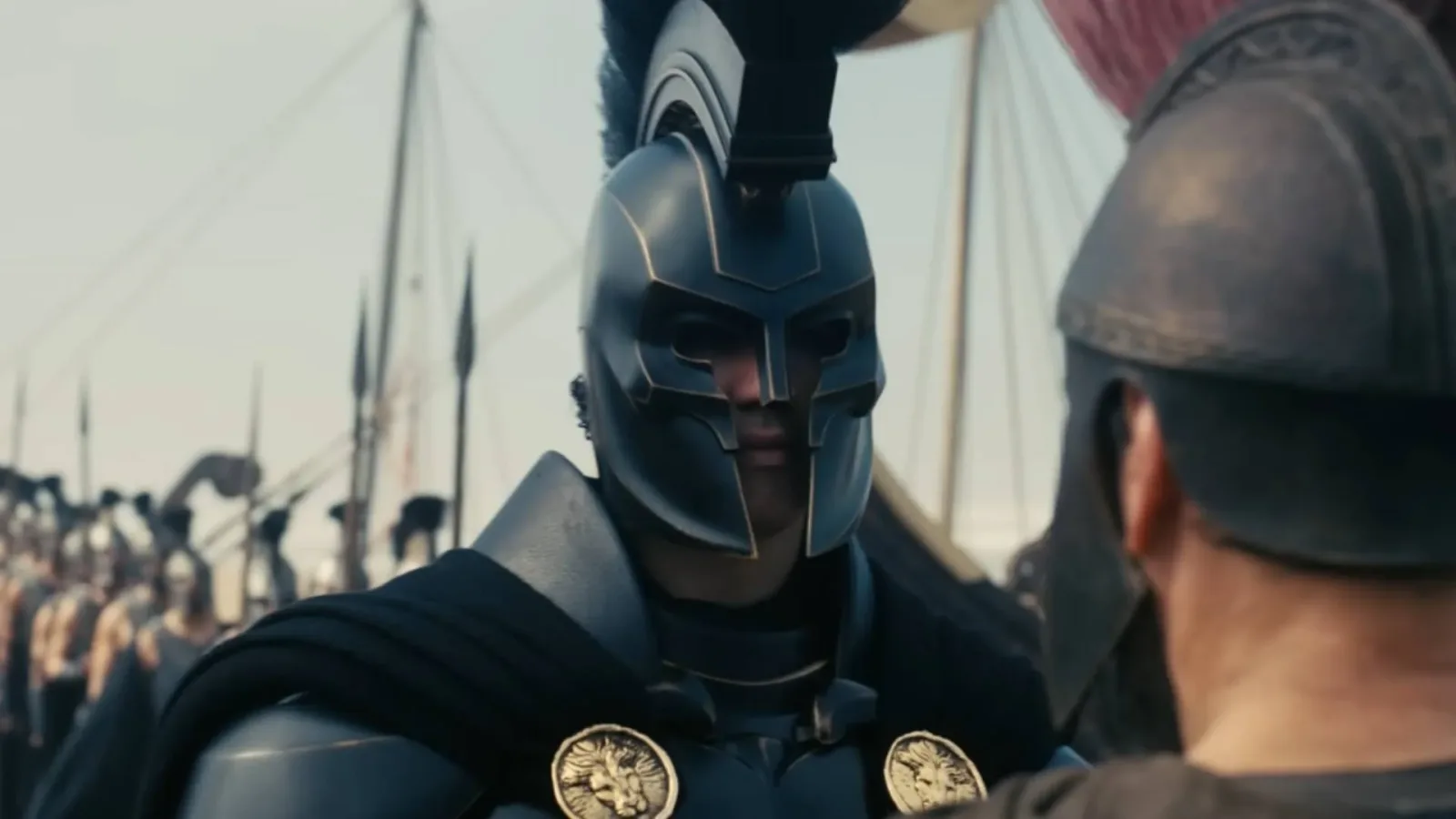
Elon Musk's AI assistant Grok has released the first portion of its much-discussed adaptation of The Odyssey, putting a seven-minute opening sequence online through X. The project, presented as a creative collaboration involving Wonder Studios and director Dev Walker, follows Odysseus as he begins his journey toward Troy.
Rather than serving as a triumphant demonstration of AI filmmaking's rapid advancement, the initial footage has generated widespread criticism. Viewers responding to the release have taken issue with its uncanny digital characters, stiff vocal performances and an action sequence that has been described as lacking energy. Terms including "soulless" and "terrible" have appeared repeatedly in the reaction to the experiment.
The response matters because the clip arrives after months of bold claims around Grok's potential to make feature-length entertainment. Musk had previously positioned the technology as an alternative path for adapting Homer's ancient epic, including criticism aimed at Christopher Nolan's own version of The Odyssey. Now that Grok's take can be judged in motion rather than in promises, the gulf between a short AI-generated showcase and a conventional blockbuster production is at the center of the conversation.
A famous voyage begins with an AI experiment
The Odyssey is one of the most enduring works in Western literature, telling the story of Odysseus and his protracted attempt to return home following the Trojan War. It has inspired retellings across theatre, novels, television and cinema for generations. That cultural familiarity gives any new adaptation an immediate advantage: audiences understand the broad contours of the myth even before the first scene begins.
For useful background on this topic, read Alix Wilton Regan Will Host the Golden Joystick Awards 2026 as Ultimate Game of the Year Voting Opens.
Grok's released segment instead focuses on the earlier part of the saga, depicting Odysseus setting out toward Troy. In principle, that provides plenty of material for a visual spectacle: ships departing for war, the scale of the Greek expedition and the personal stakes behind a conflict whose aftermath will define Odysseus' legendary journey.
In practice, viewers have criticized the execution. The characters in the video have prompted the kind of unease often associated with generative video's attempts to reproduce human faces and movement. The line readings have also been singled out as unusually flat and unnatural, undermining scenes that need conviction and emotional tension. A battle sequence, meanwhile, has been met with complaints that it lacks the excitement expected from a story built around monumental conflict and perilous travel.
Seven minutes is not enough to represent every creative possibility of a planned feature, and a brief opening cannot reveal how an entire adaptation might have handled Homer's narrative. Yet it is enough to establish a first impression. For a project framed around demonstrating video and voice capabilities, the short length has made every weakness especially conspicuous.
Big promises met a demanding piece of material
Musk had made ambitious statements about Grok's cinematic goals earlier in 2026. In July, he said that Grok Imagine would create a full-length Odyssey movie before the end of the year, describing it as historically accurate and faithful to Homer's art. X also promoted the technology with a contest offering three cash prizes worth up to $100,000 for prompts intended to display what Grok Imagine could accomplish with video and voice generation.
Those promises set an exceptionally high bar. Making a feature is not simply a matter of generating visually recognizable shots. A compelling movie needs continuity between scenes, consistent performances, readable geography in action, deliberate pacing and an emotional through-line that holds together across its full running time. For an epic such as The Odyssey, it must also convey the scale of a mythic world while making Odysseus feel like a person rather than a collection of plot points.
Generative tools can produce startling individual images or short moments, but a cohesive narrative is a different challenge. The criticism surrounding Grok's opening highlights that distinction. If dialogue sounds disconnected, faces remain unsettling and action does not build momentum, then visual novelty alone will not carry viewers through a longer story.
There is also an inherent creative challenge in adapting Homer. Different versions of The Odyssey can emphasize adventure, tragedy, homecoming, war, romance or the intervention of gods. Each choice shapes the protagonist and the tone. A film needs a perspective: it needs to decide what it wants the audience to feel about Odysseus and what the long road home represents. The early reaction to Grok's footage suggests that many viewers did not find that authorial perspective in the material released so far.
Christopher Nolan's version casts a long shadow
The release has inevitably been viewed alongside Christopher Nolan's The Odyssey, a major 2026 theatrical adaptation that has already become a substantial commercial success. Its box-office run is nearing its end with almost $1.8 billion in worldwide takings, making it the highest-grossing R-rated movie ever and the most successful film of Nolan's career.
That performance gives the comparison an unusual edge. The two projects are tied to the same foundational text, but they represent radically different ideas about what a screen adaptation can be. Nolan's film is a large-scale studio production with a cast that includes Anne Hathaway and Robert Pattinson, both of whom have been mentioned in awards-season discussion. Grok's release, by contrast, is an AI-generated proof of concept unveiled in a short online segment.
It would be simplistic to treat the situation only as a competition between "old" and "new" production methods. Technology has long been part of filmmaking, from optical effects and editing machinery to digital compositing, performance capture and virtual production. The more revealing contrast is between tools and creative control. A film's impact often depends on the accumulation of thousands of precise human decisions: how an actor delivers a pause, how an editor shapes a reaction, how a sound mix creates dread, and how a director links spectacle to character.
The adverse response to Grok's footage has reinforced the argument that these choices cannot be reduced to a surface-level imitation of cinema. Viewers may be willing to accept new tools in the creative process, but many still expect a film to have intentionality, rhythm and genuine feeling.
The limitations visible in short-form AI video
AI video has become a major topic in entertainment because it promises speed and accessibility. A creator may be able to develop visual concepts without assembling a conventional crew, booking locations or building physical sets. That potential can be useful for storyboards, experiments and independent projects. It may also lower barriers for people who have ideas but limited resources.
However, speed does not automatically solve the difficult parts of filmmaking. A dramatic scene needs performers who can communicate subtext. A battle requires spatial clarity so the viewer understands who is fighting, why it matters and where the danger is coming from. Historical or mythological material needs production design that feels deliberate rather than assembled from disconnected visual references.
The Grok clip appears to have brought these concerns into sharp focus. Uncanny imagery is not merely a cosmetic problem when the audience is being asked to invest in characters. Stilted voices are not merely a technical flaw when the story depends on heroic speeches, fear, loyalty and grief. A sleepy action scene is not just an issue of pacing when the opening is meant to introduce an epic war.
That does not mean generative filmmaking will stand still. The technology will continue to change, and future work may address some of the problems visible in today's material. But the reaction to this release is a reminder that technical improvement and artistic success are not identical goals. The ability to generate more detailed frames does not necessarily create a stronger performance or a more meaningful scene.
An early verdict, not the end of the debate
For now, Grok's The Odyssey has become an example of how quickly a major AI claim can be tested by audiences. A promise of a feature-length, historically minded Homer adaptation created through AI is bound to invite scrutiny. Releasing an opening sequence means the debate can move beyond promotional language to the footage itself.
That first test has not gone well. The prominent criticism centers on qualities viewers usually expect even from modest productions: believable delivery, engaging action and characters that do not look distracting or artificial. The result has made the project feel less like a challenge to traditional cinema and more like a demonstration of the problems that still stand between generative video and a fully satisfying dramatic feature.
The discussion will continue if more of the adaptation is released. A longer version could offer additional context, improve on the opening or reveal a clearer narrative approach. At present, though, the available seven minutes have left much of the audience unconvinced.
For Nolan's acclaimed adaptation, Grok's debut is unlikely to pose much threat. For AI filmmaking more broadly, it is a useful and very public reality check: epic stories are not sustained by imagery alone. They depend on the difficult, often invisible craft of making an audience care what happens next.
Community
Discussion
Start the conversation.
No comments have been posted yet.