

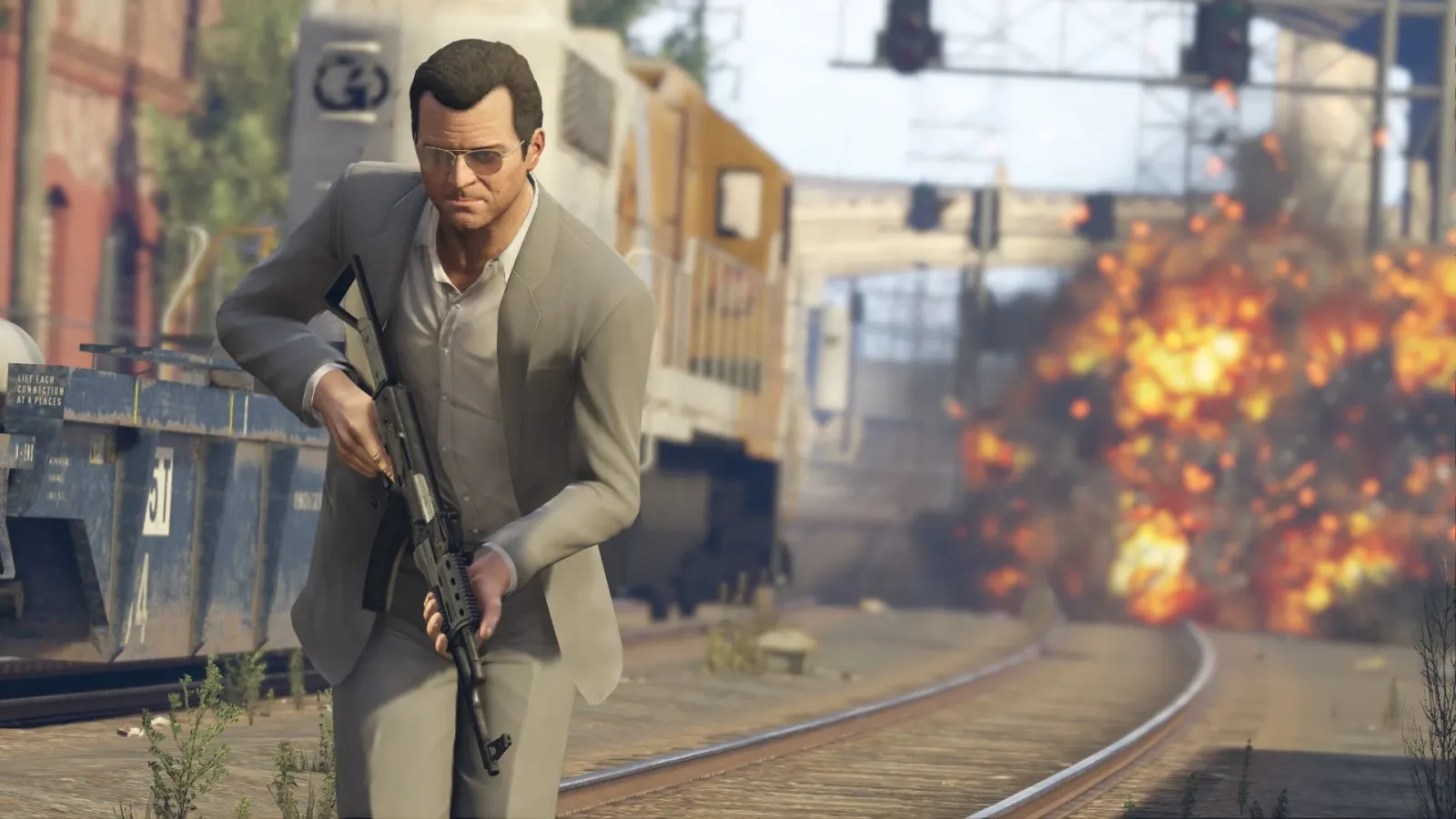
Grand Theft Auto 6 is expected to take players back to Vice City and into the wider state of Leonida, but Rockstar's aim has never been to turn a real location into a one-to-one virtual map. Aaron Garbutt, GTA 6 co-studio head and a long-serving Rockstar art director, has described a design philosophy built around interpretation, compression, and atmosphere rather than exhaustive geographical accuracy.
In comments published in Edge after the launch of Grand Theft Auto 5, Garbutt explained that Rockstar's modern open-world games begin with real cities but deliberately move away from them as development progresses. For him, reconstructing a city street by street would not just be an enormous undertaking. It would also make for a less rewarding process for the developers and, crucially, a less satisfying place for players to explore.
That perspective helps explain why locations such as Los Santos and Liberty City can feel immediately familiar even when their roads, districts, coastlines, and landmarks do not line up exactly with Los Angeles or New York. They are designed to capture a culturally shared idea of those places: the version shaped by movies, television, music, tourism, headlines, and memory.
Rockstar starts with reality, then builds a game world
Garbutt said Rockstar had used the same broad method across its contemporary Grand Theft Auto settings. The team works from a real-world city at a large scale first, identifying the kinds of districts and environments that need to be represented. From there, the process narrows toward individual areas and buildings, while the degree to which specific landmarks are retained can vary.
For useful background on this topic, read Everything is Crab's Free Tide Turner Update Rebuilds the Water Biome.
The important distinction is that reference material is not treated as a set of restrictions. Real geography is a foundation, not a rulebook. Rockstar can relocate neighbourhoods, reshape their relationship to one another, intensify visual contrasts, and alter the scale of the city to create a stronger open-world experience.
"I'd never want to rebuild a city," Garbutt said, arguing that such an approach would be less satisfying to create and less satisfying to play.
That statement gets at a central challenge in open-world design. A real metropolitan area is vast, uneven, and often full of long journeys between places that might be meaningful in real life but uninteresting in a game. An interactive city needs a different rhythm. Players need recognisable routes, distinct districts, entertaining travel, opportunities for spontaneous encounters, and enough variety that moving from one side of the map to another feels like part of the experience rather than empty downtime.
Literal fidelity can sometimes work against those goals. The most accurate route through a city might not be the best route for a car chase. A neighbourhood's authentic layout could obscure useful sightlines, slow mission pacing, or make it harder for players to develop a mental map. Rockstar's approach gives its teams permission to preserve the character of a place while changing the practical details needed for driving, exploration, missions, and sandbox mayhem.
Why the popular image of a city matters
Garbutt's reasoning also rests on the way most people encounter major cities. Only a limited proportion of players will have deep, everyday familiarity with Los Angeles or New York. Many more know them through screen fiction, photographs, news footage, brief holidays, and cultural stereotypes. Those impressions are already selective, curated, and heightened.
Rockstar's worlds are similarly edited. The studio takes a city's perceived feel and concentrates it into a dense interactive space. That means emphasizing certain features, using familiar visual shorthand, and putting contrasting environments closer together than they would be in reality. The outcome may not be a precise replica, but it can feel truer to the version of the city that exists in global popular culture.
Los Santos in GTA 5 is perhaps the clearest example. It evokes the glamour, traffic, beaches, hills, sprawl, celebrity culture, entertainment industry satire, and surrounding wilderness associated with Southern California. Yet it is not simply Los Angeles recreated at a reduced scale. Its geography has been reorganized to support the game's missions and systems, while Blaine County delivers a concentrated version of the deserts, mountains, small towns, and open roads that help define the wider regional fantasy.
That compression is especially important because GTA is not a passive sightseeing experience. Rockstar cities must support every kind of player behavior: following story missions, speeding across the map, escaping police, discovering side activities, experimenting with vehicles, roleplaying everyday routines, or just wandering. Each district needs its own visual identity, but it also has to connect cleanly to the larger gameplay machine.
Los Santos, Liberty City, and changing hardware limits
Rockstar's interpretations have evolved alongside its technology. Grand Theft Auto IV presented Liberty City as a densely built take on New York, while its version of New Jersey arrived later in the game's expanded material. The emphasis was on urban texture, traffic, architecture, and the feeling of being surrounded by a packed cityscape.
Grand Theft Auto: San Andreas had previously offered its own Los Santos and a broad slice of California-inspired territory. That game established the importance of a city being part of a larger regional identity, including countryside and smaller settlements beyond the urban core. However, the hardware of its era limited the level of visual detail and environmental density Rockstar could achieve.
GTA 5 pushed the Los Santos concept much further, making the relationship between its city and surrounding county a major part of the experience. The shift was not simply about graphical improvement. More capable hardware enabled Rockstar to make transitions between locations feel richer and more convincing, with a greater sense of landscape, activity, and detail.
That history is relevant as GTA 6 approaches. More than 13 years separate GTA 5 from Rockstar's next mainline Grand Theft Auto, and the studio has also released Red Dead Redemption 2 in the intervening period. Red Dead Redemption 2 demonstrated Rockstar's interest in richly layered environments, environmental storytelling, and places that feel inhabited even when the player is not directly engaged in a mission.
Leonida could be the key to GTA 6's identity
Vice City is an instantly recognisable name for Grand Theft Auto fans, but GTA 6's setting has the potential to extend beyond a single urban parody. Miami carries an established visual identity of its own, from beaches and nightlife to neon, luxury, waterways, and distinctive architecture. At the same time, Florida as a whole has become a powerful and often stranger-than-fiction fixture in popular culture.
That makes Leonida particularly suited to the approach Garbutt described. Rather than treating Miami as an isolated city, Rockstar can draw on the contrast between its urban center and the state around it. The character of Florida is shaped by coastlines, marshes, highways, tourism, suburbs, rural communities, wildlife, extreme weather, and a constant collision of wealth, spectacle, and the everyday absurdity that has become part of the region's media image.
The more of that range GTA 6 brings together, the more Leonida could become a setting with a personality beyond Vice City itself. A carefully compressed state can place dramatically different spaces within reach of one another, allowing players to move quickly from dense city streets to coastal roads, remote wetlands, small settlements, or other environments that support different kinds of missions and emergent activity.
There is a practical benefit as well. A world built around contrasts helps players feel that travel has purpose. GTA has always relied on vehicles and movement, so the journey between destinations matters almost as much as the destinations themselves. If Leonida is designed with the same selective, player-first logic as Los Santos, its roads and regions should be organized around memorable gameplay possibilities rather than geographic obligation.
Accuracy is not the same as authenticity
Garbutt's comments offer a useful way to frame expectations for GTA 6. Fans will inevitably compare Vice City and Leonida with Miami and Florida, looking for recognizable buildings, local details, roads, and cultural references. Those comparisons are part of the fun. But Rockstar's stated creative priority is not total accuracy.
Instead, the target is authenticity of mood: a place that feels believable in the heightened reality of Grand Theft Auto. That may require changing the map, combining inspirations, shifting locations, or making real-world traits more visible than they would be in everyday life. In Garbutt's view, those choices can make a fictionalized city more convincing because they match what players expect a place to feel like.
For GTA 6, that means the most interesting question may not be whether Leonida precisely mirrors Florida. It may be how effectively Rockstar transforms Florida's many competing identities into a world that feels coherent, explorable, surprising, and unmistakably its own. If the studio can apply the lessons of Los Santos while building on the environmental depth seen in Red Dead Redemption 2, Vice City's return could be about far more than revisiting a familiar name.
Community
Discussion
Start the conversation.
No comments have been posted yet.