

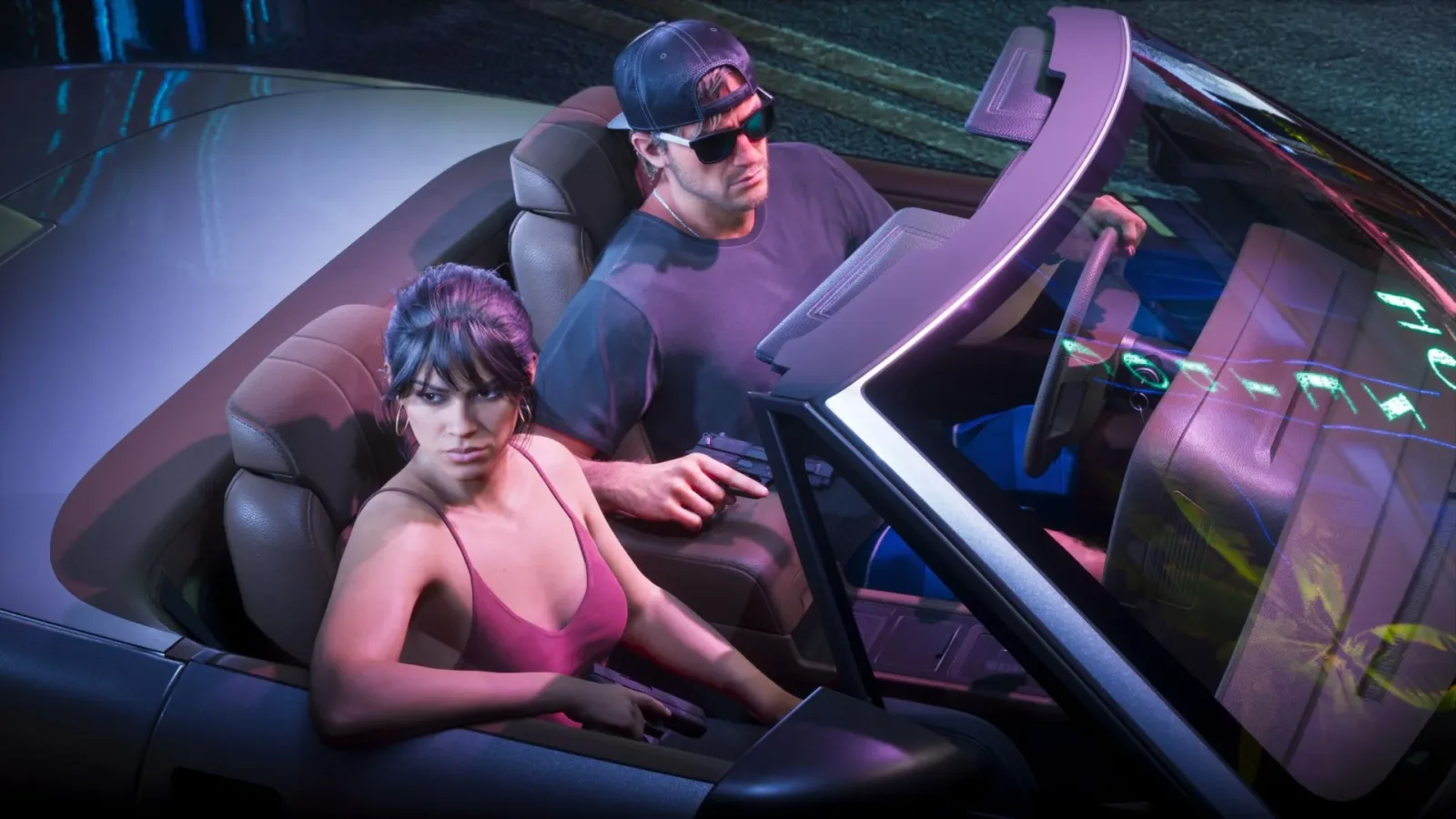
Grand Theft Auto 6 is positioning the relationship between its two central characters, Jason and Lucia, as a major part of its open-world story. That ambition reportedly extends beyond dialogue and major plot scenes: Rockstar Games says representing the pair's physical intimacy required substantial thought, repeated iteration, and animation work intended to make their interactions feel affectionate rather than mechanical.
Mark Tennant, Rockstar's vice president of animation, explained that the team had to consider how players could engage with Jason and Lucia's relationship in ways that felt natural while also reflecting the state of that relationship. The challenge was not simply creating a single cinematic sequence or a one-size-fits-all interaction. Rockstar wanted the characters' responses to make sense in light of the player's broader investment in the romance.
"Exploring the physical relationship between Jason and Lucia required a lot of thought and iteration," Tennant said.
That is a notable focus for a series whose earlier games have often treated sexual encounters as brief, detached side activities. In GTA 6, intimacy appears to be tied more directly to the game's lead partnership and the choices players make while navigating it. Jason and Lucia can apparently develop as intensely passionate lovers or remain more restrained, functioning chiefly as crime partners. The game's physical interactions therefore need to work across more than one emotional reading of the pair.
For useful background on this topic, read GTA 6: Should You Shoot or Spare Benedict Halifax in Dubious Provenance?.
A relationship designed to reflect player decisions
Rockstar's stated objective is for Jason and Lucia's romance to avoid feeling like a fixed track that plays out exactly the same way for everyone. If a player approaches their connection as deeply personal and romantic, the characters' behavior needs to support that. If the player instead steers them toward a more practical, cautious partnership, their interactions should not suddenly suggest a level of closeness the story has not earned.
That type of reactive characterization creates a difficult problem for animators. Game animations must be authored in advance, but the context in which players encounter them can vary widely. A gesture that reads as warm, playful, or passionate in one situation could feel out of place in another. The development team has to account for those changing circumstances without making every encounter look stiff, overly scripted, or disconnected from player behavior.
Tennant said Rockstar needed to let players interact with their partner in a "natural, loving way," while maintaining a believable sense of progression. The wording is important because it frames these scenes as part of an evolving bond rather than as a separate reward system. The intended effect is not just to show that Jason and Lucia are involved, but to communicate where they are emotionally at a given point in an individual player's version of the story.
For a huge open-world game, that can mean considering the relationship across missions, free-roam activities, quieter downtime, conversations, and the player's general treatment of each character. Even if the underlying system has limits, the animation work must give the impression that both people are present in the relationship and responding to one another rather than simply waiting for a player input.
Agency needs a responsive partner
The most complicated part of Rockstar's goal may be the balance between agency and response. Players need room to influence the tone of the relationship, yet Lucia cannot feel like a passive prop whose reactions exist only to validate whatever Jason does. A convincing romantic dynamic depends on both sides appearing to have feelings, boundaries, moods, and meaningful reactions.
Tennant described the work as finding a realistic equilibrium between player agency and partner response while keeping the result "fun, passionate, and rewarding." That is a broad creative target, but it highlights the competing demands at work. An interaction system can be responsive without being emotionally convincing. It can be realistic without being enjoyable. And it can be dramatic without fitting the loose, player-driven structure associated with Grand Theft Auto.
Animation is central to solving that problem. Dialogue can explain a relationship's status, but small physical details often establish whether players believe it. The timing of a look, posture during a conversation, a hesitant pause, or an affectionate gesture can signal a great deal without stopping the game for exposition. If GTA 6 wants Jason and Lucia's connection to carry emotional weight, those details need to change appropriately as their relationship changes.
Rockstar's comments also suggest that the studio views intimacy as something that has to be earned through the wider experience. Rather than treating it as an isolated event triggered by spending in-game money or visiting a specific location, the stated approach connects it to the ongoing relationship between the protagonists. That direction could make the characters' personal lives feel more closely tied to the game's narrative choices.
A departure from older Grand Theft Auto conventions
Sex and adult material have been part of Grand Theft Auto's identity for many years, often used for satire, provocation, or a deliberately impersonal view of the fictional worlds the series visits. Past entries have included interactions with romantic partners and sex workers, but these systems were frequently transactional or played for crude humor. They generally did not ask players to think very much about emotional reciprocity.
GTA 6's approach, as described by Tennant, represents a change in emphasis. The relationship between Jason and Lucia gives Rockstar a specific narrative reason to approach intimacy differently. Instead of centering a lone protagonist moving through a world of disposable encounters, the game places two leads at the heart of its story. Their connection can become one of the lenses through which players experience Leonida and the criminal life surrounding them.
That distinction is also linked to a reported change in the game's world design: Rockstar is not allowing players to hire prostitutes in GTA 6. The decision fits the studio's effort to make Jason and Lucia's romance central rather than competing with it through an older Grand Theft Auto activity. It does not mean adult themes have been removed; by Rockstar's own framing, nudity and intimacy remain prominent. The difference is that those elements are being presented within a more character-focused context.
There is still plenty that remains unknown about the exact boundaries of the system. Rockstar has not detailed every choice that affects Jason and Lucia's relationship, how often intimate interactions occur, or precisely how much variation players will see between different playthroughs. It is also unclear how these scenes will be paced amid the game's missions, exploration, criminal activities, and the broader open-world structure.
Those unanswered questions matter because relationship mechanics can range from lightly reactive presentation to a genuinely consequential feature. Tennant's comments establish the creative aspiration, but players will ultimately judge the result by how consistently the game's scenes, dialogue, animations, and player choices support one another over a full campaign.
Why the animation challenge matters
Rockstar's ambitions with Jason and Lucia go beyond adding romance to an established formula. The studio is attempting to make an adult relationship feel credible inside a game where players may have considerable freedom in how they spend their time and how they interpret the protagonists. That is an unusually demanding task, particularly for a series built on satire, escalation, and large-scale player-driven chaos.
If the implementation succeeds, the relationship could give GTA 6 a stronger emotional center than the franchise's more transactional depictions of sex and romance. Jason and Lucia would not merely share the screen as co-leads; their shifting closeness could shape how players understand the risks, loyalties, and tensions in the story around them.
If it falls short, the contrast between Rockstar's stated ambitions and the final experience will be conspicuous. Believable intimacy is one of the harder things for games to portray because players immediately notice when an interaction is repetitive, unearned, or lacking a genuine response from the other character. Rockstar's extensive animation work is meant to avoid exactly that outcome.
For now, Tennant's comments offer a clearer picture of the studio's priorities. GTA 6 is not treating Jason and Lucia's physical relationship as a simple optional animation or a throwback to past Grand Theft Auto systems. Rockstar is building it as an evolving expression of player choice, character response, and a romance that sits at the center of the game's story.

Community
Discussion
Start the conversation.
No comments have been posted yet.