

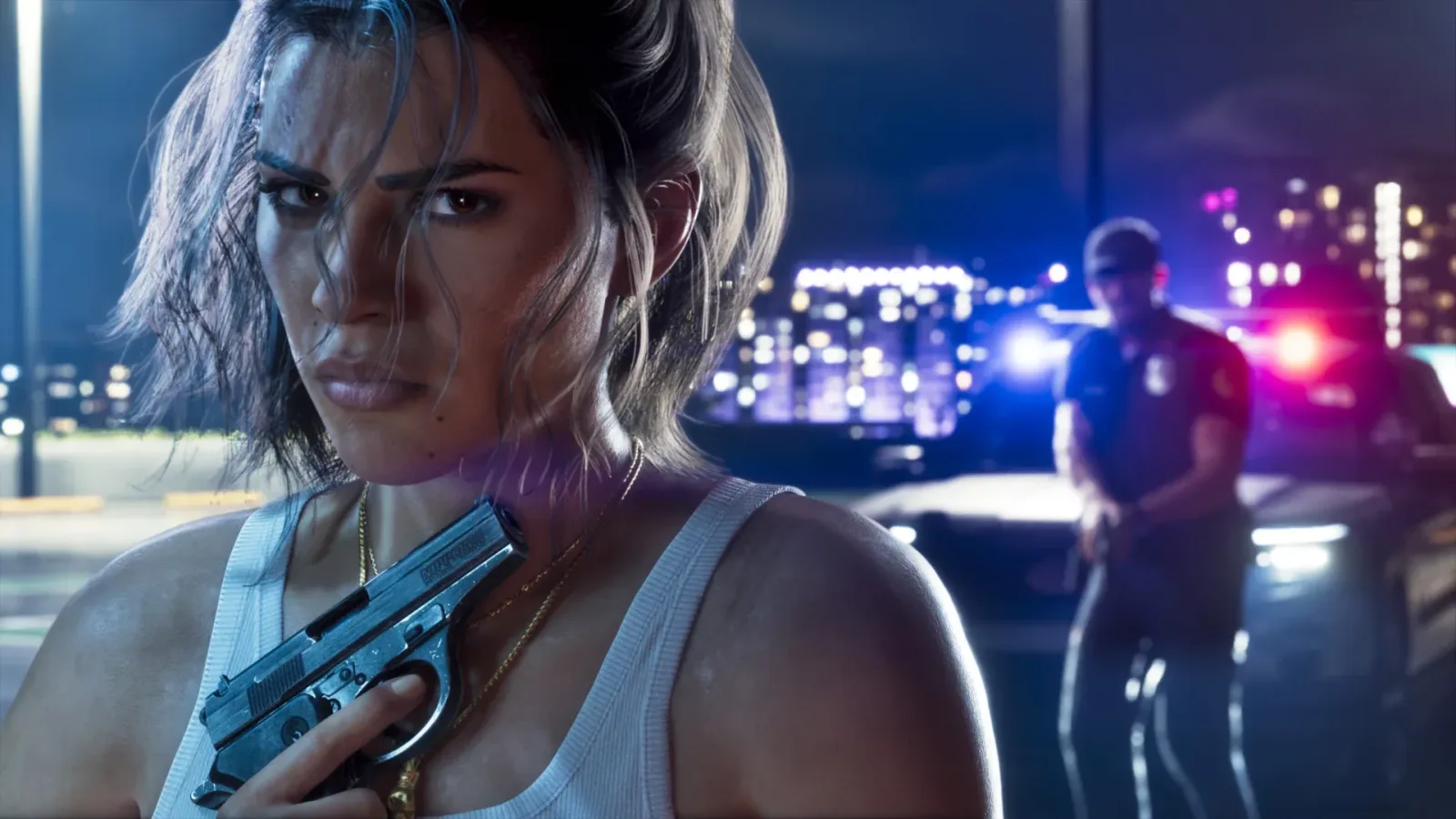
Grand Theft Auto 6 has found an answer to a small question that has quietly followed the series for decades: why can the player always hear police radio chatter after committing a crime? The feature has been a staple of Grand Theft Auto since the original game, providing reports on the player's actions, descriptions, and last known location during encounters with law enforcement. In GTA 6, however, that information is no longer treated as a purely player-facing gameplay aid.
Early in the game, Jason's friend Cal, described as both a hacker and a stoner, installs a custom homebrew police scanner program on Jason's phone. From that point forward, Jason can hear the police communications tracking his crimes and movements. The result is a relatively modest story moment with a surprisingly large implication: Jason himself knows what the authorities are saying, rather than the player receiving information that exists outside the world of the game.
Lucia later has access to the same kind of police scanner app when GTA 6 allows players to explore as her. The game does not show Cal setting up the software on her device, but the shared functionality means both protagonists can react to police reports during their escapes.
A familiar GTA convention becomes part of the fiction
Police radio audio has long been one of Grand Theft Auto's most recognizable pieces of feedback. A crime triggers a response, dispatchers relay a description, and patrol units are directed toward the suspect. It has helped make pursuits feel more immediate while also telling players how much attention they have attracted.
For useful background on this topic, read GTA 6 Map Crossing Test Takes More Than Three Hours on Foot.
Earlier games did not generally pause to establish why their protagonists could hear these transmissions. Players controlling characters such as Tommy Vercetti or Carl "CJ" Johnson could receive law-enforcement updates without being shown a scanner, radio interception device, or other explanation. That was easy enough to accept as a convention. Video games regularly provide information to players that the characters may not literally possess, especially when that information supports navigation, mission clarity, or moment-to-moment action.
GTA 6 takes a different approach. By placing a scanner app on the protagonists' phones, it grounds the old feature in the setting and makes it an explicit tool available to Jason and Lucia. The change does not radically alter what police chatter does for the player, but it changes how that chatter fits into the narrative.
Rather than hearing an abstract dispatch feed, players are hearing something the characters are also listening to. That distinction lets the protagonists respond naturally when law enforcement identifies their vehicle, notes what they are wearing, or updates the search area. Their knowledge is no longer something that needs to be mentally separated from the player's knowledge.
Why the scanner matters during escapes
The explanation is more than a throwaway bit of flavor. Police transmissions matter during chases because they can indicate whether the authorities have connected Jason or Lucia to a particular car or recognizable outfit. Those details are useful when deciding how to shake pursuit, and GTA 6's framing means the characters have a clear reason to make decisions based on that information.
If the police have circulated a description of a vehicle, abandoning or changing that vehicle becomes a sensible response within the world. If clothing has been identified, changing appearance can similarly be understood as an informed attempt to avoid detection. The scanner concept connects the player's tactical choices to the protagonists' awareness in a direct way.
That is an important difference from a traditional heads-up display or invisible mission prompt. Those systems can still be effective, but they often exist outside the fiction. A phone app is a natural fit for a modern Grand Theft Auto setting, particularly one built around characters who can carry an everyday device while moving through the world. It provides a believable delivery mechanism for information that the series has always considered useful.
The setup also supports dialogue during high-pressure moments. When Jason and Lucia refer to a police report while trying to escape, the conversation has a basis in the game's world. They are not somehow reacting to a message that only the person holding the controller can hear. The scanner turns police chatter into shared information between player and protagonist.
A small detail with a long series history
Grand Theft Auto has never been a series that depends on strict realism in every system. Its worlds are intentionally exaggerated, and many of its mechanics are designed first for readability, comedy, or momentum. Players can accept unusual rules because they make the games more playable: characters can recover from situations that would end a real person's story, the world can reset after chaos, and systems can communicate exactly what a player needs to know at any given time.
That makes the scanner app notable precisely because no explanation was strictly necessary. The police radio could have remained one more accepted game convention. Instead, GTA 6 spends time acknowledging it and fitting it into the characters' lives.
It is the kind of world-building choice that does not demand attention from every player, but rewards those who have spent years with the series. Veterans will recognize the familiar audio immediately. Newer players simply receive a clear explanation of why their characters can listen in on law-enforcement communications. Both groups get the same practical information, but the game now gives that information a narrative home.
The decision also reflects how long-standing series mechanics can evolve without being discarded. GTA 6 is not replacing the police radio format with an entirely new pursuit system. It is retaining a recognizable piece of Grand Theft Auto's identity while adding context that previous entries left unstated.
Cal's role makes the idea feel specific
Having Cal install the app gives the explanation personality. A generic menu notification stating that Jason has acquired a police scanner would have established the same basic fact, but tying it to Jason's hacker friend makes the feature feel like an extension of the cast and their skills. It is not presented as official consumer software; it is custom, homebrew technology passed along by someone with the know-how to create or obtain it.
That detail helps sell the premise. Listening to police traffic is not framed as a miraculous ability or an unexplained convenience. It is a questionable but plausible piece of illicit tech in the hands of people who can benefit from it. The app's presence also suits Grand Theft Auto's recurring interest in criminal tools, improvisation, and using available technology to stay ahead of the authorities.
Lucia's access to the app extends the logic to the game's dual-protagonist structure. Although the installation is not shown on screen for her, the fact that she can use the scanner ensures that both playable leads can operate with the same awareness during free-roam play and police encounters.
An unusually grounded answer to a game-like question
The police scanner is not likely to be the defining feature of GTA 6, and it does not need to be. Its value is in how neatly it resolves a familiar bit of video-game logic. For years, players could reasonably assume that police dispatch audio existed for them alone. GTA 6 instead says that Jason and Lucia hear it too.
That simple clarification makes pursuit dialogue, vehicle changes, clothing changes, and escape planning feel more connected. It creates a shared perspective between the player and the protagonists while preserving the tense, informative police chatter that has been part of Grand Theft Auto from the beginning.
For a franchise known for massive cities, criminal empires, and spectacular chaos, it is a surprisingly small piece of design. But it is also a smart one: a decades-old gameplay convention has been given an in-world explanation, and GTA 6 uses that explanation to make its characters' reactions during a chase feel more natural.
Community
Discussion
Start the conversation.
No comments have been posted yet.