

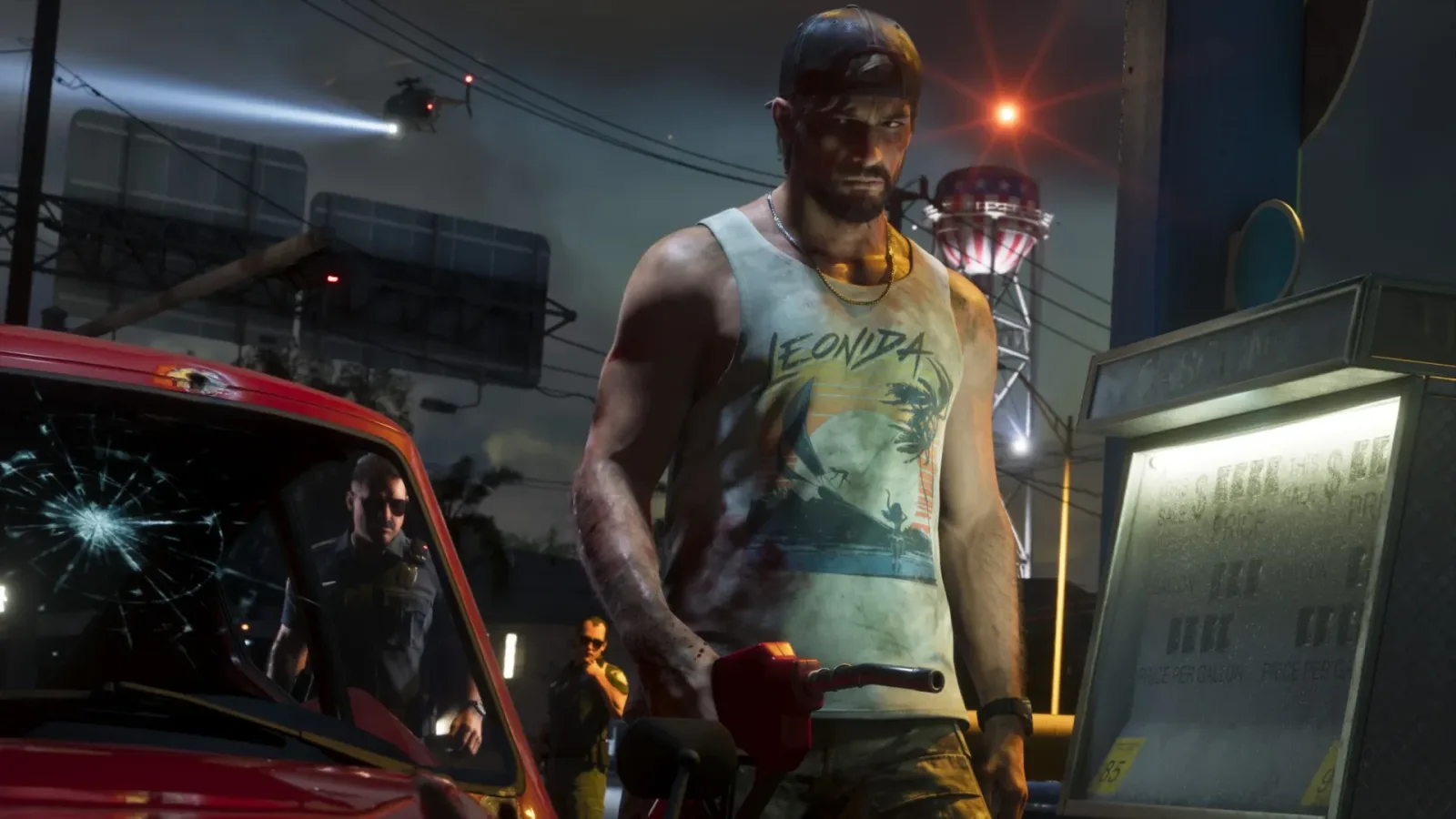
Grand Theft Auto 6 reportedly takes an unusual approach to life after the main story. Rather than simply placing players back into the world after the final mission with the narrative consequences intact, Rockstar Games' next open-world crime epic is said to return players to a key point immediately before the finale begins.
The design means players should not feel pressured to clear every icon, activity, race, side mission, and encounter from the map before advancing toward the story's conclusion. After the credits, players can reportedly resume their adventure from the moment when protagonists Jason and Lucia are given the choice to commit to the final stretch of the game. This time, they choose not to proceed, leaving Vice City open for further exploration and unfinished business.
It is a notable variation on a familiar Rockstar formula. Rockstar's games have commonly allowed players to continue roaming after a campaign ends, but the way that freedom is framed has differed considerably from game to game. GTA 6's reported solution seems designed to preserve both a definitive finale and a broad open-world endgame without forcing the game to account for every possible narrative outcome in later side content.
A major point of no return, with a safety net
The reported structure begins when players approach GTA 6's final mission. Before entering it, the game reportedly gives unusually clear warning that moving ahead means beginning the conclusion. That warning matters in a game described as packed with story missions, optional missions, random events, activities, and races. For completion-minded players, a visible point-of-no-return prompt can remove much of the anxiety that often accompanies an endgame mission in a large RPG or open-world adventure.
For useful background on this topic, read GTA 6 Gives a Long-Running Police Radio Feature an In-World Explanation.
One playthrough account placed the arrival at that final threshold at roughly 90 hours, underlining the apparent scale of the campaign and its surrounding distractions. Naturally, completion time will vary greatly depending on how players approach Vice City, how much time they spend on optional content, and whether they focus directly on main missions. Still, the account suggests the game's finale comes after a substantial journey rather than a brief closing chapter.
Once the multi-mission ending sequence has been completed and one of the game's main endings has played out, the reported post-credits state does not continue chronologically beyond those events. Instead, the game returns to the pre-finale decision point. Jason and Lucia decline to move forward, then head back into Vice City, effectively restoring the player to an open-ended version of the world before the conclusion becomes locked in.
The final mission marker reportedly remains available on the map in that restored state. Players can therefore return to the finale whenever they are ready, whether they simply want to replay the ending or hope to make choices that lead to a different result. That is especially important because GTA 6 is said to feature more than one main ending, with at least two outcomes described as dramatically different in tone and execution.
How it differs from earlier Rockstar post-games
Rockstar has experimented with post-story freedom before, though not always in the same fashion. In Grand Theft Auto IV, players can continue to play as Niko Bellic after the main story ends. The world remains accessible, allowing remaining activities and side pursuits to be completed while the campaign's conclusion remains part of the game's timeline.
Grand Theft Auto V also supports continued free-roam play after its central story, allowing players to revisit Los Santos and pursue remaining content. In both that game and much of the broader GTA series, the post-game traditionally feels like an extension of the existing save file: the story has happened, the world is still there, and players are free to carry on.
Red Dead Redemption 2 handles the idea differently again. Its epilogue changes the playable character and uses that shift to give the game a meaningful narrative continuation after the central credits sequence. That approach lets the world move forward, but it also ties endgame exploration to a new status quo and a different perspective.
GTA 6's reported rewind method does neither of those things exactly. It does not appear to advance the timeline into a new epilogue, and it does not simply leave Jason and Lucia in a world that must acknowledge every possible final outcome. Instead, it creates a deliberate narrative holding pattern. The protagonists remain at the edge of the ending, while the player gets all the time needed to explore, collect, race, experiment, and work toward total completion.
Why a reset may make sense for a branching ending
The apparent trade-off is that the post-game world may feel frozen in time. If several endings can take the story in substantially different directions, adding a major new chain of missions after the finale would be difficult. Any substantial new storyline would need to recognize whichever ending the player saw, avoid contradicting the others, and potentially account for major changes in the characters' circumstances.
By returning to the moment before the final sequence, Rockstar can avoid that problem. Side activities can remain stable, Jason and Lucia can continue to exist in a version of Vice City that works for every player, and the finale can still deliver outcomes with real contrast. The game is not required to build a sprawling post-ending narrative branch for each possible conclusion.
For some players, this may be less emotionally seamless than exploring a world permanently changed by the story's climax. A conventional post-game can make an ending feel final because the player lives with its aftermath. The rewind-style structure instead asks players to regard free-roam as an opportunity to finish everything before definitively closing the book.
That may be a fair exchange in a game as large as GTA 6 is expected to be. Open-world players often arrive at a finale with a map full of incomplete tasks, either because they stayed focused on the story or because new activities continued to appear throughout the campaign. A reset to the pre-finale world means none of that content needs to be sacrificed, and no one needs to spoil the ending for themselves by delaying every major mission until the map is empty.
Completion and cheats reportedly open after finishing the story
The post-game loop is said to include more than casual free-roam. Completing the final mission reportedly unlocks access to the path toward 100 percent completion. That suggests the game reserves at least some broader completion progress for players who have seen an ending, even if the map itself can still be explored before that point.
Challenges are also reportedly tied to the return of in-game cheat codes. Players who complete the relevant objectives can apparently reveal cheats that allow for more chaotic experimentation around Vice City. Rockstar games have long had a history of cheats that turn free-roam into a sandbox for stunts, mayhem, unusual vehicles, and rule-breaking play, so connecting their discovery to endgame challenges could give completionists another reason to remain in the city after the story is finished.
The exact scope of those cheats, their unlock requirements, and whether they affect progress have not been detailed here. Players should therefore avoid assuming that every classic GTA-style modifier will be present or that the system works exactly like previous entries. What is clear from the reported structure is that the game's final credits are not meant to be a hard stop.
What players should take away
The most practical implication is simple: there appears to be no need to exhaust GTA 6's map before accepting the final mission. Players who want to reach the ending can do so, then return to Vice City in a pre-finale state to chase unfinished objectives. Those who want to preserve a particular ending as their final memory can still make that last trip to the mission marker once all other priorities are complete.
This arrangement also gives players a reason to revisit the finale. With the mission marker still present and multiple endings reportedly possible, the conclusion is not necessarily a one-and-done event. It becomes a repeatable destination in the world, while the rest of the game remains available as a broad playground for Jason and Lucia.
GTA 6's endgame may not push its timeline beyond the finale in the way some players expect, but that restraint appears purposeful. Rockstar seems to be prioritizing player freedom, alternate outcomes, completion goals, and the ability to keep enjoying Vice City without making a single ending canon inside an ongoing post-game world. For a huge open-world game with a potentially divergent conclusion, it is an elegant way to let the credits roll without telling players their time in the city is over.
Community
Discussion
Start the conversation.
No comments have been posted yet.