


Grand Theft Auto 6 may be built to consume months of a player's free time, but reviewing a game of that scale means experiencing it under a very different set of conditions. One reviewer who spent several weeks with Rockstar Games' latest open-world crime epic logged around 120 hours on the game's own counter before writing a final verdict, yet still came away convinced that enormous sections of Leonida remained unseen.
That tension sits at the center of reviewing a release with GTA 6's scale and profile. The game's story can be completed, its systems can be tested, and a substantial portion of its activities can be explored. But a deadline does not stop simply because a simulated state has more roads to drive, mysteries to find, and side activities to master. For a game positioned as one of the decade's defining entertainment launches, the task is not merely reaching the credits. It is deciding when enough has been seen to make an informed judgment while accepting that no single person can exhaust every possibility before publication.
The reviewer, who had played every Grand Theft Auto entry, including the PlayStation 1-era games, described the GTA 6 assignment as a demanding balancing act rather than a leisurely trip through a huge virtual world. Having also reviewed Grand Theft Auto 5 in 2013 and attended Grand Theft Auto 4's midnight launch, they arrived with an unusually long history with the series. That background helps give perspective to the particular pressure surrounding GTA 6: it is a sequel that has been anticipated for years, scrutinized intensely, and expected to be discussed the instant reviews become public.
Reviewing a world designed to distract you
The central enemy, in the reviewer's words, is time. Review embargoes establish a hard point at which coverage can be published. Critics need to have their work ready by then, particularly on a release where readers are eager to learn whether the game meets the extraordinary expectations around it. Even when early access lasts multiple weeks, those hours have to be divided between playing, taking notes, testing features, writing, sleeping, eating, and handling the ordinary responsibilities that do not disappear for a major game launch.
For useful background on this topic, read GTA 6's 'Bimyou' Café Has Japanese Players Laughing at a Sharp Restaurant Joke.
That process naturally changes how an open-world game is played. In a normal personal playthrough, a player might spend an evening driving without purpose, chasing a minor collectible, replaying an activity, or simply spending time with protagonists Jason and Lucia. During review, every detour raises a practical question: is this important enough to justify the time it takes away from mission progress, system testing, and the final written assessment?
GTA 6 makes that question more complicated because some apparent downtime is not simply decorative. The game includes moments where players can sit with Lucia on the couch, watch in-universe television, or play fictional video games. Those interactions contribute to the texture of the world and the relationship between its central characters. They may seem easy to postpone when a deadline is approaching, but they are part of the experience a review needs to understand.
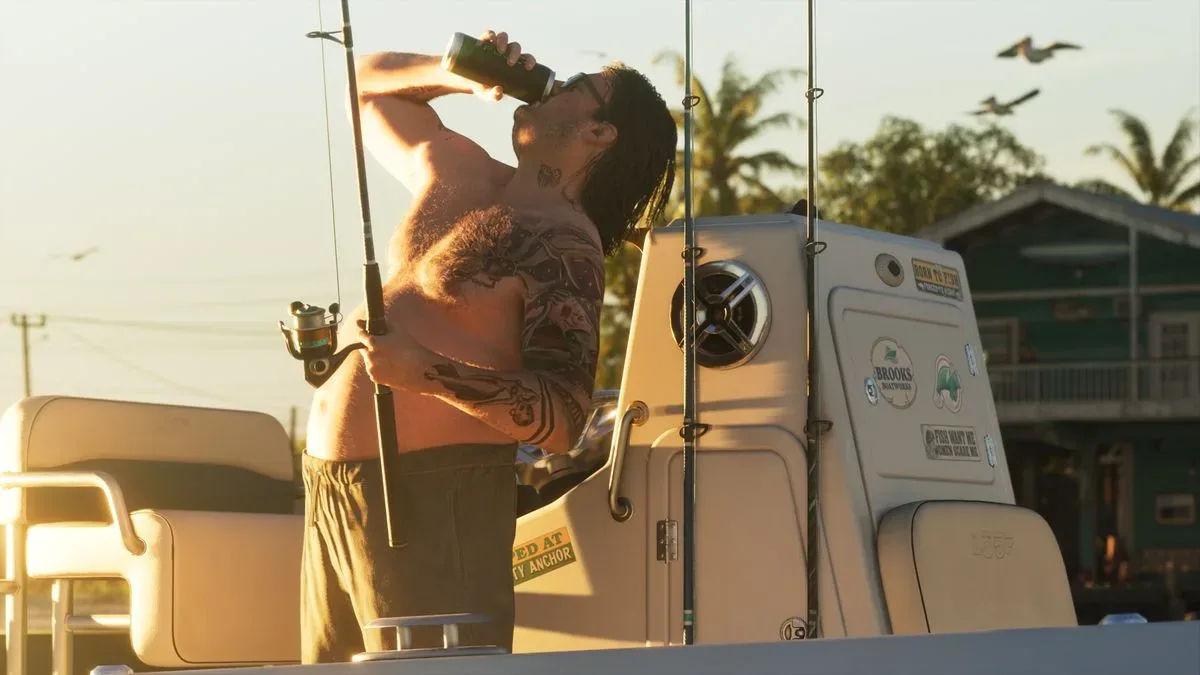
More importantly, leisure activities can have real mechanical value. The reviewer identified Focus as GTA 6's most useful skill, while also calling it the most difficult one to improve. Raising it often involves activities that demand attention and time: minigolf, shooting-range sessions, meditation, and fishing. A critic racing toward the finish line may be tempted to prioritize major missions, but skipping those pursuits would also mean overlooking how the game encourages players to build their characters and engage with the wider world.
120 hours, a finished story, and 80% completion
By the point the GTA 6 review was written, the in-game tracker showed roughly 120 hours of play. The PlayStation 5 system clock, however, reportedly recorded considerably more time than that. The discrepancy is a useful reminder that a review's playtime number is not always a complete account of the work involved. Menus, repeated attempts, testing, pauses, note-taking, and the broader process of examining a game can all make the real commitment larger than a single save-file figure suggests.
At that stage, the main story was complete and overall completion had reached 80%. In many games, that would represent a remarkably comprehensive tour. In GTA 6, it still did not mean the reviewer had encountered everything worth seeing. After the verdict had been filed and the game had launched, further exploration led to a remote part of the map that seemed to have little obvious reason to visit. There, the reviewer was pulled into a strange, elaborate scripted encounter that became one of their favorite moments in the entire game.
That anecdote captures one of the enduring appeals of Rockstar's open-world design. The most memorable discovery is not always placed directly on the critical path or signposted as major content. It can emerge from a curious turn down an unfamiliar road, a decision to investigate an isolated area, or a willingness to travel somewhere the game has not explicitly asked the player to go. For players, that unpredictability can make a world feel alive. For reviewers, it also means recognizing that a final score or verdict reflects a substantial but necessarily incomplete encounter with an enormous game.
The reviewer was clear that, even after more than 120 hours, the story ending, and 80% completion, there was still much to discover and master in Leonida. That does not diminish the value of a review; rather, it explains the standard a critic must meet. The goal is to assess the main campaign, key systems, technical performance, activities, characters, pacing, and the world's overall design with enough breadth and depth to form a reliable opinion. Total completion is a different kind of undertaking, one that can require far more time than an embargo schedule permits.
The small moment that made Leonida feel real
The first indication that GTA 6 had achieved something special did not arrive through a huge story set piece. Instead, it came from a minor mishap in the Keys involving Jason's old Vapid '70 Ganado. Early in the game, the reviewer spent their limited cash modifying the vehicle, adding fresh paint and engine improvements. Soon after leaving the mod shop, another driver made an illegal turn and collided with the car.
The reaction was telling. Rather than treating the collision as a disposable open-world inconvenience, the reviewer pulled over, stepped out, inspected the damage, and felt frustrated that the newly spent money now seemed wasted. In that instant, the virtual car had stopped being an interchangeable tool for getting between missions. It had become something the player had invested in and cared about.
That is a small but potent expression of immersion. Open-world games often aim to create a sense of ownership through money, upgrades, vehicles, property, progression, and relationships. GTA 6's vehicle incident appears to have made those systems feel immediate enough that an unexpected traffic accident carried genuine emotional weight. The reviewer said that sensation of being drawn into the game's reality arrived only a few hours in and did not truly fade afterward.
Why the review deadline still matters
There is an understandable temptation to ask why a reviewer would not wait until every side activity, corner of the map, and emergent encounter has been found. The answer is that criticism and completionism serve different purposes. A review is meant to help players understand a game at launch: what it does well, where it struggles, how it feels to play, and whether its most important ambitions succeed. It must be published while that information is useful to people deciding whether to play.
For a release such as GTA 6, deadlines are especially unforgiving because the scale of public interest is so immense. Waiting for 100% completion could mean withholding an assessment for an impractical length of time, while the conversation has already moved forward. The reviewer's experience demonstrates the compromise involved: invest extraordinary time, cover the story and a wide range of systems, push deeply into the world, and be candid about what remains beyond the horizon.
For players beginning their own journeys through Leonida, the 120-hour account offers a reassuring prospect. Reaching the credits is not presented as the end of GTA 6's possibilities. Nor is reaching 80% completion. There are apparently still odd corners, surprising scripted events, skills to improve, and quieter character moments to experience. GTA 6 may demand intense focus from anyone reviewing it before launch, but its larger promise is that players will be able to slow down afterward and discover the parts that a deadline cannot accommodate.
Community
Discussion
Start the conversation.
No comments have been posted yet.