

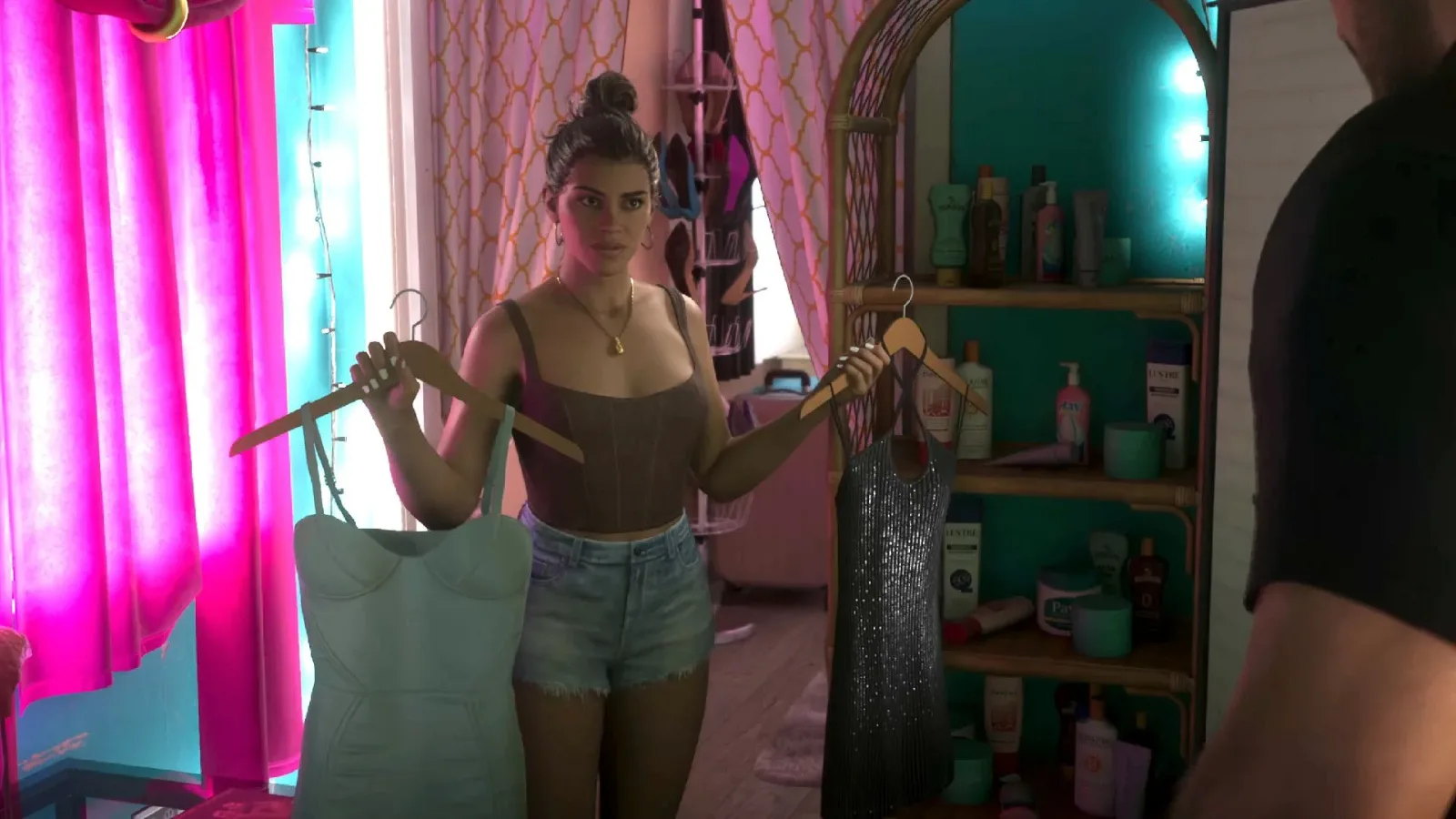
Grand Theft Auto 6 has been shown running at 30 frames per second throughout its trailers, and that presentation is now looking less like a temporary showcase limitation and more like a fundamental technical target for the game's current-console versions. While many players had hoped that more capable hardware, particularly PlayStation 5 Pro, might open the door to a 40fps or 60fps option, a prominent technical analyst believes Rockstar's apparent 30fps cap is a sensible result of the game's unusually demanding design.
The central issue is not simply image quality or graphics processing horsepower. GTA 6 is expected to feature a huge open environment filled with traffic, pedestrians, physics, AI routines, streaming data and the kind of unpredictable systemic interactions Rockstar is known for. Those demands place intense pressure on a console's CPU, and that is an area where the difference between the base PlayStation 5 and PS5 Pro is far less dramatic than the gap in their graphical capabilities.
Richard Leadbetter, speaking during a technical discussion, argued that the 30fps target should be viewed through the development constraints behind every rendered frame. For players, the difference between 30fps, 40fps and 60fps is usually discussed in terms of motion clarity and controller response. For developers, though, each target represents a strict time limit in which the entire game must update and produce its next frame.
Why frame time matters more than the number alone
At 30fps, a game has roughly 33.3 milliseconds to complete the work required for each frame. That work includes rendering the image, but it also covers the game world itself: AI decision-making, physics, animation, input processing, environmental simulation, streaming in assets and handling all the background systems that make an open world feel alive.
For useful background on this topic, read GTA 6 Confirms Manni L. Perez as Lucia Through The Game Awards 2026 Nomination.
That 33.3ms budget may sound abstract, but it is the key to understanding why a leap from 30fps to 60fps is not a straightforward matter of turning down a few visual settings. A 60fps mode provides only around 16.7ms per frame. In practical terms, the game must do almost the same overall work in half the time.
That can be achievable in games where the workload is dominated by GPU rendering and where developers can scale back resolution, shadows, ray tracing, foliage density or similar visual features. But GTA 6's challenge may be more deeply rooted in simulation. Reducing the resolution does not automatically make crowds think faster, traffic systems update faster, or a busy city's underlying world logic run faster.
Leadbetter's assessment is that Rockstar has likely determined it needs the full 30fps budget for the experience it wants to deliver. If that is the case, a conventional 60fps performance mode would not merely require a softer image or fewer visual flourishes. It could demand significant compromises to the density, complexity or consistency of the world itself.
PS5 Pro's extra GPU power may not solve the bottleneck
PlayStation 5 Pro has delivered improvements in a range of existing games, including higher resolutions, enhanced image reconstruction, improved ray-traced effects and, in some cases, higher frame-rate modes. That makes it understandable that GTA 6 players would look to the upgraded console as the most likely candidate for a smoother option.
However, more GPU power is most useful when rendering is the primary limitation. An open-world game can instead be constrained by CPU performance, especially when it has to maintain a large number of active systems at once. GTA games are not just scenic driving tours; their appeal relies heavily on NPC behavior, vehicles, law enforcement responses, mission scripting, destruction, world streaming and countless player-driven interruptions to the intended flow.
The PS5 Pro does have some CPU-related advantages, but they are modest compared with its graphical uplift. That distinction matters. If Rockstar's 30fps target is being set because the CPU needs close to 33.3ms to simulate a particularly busy scene, a stronger GPU alone cannot reliably transform that scene into one that completes in 25ms for 40fps or 16.7ms for 60fps.
Consistency is also crucial. A performance mode is only worthwhile if it can sustain its promised target under demanding conditions. A game might run above 30fps while driving through a quiet area, then fall sharply when a player creates chaos in a crowded street, triggers a large police pursuit or enters a mission full of scripted activity. For a systemic sandbox built around the possibility that almost anything can happen, designing around worst-case scenarios is likely more important than achieving higher numbers in calmer moments.
Why 40fps is appealing--and still a major hurdle
A 40fps mode has become a popular compromise in big-budget console games, especially for players with 120Hz displays. It offers noticeably better motion and responsiveness than 30fps, while allowing developers to retain more of the visual richness that might be sacrificed for 60fps.
It is easy to see why GTA 6 at 40fps sounds appealing. Rockstar's games emphasize cinematic presentation, detailed worlds and visual atmosphere, all of which can benefit from a quality-focused approach. At the same time, driving, shooting and rapid movement generally feel more immediate when frame rates rise. A 40fps mode would seem to offer an attractive middle ground.
But 40fps is not just "10 frames more" than 30fps. The required frame time drops from approximately 33.3ms to 25ms. That means every frame has to be completed about 25 percent faster. It is a substantial reduction in available processing time, not a minor tuning adjustment.
Leadbetter described the optimization or cutbacks needed to reach that 25ms budget as significant. In a title as ambitious and densely simulated as GTA 6, developers would need to identify where that time could be saved without causing unacceptable changes elsewhere. Lowering visual resolution may help the GPU, but it may not meaningfully reduce CPU-heavy world simulation. Cutting back on the systems that create a convincing, reactive city could conflict with the core promise of a new Grand Theft Auto.
120Hz displays explain the interest in 40fps
Most console frame-rate targets have traditionally centered on 30fps and 60fps because televisions commonly refresh at 60Hz. Those targets divide neatly into a 60Hz refresh cycle: a 60fps game displays a new frame every refresh, while a 30fps game displays a new frame every two refreshes.
Frame rates that do not divide evenly into the display refresh can create uneven frame pacing and visible judder. The rise of 120Hz television panels has changed the equation. At 120Hz, 40fps divides evenly, with each game frame shown for three screen refreshes. This allows 40fps to appear smooth and consistent in a way that is not normally possible on a standard 60Hz display.
As more premium televisions and console games have adopted 120Hz support, 40fps modes have become an increasingly valued feature for enthusiasts. They do not replace a full 60fps performance option for players who prioritize responsiveness above all else, but they can be an excellent choice in graphically intensive single-player games.
That context makes the apparent absence of a higher-frame-rate GTA 6 option more disappointing for some players. Yet it also illustrates how demanding Rockstar's project may be. If 40fps cannot be delivered consistently without major concessions, then a stable 30fps presentation may be preferable to an uneven mode that performs well only under ideal conditions.
A stable target may be Rockstar's priority
For now, the discussion is less about whether 30fps is universally preferred and more about what the target suggests regarding GTA 6's technical ambitions. The game appears to be aiming for a world with substantial visual detail and a high degree of systemic complexity. That combination is expensive, particularly on hardware that has to support a massive open environment while maintaining reliable gameplay across unpredictable player behavior.
There will inevitably be players who would accept lower resolution, reduced effects, thinner crowds or other compromises in exchange for 60fps. Others will prefer Rockstar to preserve the maximum density and presentation available on PlayStation 5 and Xbox Series X, even if that means playing at 30fps. Both preferences are understandable, and the debate will likely continue until players can test the final game for themselves.
What the frame-time analysis makes clear is that GTA 6's performance question cannot be reduced to GPU specifications or a simple comparison with other PS5 Pro-enhanced games. If the game is CPU-limited by the complexity of its world, higher frame rates demand far more than extra graphical power. They require Rockstar to make the simulation itself complete more quickly, or to reduce the amount being simulated.
That is why the 30fps cap can be interpreted as a design decision rather than a missed setting. For a game built around a dense, reactive and potentially chaotic open world, the safer choice may be to preserve the experience at a stable 30fps rather than risk compromises or instability while pursuing 40fps or 60fps on current consoles.
Community
Discussion
Start the conversation.
No comments have been posted yet.