

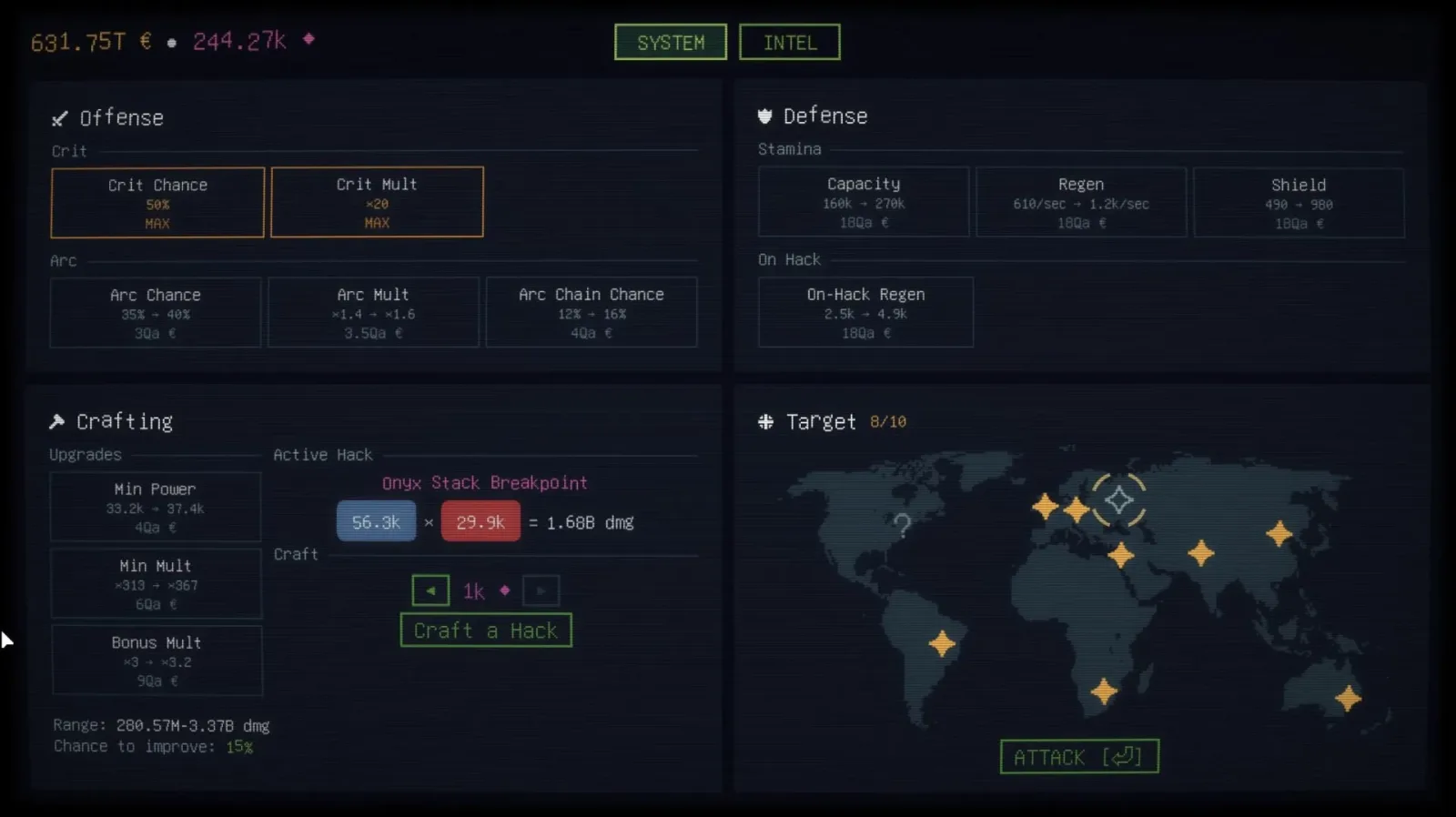
Hack 42 is built around a combination that sounds almost deliberately strange: it is an incremental game in which the core action is typing. Rather than repeatedly clicking an icon or waiting for an idle economy to tick upward, players type their way through digital networks, crack nodes, extract money, buy upgrades, and gradually transform a demanding keyboard challenge into an increasingly automated machine.
It is a small-scale concept with an appropriately focused run time, lasting roughly three hours, but it finds plenty of room for escalation. The starting point is familiar to anyone who has spent time with games built on ever-rising numbers: make a little money, spend it to improve efficiency, then use that efficiency to make vastly more money. Hack 42 gives that loop a more active twist by making typing accuracy the skill that initially determines how far a player can get.
A hacking game driven by the keyboard
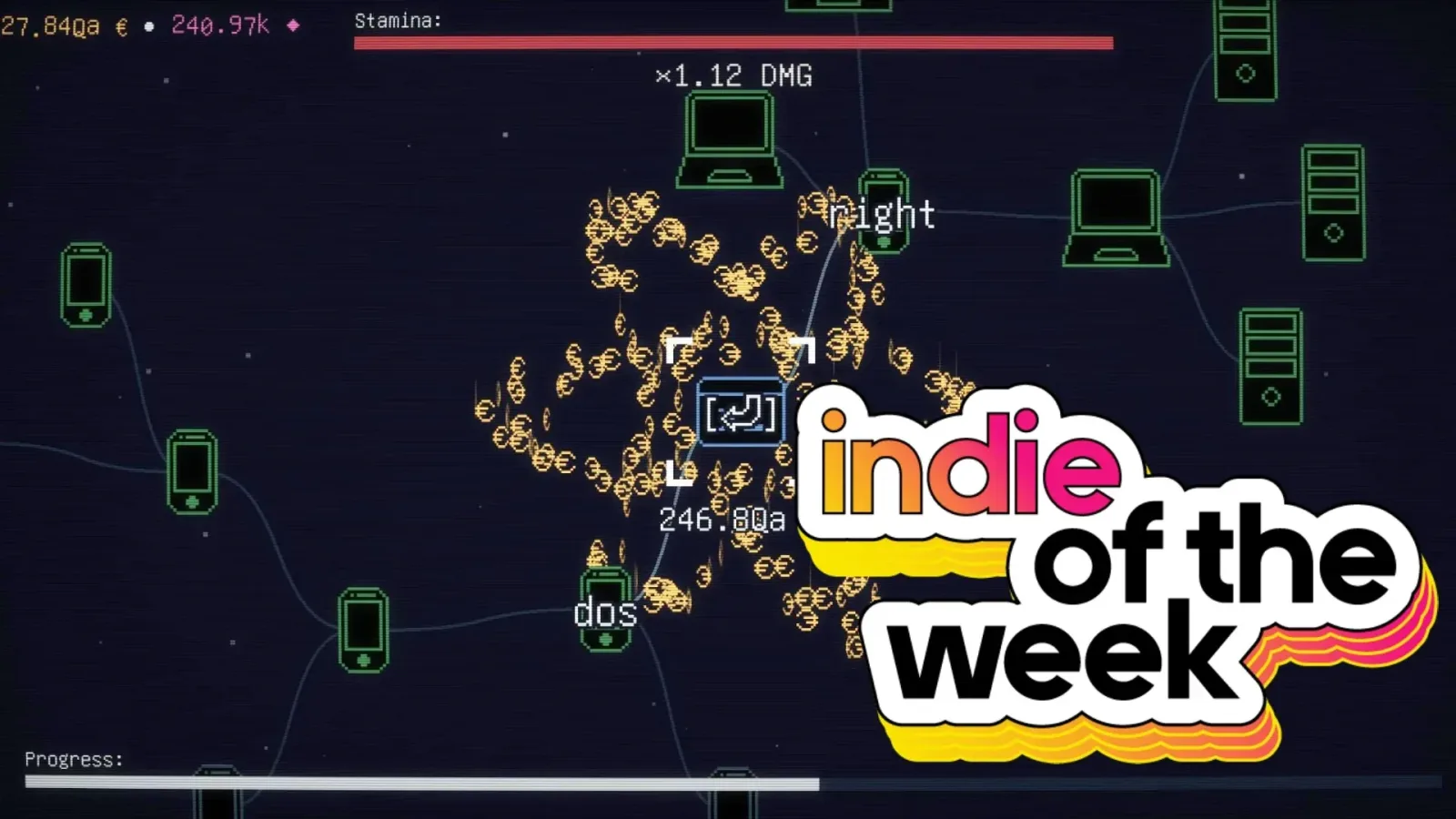
The premise sends players into systems tied to different nations, where the objective is to breach infrastructure and take the money within. Each hacking sequence is presented as a network of nodes. A node becomes available when the player accurately types the word, phrase, or technical term attached to it, and opening nodes creates routes to further targets.
There is an immediate reward for every successful entry, since cracked nodes provide cash. But the hacking runs are not simply a speed test. They are governed by stamina, a resource that turns each server intrusion into a balancing act. Typing consumes stamina letter by letter, while successfully unlocking nodes replenishes some of it. This makes clean execution valuable: errors cost time and resources, and a sequence of mistakes can put a promising run in danger.
For useful background on this topic, read GTA 6 jet Guide: How to Raid Mile Zero Air Station and Escape the Military.
The stakes are especially clear because a player who exhausts stamina before leaving a server loses the money earned during that attempt. That structure encourages care rather than frantic button mashing. A difficult term can become surprisingly stressful when a failed entry threatens an entire haul, particularly when the vocabulary shifts away from everyday language and toward technical jargon.
Hack 42 leans into that friction. Its word lists include acronyms, Linux-adjacent terminology, and other intentionally nerdy phrases that can catch even confident typists off guard. A common word may flow almost automatically from recognition and muscle memory, while an unfamiliar technical string forces a player to slow down and consciously locate each key. The game gets much of its tension from the gap between those two experiences.
Incremental progression with more than one layer
Once a hacking run pays out, the money can be invested in a large set of abilities and upgrades. The most essential improvements increase the effectiveness of typing itself, making nodes easier to break through and helping players push deeper into more demanding systems. That is where Hack 42 connects most directly to the modern incremental formula: every gain feeds the next gain, and modest early progress eventually becomes absurd output.
However, the game does not limit its progression to the hacking screen. A separate system asks players to type pairs of letters in order to release fragments. Those fragments are decoded into cells, represented by pink diamonds, which become another important part of the wider upgrade economy.
At first, this secondary process is another hands-on typing task. As players unlock more improvements, though, it changes character. The process can be optimized and ultimately automated, reaching the point where hundreds of cells can be generated every second without direct input. That shift from manual labor to self-sustaining production is central to the appeal of the genre, and Hack 42 uses it to make players feel the contrast between its tense beginnings and its much more powerful late-game state.
The progression continues through a sequence of nations. Completing one hack opens a more difficult challenge, giving the game a clear forward path while steadily raising the demands placed on both upgrades and player accuracy. The fiction may be knowingly exaggerated, but the growth curve is the real star: the player moves from earning tiny sums to dealing in figures that rise into the quintillions.
Why the incremental format fits
Incremental games have become a major fixture on PC storefronts because they are unusually good at delivering visible, constant progress. Their pleasures can be simple--watching values rise, clearing an upgrade tree, or reducing a formerly repetitive action to an automatic background process--but their best versions find a distinctive activity to put at the center of that loop.
Hack 42's distinction is that its initial action requires genuine concentration. The game does not begin by asking players to click endlessly on a single object. It asks them to type accurately under pressure, and then rewards them with systems designed to reduce the burden over time. That creates a satisfying narrative arc even without a lengthy campaign: the player begins as the person doing the work and ends as the architect of an efficient automated operation.
There is a useful irony in the design. The more effective a player becomes, the less they may need to perform the same repetitive tasks manually. The goal is not simply to become faster at typing forever; it is to build a collection of upgrades that changes what typing can accomplish and eventually handles parts of the work independently.
That is also why the game's short length is a strength rather than a limitation. A roughly three-hour incremental game can provide the key satisfaction of explosive growth without stretching a single loop beyond its welcome. Hack 42 has enough time to establish its typing-and-stamina challenge, expand into its cell system, and let automation take hold, then conclude before the escalation becomes routine.
Energy in the interface
The presentation helps sell the action. Hack 42's interface is notably responsive, with elements that move and react as words are entered. That kinetic feedback matters in a game where much of the interaction consists of pressing keys and looking at menus. It gives each successful input a sense of impact, helping the hacking screens feel more animated than a static series of text prompts.
The UI also supports the game's mix of silliness and clarity. Hacking national infrastructure to seize enormous quantities of money is intentionally over-the-top, and the march toward effectively taking over the world does not pretend to be a grounded simulation. Yet the underlying systems are readable: type to open nodes, manage stamina, secure the payout, and direct the proceeds into better tools.
That directness makes the game approachable even as its upgrade options expand. Players are not expected to master a realistic depiction of computer intrusion. Instead, the hacking theme provides a framework for a game about words, resource risk, and accelerating production. The fantasy is less about technical authenticity than the pleasure of becoming overwhelmingly efficient.
A small PC game with a clear hook
At $4, Hack 42 is positioned as a low-cost experiment for players interested in something outside the usual incremental playbook. Its premise will likely be especially appealing to people who enjoy typing tests, score-chasing challenges, compact indie games, or automation-heavy progression systems. The stamina mechanic also gives it an edge for those who want an idle-inspired game that still asks for attention and precision before the automation phase arrives.
It will not be for everyone. Players who dislike typing unusual terminology, who become frustrated by accuracy penalties, or who prefer long-running incremental games with weeks of optimization may find its focused format less appealing. The deliberately goofy hacking setup may also be part of the charm rather than a serious dramatic hook.
But Hack 42 understands exactly what it wants to be. It takes the familiar thrill of watching numbers grow and ties it to an unexpectedly tactile skill: knowing where the keys are when the pressure is on. From cautious node cracking to automated cell generation and astronomical earnings, it turns keyboard fluency into a satisfying route toward total digital dominance.
Community
Discussion
Start the conversation.
No comments have been posted yet.