

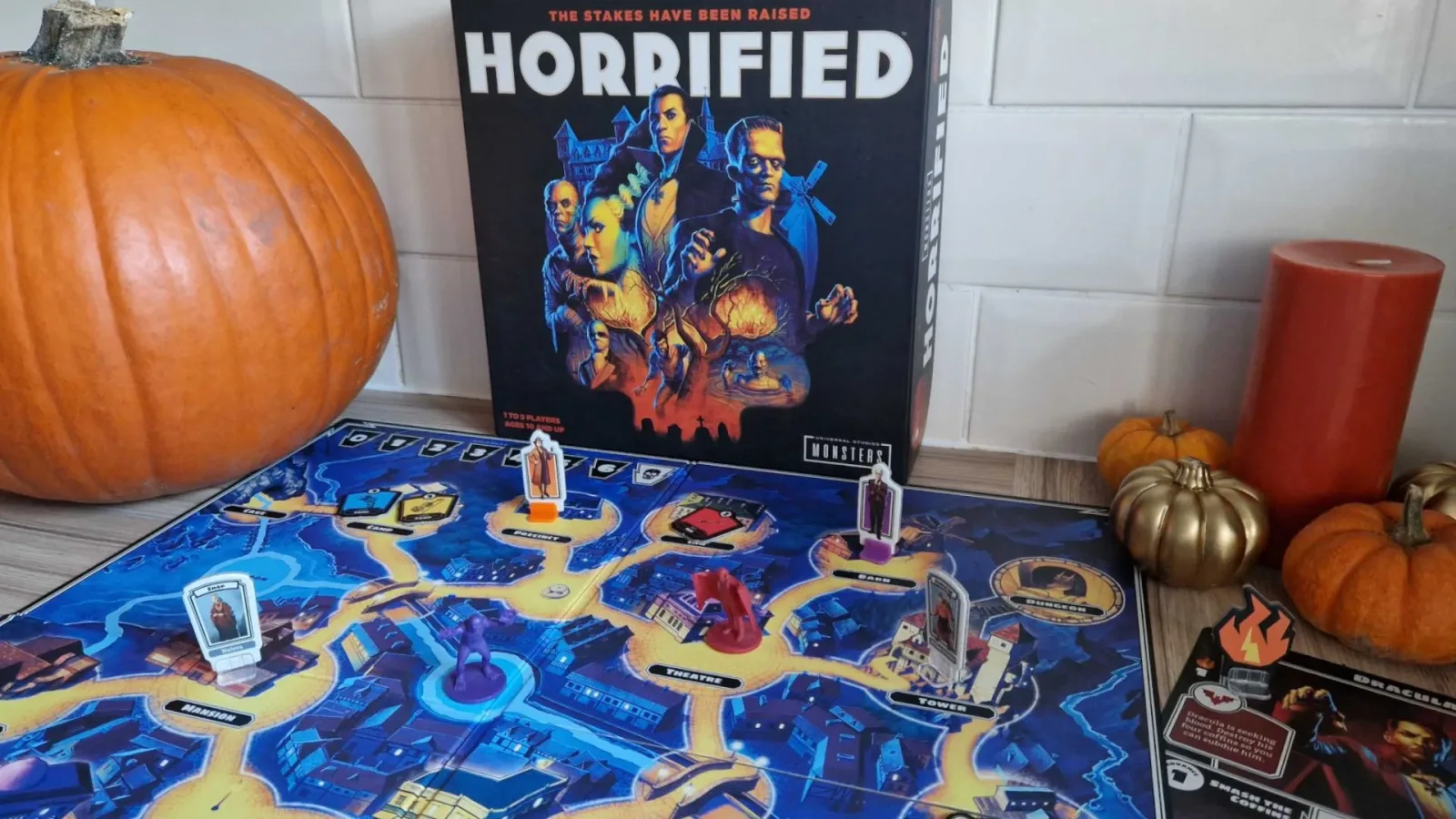
Halloween board games often face a difficult balancing act. They need enough atmosphere to feel appropriately spooky, enough strategy to keep experienced players invested, and rules simple enough that a family gathering does not turn into an evening spent buried in a rulebook. Horrified lands unusually close to that sweet spot. Its premise is immediately inviting: a group of players enters a gloomy, old-world village and attempts to save its citizens from a lineup of classic movie monsters.
The game's great strength is that it does not treat its horror theme as mere decoration. Dracula, Frankenstein's Monster, the Bride of Frankenstein, the Wolf Man, the Mummy, the Invisible Man, and the Creature from the Black Lagoon are not interchangeable enemies with different artwork. Each presents a different problem for the group to solve, turning every combination of monsters into a somewhat different cooperative puzzle.
Recommended for ages 10 and up, Horrified is positioned well for families with older children, as well as groups of friends looking for a lighter but still tense horror-themed game. It is not the most frightening option on the table, and it is not trying to be the most rules-heavy. Instead, it offers an accessible version of classic monster-movie peril, where every turn can force the team to weigh a valuable objective against the immediate need to rescue someone in danger.
A Universal Monsters village in trouble
Horrified's setting is as important as its cast. Players move through a gothic village filled with locations that sound pulled from a black-and-white creature feature: a looming castle, an institute, a windmill, and other ominous landmarks. Villagers appear across the map and require protection, while the monsters roam ever closer. The result is a board that immediately communicates what kind of story the table is creating. This is not abstract scoring or economic management; it is a desperate effort to keep a cursed town from collapsing into monster-fueled chaos.
For useful background on this topic, read Abxylute M5 and M6 Aim to Put Full Mobile Controls in Your Pocket.
That familiar setting also makes Horrified especially easy to introduce. Most players understand the basic stakes before a full explanation begins. Dracula is dangerous. The Invisible Man is difficult to track down. The Creature from the Black Lagoon belongs near the water. Even newcomers who have not spent much time with vintage horror movies can quickly grasp the broad identities of these villains.
There is a playful quality to the presentation, but the game retains the sense that things can go wrong rapidly. Civilians are not just thematic pieces placed around the board. Their safety is a central concern, and letting them fall victim to the monsters increases the group's shared terror level. Allow that meter to climb too far, and everyone loses.
Every monster asks players to solve a different problem
The most memorable design decision in Horrified is that monsters are defeated through tailored objectives rather than straightforward combat. Players cannot simply assemble weapons, march up to a villain, and repeatedly attack until a health bar disappears. The group instead has to learn what each threat requires and gather the right resources around the board.
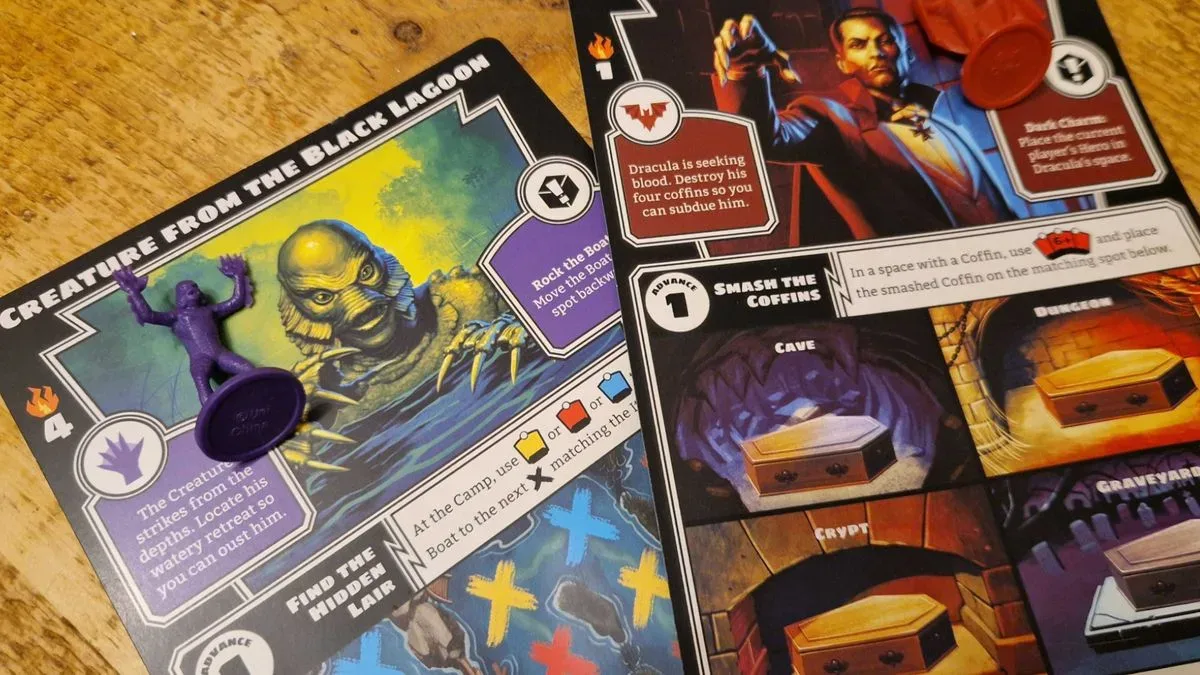
Dracula, for example, must be weakened by dealing with his coffins before the final confrontation can be completed. The Creature from the Black Lagoon requires players to find its lair. Frankenstein's Monster and the Bride introduce their own progress-based tasks. These individual systems give the game a pleasing sense of character while also making monster selection a meaningful part of setup.
A session begins with players choosing two monsters, though more can be added for groups seeking a tougher challenge. That decision changes the game's rhythm. Some pairings may demand frequent travel between distant locations. Others can put intense pressure on item collection or force players to divide their attention between several urgent goals. Adding more monsters does not just mean placing more enemies on the board; it means layering additional demands onto the group's limited turns and resources.
This is where the cooperative structure shines. Players have to discuss priorities constantly. Is it better to spend a turn advancing a monster's defeat condition, or should someone rush across the map to escort a vulnerable villager away from danger? Should a useful item be spent to protect a hero from an incoming attack, even though the same item may be essential to completing a monster objective later? Horrified repeatedly creates these small, uncomfortable decisions.
The terror meter gives every rescue real stakes
Monster activity does not pause while players build toward victory. At the end of turns, events can activate monsters, create new problems, and alter the board state. The creatures move toward nearby players or civilians when able, and attacks can raise the shared terror level. Once that terror reaches its losing threshold, the village has been overwhelmed.
This pressure system is one reason Horrified works so well as a group game. It produces the kind of tension cooperative games need: no one can simply pursue a personal plan in isolation. A player might be on the verge of finishing Dracula's objective, only for a newly spawned villager to appear near the Wolf Man. Ignoring that civilian can have consequences for everybody. Helping them might delay the group's larger mission. Neither choice is always clearly correct.
The structure will feel familiar to people who have played cooperative games such as Pandemic. There is the same sense of an escalating crisis that must be contained while players work toward broader win conditions. Horrified, however, wraps that tension in a more immediately seasonal package and gives each major threat a distinct identity. The game's horror is not based on graphic content; it comes from mounting pressure, unlucky timing, and the knowledge that one neglected problem can snowball.
Luck can certainly influence a session. An inconvenient event draw, hard-to-reach items, or civilians emerging too near a monster can put the team in trouble early. But those moments are also part of the game's monster-movie energy. Players are meant to feel as though they are starting on the back foot, improvising under pressure while danger closes in. Smart planning, movement efficiency, and communication can often pull a team back from a rough opening.
Accessible strategy without empty simplicity
Horrified's accessibility should not be mistaken for a lack of tactical substance. The basic turn structure is approachable, but choices accumulate quickly. Items are collected for specific monster tasks, yet may also be discarded to avoid harm. Characters have different abilities, encouraging the group to consider who is best placed for a particular job. The board's connected locations matter, especially when a rescue mission or monster objective requires crossing the village quickly.
Because all players win or lose together, communication is more valuable than individual cleverness. The game rewards a group that talks through immediate threats while keeping an eye on the endgame. Players who prefer complete control may need to resist directing everyone else's moves, but Horrified's shifting emergencies naturally give each person opportunities to contribute. One player may be carrying the items needed for a major objective while another is better positioned to retrieve a villager or intercept a threat.
For households with younger children, the age recommendation is worth respecting. The rules and coordination demands may be too much for very young players, even if the monster theme appeals to them. Families looking for a gentler entry point for younger children may find a title such as Zombie Kidz Evolution more suitable. For players around 10 and older, however, Horrified offers a satisfying step into more involved cooperative play without becoming intimidating.
The original remains a compelling place to start
The Horrified line has expanded beyond the Universal Monsters setting. Other entries have taken the formula toward North American cryptids, classic Dungeons & Dragons enemies, and the gothic Dungeons & Dragons setting of Horrified: Ravenloft. That range is useful for groups that prefer a different flavor of genre fiction. Someone who would rather investigate strange creatures than face Dracula, for instance, has options.
Still, the original game has a particular advantage. Its Universal Monsters theme is timeless, recognizable, and exceptionally well matched to the mechanics. Gathering supplies to hunt Dracula, searching for the Creature's home, and trying to keep villagers alive all feel like natural extensions of its old-school horror setting. The game's village, villains, and escalating terror system reinforce one another rather than competing for attention.
It also helps that Horrified is commonly available below its $45/£40 full price, with discounts frequently appearing. No specific sale is guaranteed, but the game's regular promotions make it easier to recommend as a seasonal purchase or a recurring addition to an October game night rotation.
A Halloween game with staying power
Many games work for one themed evening and then return to the shelf until the following year. Horrified has more staying power because the core cooperative challenge remains engaging after the Halloween decorations come down. Changing the monster lineup creates variety, and the group's performance can be dramatically affected by turn order, event draws, character abilities, and the choices made when the terror meter begins to rise.
For players seeking elaborate horror campaigns or genuinely unsettling themes, there are darker and deeper alternatives. For those who want an inviting game that still captures the urgency of a monster invasion, though, Horrified is hard to beat. It combines famous villains, clear objectives, rising suspense, and meaningful teamwork in a format that welcomes a wide range of players.
Horrified is a strong Halloween board game because it understands that a great group scare is not only about monsters. It is about the conversation around the table when a plan starts to unravel, a villager needs saving, and the team has one turn left to decide what matters most.
Community
Discussion
Start the conversation.
No comments have been posted yet.