

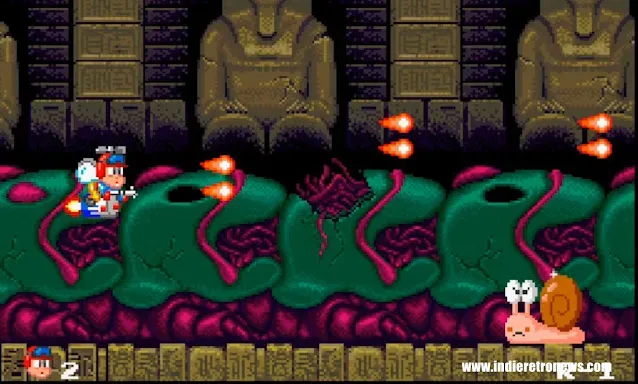
An early build of an unofficial Commodore Amiga conversion of Insector X is now available as a work in progress, giving retro enthusiasts a strikingly technical new way to experience Taito's 1989 horizontal arcade shooter. Developed by caiusarcade, the project is not described as a conventional remake. Instead, it uses static recompilation to turn code from the original arcade hardware into code capable of running natively on compatible Amiga systems.
That distinction is important. A remake typically rebuilds a game's mechanics, graphics, sound, and behavior in a new engine, often requiring developers to reinterpret how the original worked. This Insector X project takes another route: the arcade version's two Z80 processors are translated into native 68020 code. The stated goal is to preserve the original game logic along with its artwork and audio, rather than substitute newly created equivalents.
For Amiga fans, the result is especially interesting because Insector X was an arcade release built around hardware quite different from Commodore's home computer line. The port therefore represents a blend of preservation-minded reverse engineering and platform-specific optimization, with modern development tools helping bridge technology separated by decades.
A 1989 insect-blasting arcade shooter returns
Originally released by Taito in 1989, Insector X is a side-scrolling shooter set in a world threatened by hostile insect-like forces. Its arcade presentation belongs to an era in which fast scrolling, dense enemy patterns, imaginative creature designs, and escalating weapon power were central to the appeal of the genre.
For useful background on this topic, read Compact Switch, Steam Deck and ROG Ally Dock Falls to $13 on Amazon.
The player pilots a craft through horizontally scrolling stages, shooting waves of airborne adversaries and navigating increasingly busy combat encounters. Like many shooters of its period, the game's identity comes not just from firing at targets, but from the flow of movement, enemy timing, screen composition, effects, and audio. Those details make faithful conversion work difficult. A port can have all the right levels and sprites yet still feel wrong if timing, animation behavior, scrolling, or sound synchronization differs substantially from the arcade original.
The early Amiga build is attempting to address that challenge by working from the original material. Its game logic, visual assets, and sound are drawn directly from the coin-op release. This approach potentially reduces the amount of guesswork associated with recreating an old arcade game, though it also creates a demanding technical task: original code written for one specialized board must function properly on another very different family of processors and graphics hardware.
Static recompilation rather than a ground-up remake
Static recompilation is at the heart of the project. In simple terms, the process converts software intended for one processor architecture into code for another architecture before the game is run. Here, the original arcade machine's dual Z80 code is translated into native code for Motorola 68020-based Amiga hardware.
This is different from emulation. An emulator typically imitates the original machine's processor and related hardware in real time, allowing the original program to run within that simulation. Static recompilation instead seeks to produce a version that executes directly on the target system's processor. For an Amiga port, that can offer a more natural fit with the host machine, but achieving accurate behavior requires close attention to how the original game performed its calculations, handled timing, and communicated with its audio and video systems.
The development process has involved AI assistance, with the translated code reportedly checked frame by frame. The Amiga display has also been compared pixel by pixel against the arcade game. That is an ambitious testing standard for a work-in-progress fan conversion. Frame-level verification can help catch subtle discrepancies that may not be obvious in casual play, such as a sprite appearing a fraction too early, a scrolling layer advancing incorrectly, a projectile moving at a slightly different speed, or a palette effect failing to match its arcade counterpart.
Pixel comparisons are similarly useful, although exact presentation can remain dependent on the display configuration and the target hardware's capabilities. In a project with arcade accuracy as a major objective, this kind of methodical comparison is a notable part of the story. It suggests that the work is focused on preserving the feel and visual behavior of the original rather than merely producing a playable adaptation.
AI assistance is part of the disclosed development process
The developer has disclosed the use of AI assistance in the project, covering code, graphics, sounds, and text. In this case, the AI element is presented as part of the effort to validate and refine the conversion, including checking the translated material against the arcade release.
That makes the port an example of how newer tools are beginning to appear in retro development and preservation-adjacent work. AI-assisted workflows can be used for analysis, iteration, pattern checking, and handling repetitive technical tasks, but the presence of AI does not eliminate the need for human verification. Converting an arcade program into reliable code for another vintage platform still requires a detailed understanding of both the original title and the target machine's limitations.
The reported frame-by-frame and pixel-by-pixel comparisons underline that point. The work is not simply about generating a version of Insector X that looks broadly familiar. It is about evaluating whether the behavior and output line up with the arcade game at a granular level. As with any early beta, players should still expect rough edges, and ongoing development may alter performance or presentation before the project reaches a more complete state.
AGA Amiga hardware requirements
The current build is aimed at an Amiga 1200 or another AGA-equipped Amiga configuration. It also requires a hard drive, Kickstart 3.x, roughly 1.3 MB of available chip RAM, and at least 4 MB of fast RAM. The recommended amount of fast RAM is 8 MB.
- Target hardware: Amiga 1200 or another AGA-based Amiga
- Operating environment: Kickstart 3.x
- Storage: Hard drive required
- Chip RAM: Around 1.3 MB free
- Fast RAM: At least 4 MB, with 8 MB preferred
The Amiga 1200 is a particularly fitting target for a project of this kind. Its AGA chipset expanded the color and display capabilities of earlier Amiga models, while its standard 68020 processor provides the baseline CPU target for the conversion. Even so, arcade-accurate action places significant demands on machines of this age, especially when busy scenes require the game to process numerous enemies, bullets, effects, scrolling elements, and music playback at the same time.
On a stock 14 MHz 68020, the build is said to keep gameplay and music operating at full speed, although the refresh rate can drop in hectic sequences. That means the game's internal action is intended to remain correct, while the visual update frequency may become lower when the system is under heavier strain.
A faster processor improves the experience. A 50 MHz 68030 or anything faster is said to provide quicker performance through most of the game's action. For owners of accelerated Amiga systems, that should make the conversion more comfortable to play and may bring its on-screen motion closer to the responsiveness expected from the arcade original.
Building the port requires the original ROMs
The setup process is described as straightforward for users who have the necessary ROMs. On Windows 10 or Windows 11, the build can be compiled with a one-click tool. Linux and macOS users can assemble it with Python 3 and vasm.
This distribution approach is common among projects that avoid bundling copyrighted arcade data. The conversion tools and code can be shared separately, while users must provide the original game material themselves. It also means the process is not necessarily limited to veteran Amiga programmers. A one-click Windows build option may lower the barrier for enthusiasts who want to prepare the software for real hardware without manually configuring every element of a toolchain.
Linux and macOS support adds flexibility, though those users will need Python 3 and vasm available. The cross-platform build options are notable for a project targeting a machine from the early 1990s: modern PCs handle the conversion process, while the final result is intended to run on period-appropriate Amiga hardware.
An early build with a known audio caveat
Anyone judging the conversion from its currently available video should keep one specific caveat in mind. The audio in the footage appears to be broken, and this may be related to the early beta state of the project. That issue should not automatically be treated as representative of the intended final audio implementation, particularly given that the port's stated design uses sound data from the original arcade version.
As it stands, the Insector X conversion is best viewed as a promising technical work in progress rather than a finished replacement for the arcade game. Its appeal lies in both the shooter itself and the method being used to bring it to Amiga: native recompilation of original arcade logic, detailed visual checking, disclosed AI-assisted development, and performance scaling across different 68020 and 68030-era configurations.
For the Amiga and arcade preservation communities, projects like this highlight how much unexplored potential remains in classic hardware. A game released for arcades in 1989 can still find a new audience on vintage computers, not through a loose reinterpretation, but through an effort to retain the original's code-driven identity as closely as the target platform allows.
Community
Discussion
Start the conversation.
No comments have been posted yet.