

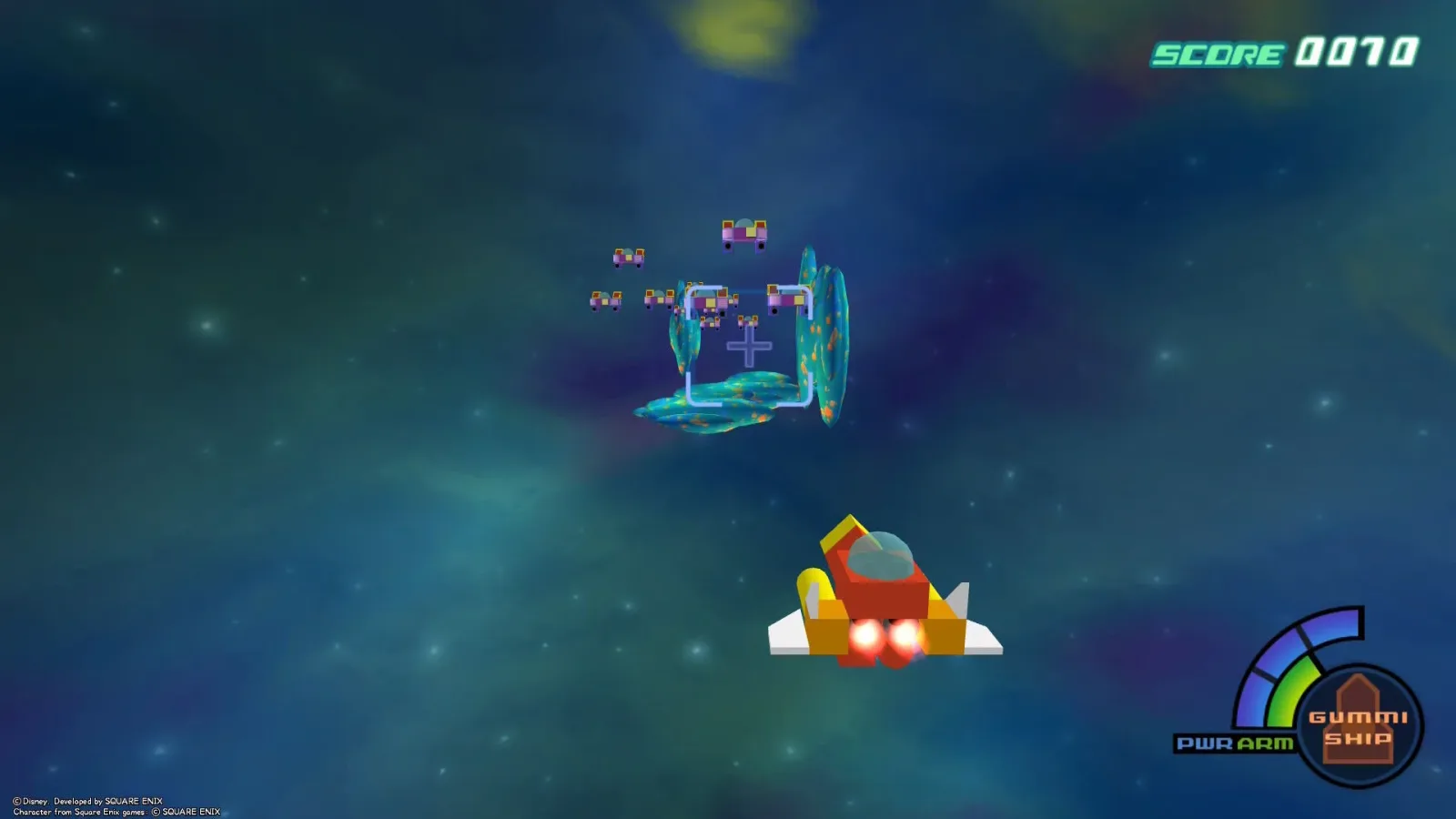
Few parts of the original Kingdom Hearts inspire as much immediate dread as the Gummi Ship. Mention the block-built spacecraft used by Sora, Donald, and Goofy to move between worlds, and many longtime players will remember slow flights, sparse enemies, awkward shooting, and a powerful urge to get back to the actual adventure. It has become one of those accepted criticisms that barely needs explaining: the Gummi Ship was bad.
Returning to it now produces a slightly more complicated answer. The Gummi Ship is not quite an irredeemable catastrophe, and it is certainly more elaborate than memory may suggest. But its underlying problem is hard to escape. The original game asks players to engage with a space-combat diversion that has a surprising amount of customization behind it, while giving them little reason to care about that customization during the early adventure. The system is deeper than its reputation, yet the act of flying often feels shallow.
A travel system caught between ideas
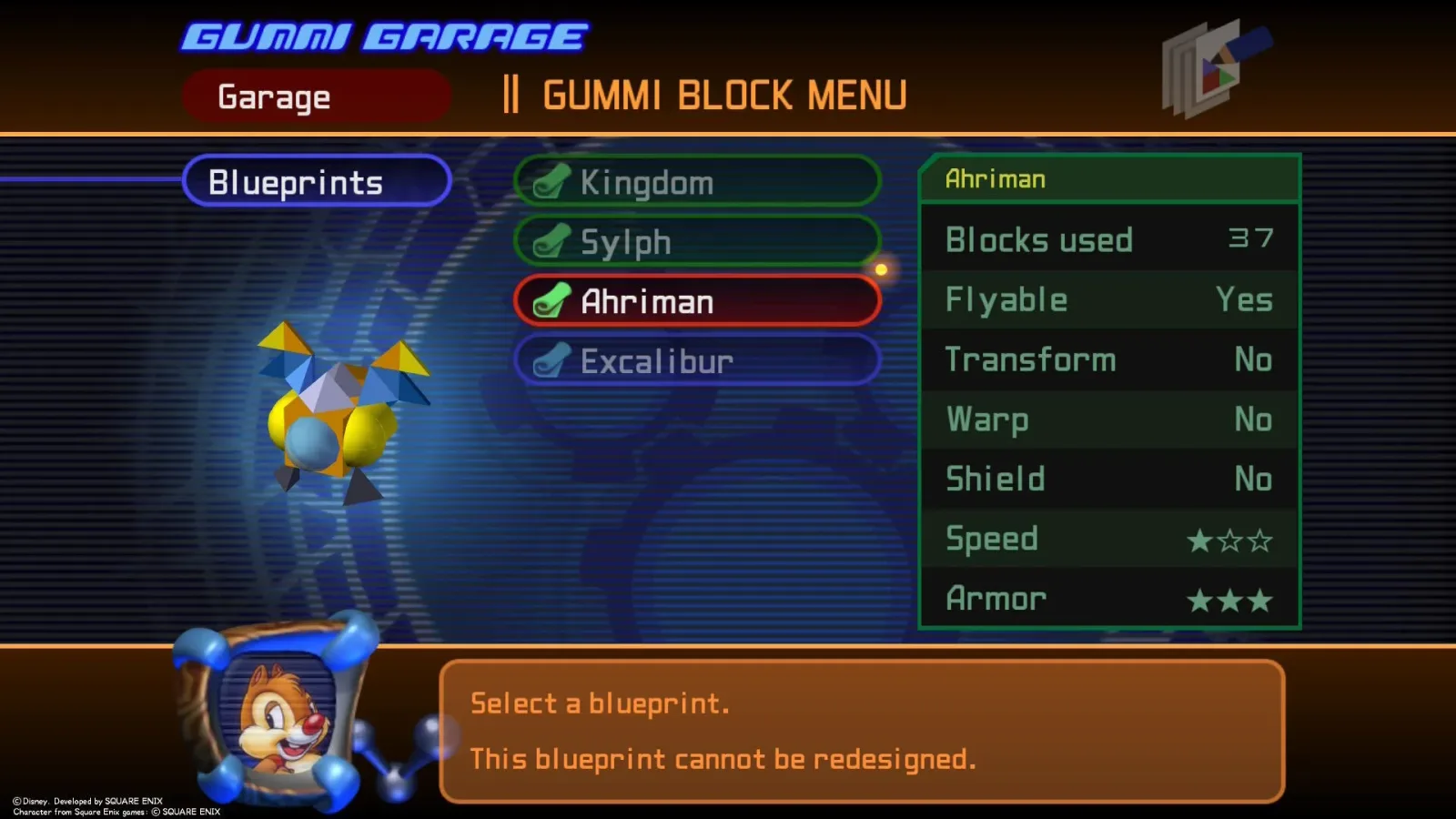
The Gummi Ship was designed as more than a loading screen between Disney worlds. The original Kingdom Hearts treats it as a small game within the larger action RPG: players can collect Gummi blocks, assemble ships piece by piece, manage statistics, fit weapons and other components, and create strange contraptions that reflect their own priorities or visual taste.
That ambition is worth recognizing. It is an unusually hands-on system for a game built around visiting recognizable fantasy locations. Instead of simply selecting the next destination from a map, players are meant to feel as though they are crossing dangerous space in a vehicle they have helped build. It is a fittingly playful concept for a series where a keyblade-wielding teenager teams up with Disney characters and moves between radically different worlds.
For useful background on this topic, read GameSir Reveals Sunset Boulevard and Ocean Breeze G7 Pro Controller Editions.
In practice, however, the moment-to-moment flights struggle to give that construction system meaning. The early routes are visually sparse and mechanically light. Enemies arrive in formations that tend to feel more like obstacles than engaging threats, while firing on them lacks the punch or urgency needed to make the trip exciting. There is movement and shooting, but little sensation of momentum, danger, or tactical decision-making.
That creates a mismatch. The garage implies experimentation and optimization; the flight sequences often make a basic solution feel sufficient. A player can spend time building a more capable or visually elaborate ship, but the rewards for doing so do not necessarily feel immediate enough to justify the investment. The system seems to anticipate that players will become amateur spacecraft designers, while many players simply want to arrive at the next world.
Customization without compelling pressure
The Gummi Ship's building tools are, in a way, a snapshot of an era when games enthusiastically packed in systems simply because they could. The idea of snapping colorful blocks together to create a ship is charming, and there is real appeal in the possibility of constructing something absurd or meticulously efficient. It gives the player ownership over an otherwise routine method of travel.
But customizable systems work best when the game consistently presents problems that make different choices feel meaningful. If a ship's speed, armor, weapons, and layout do not substantially alter how a route plays, building becomes a hobby rather than an essential part of progression. There is nothing inherently wrong with an optional hobby, especially in a game already overflowing with unusual ideas. The issue is that the Gummi Ship segments can still demand time from players who have no interest in the hobby attached to them.
That is why the feature can feel like padding. It interrupts the stronger loop of Kingdom Hearts: entering a new world, navigating an often-confusing environment, meeting familiar characters, battling Heartless, and pushing the broader story forward. The Gummi Ship does not always deepen that loop. At its weakest, it pauses it.
The old complaint therefore has some merit, but it benefits from precision. The Gummi Ship is not hated because the idea of a customizable ship is fundamentally misguided. It is disliked because the game's early spaceflight does not make a convincing case for why players should repeatedly perform it. The construction suite has more potential than the missions give it room to express.
The mercy of Warp-G
Fortunately, the original game does not force every return journey through a full route. The Warp-G block eventually allows travel back to worlds that have already been visited, dramatically reducing the number of times players need to replay completed Gummi Ship sequences. That choice changes the feature's role in the overall experience.
Rather than becoming a permanent toll for moving around the map, the Gummi Ship is primarily tied to reaching new destinations. It remains an interruption, but a limited one. This is important context for anyone revisiting the game and wondering whether the spacecraft sections truly dominate the entire experience. They do not. They are most noticeable during the opening stretch, when the player is still establishing routes and becoming familiar with the game's structure.
There is an odd design lesson in that relief. The game makes travel inconvenient for long enough that players are likely to notice and resent it, then introduces a solution that removes much of the problem. The Warp-G block is useful, but it also raises a question: why make routine revisits laborious in the first place?
That question appears elsewhere in the original Kingdom Hearts, particularly in the way it handles basic action-game conveniences. Early on, Sora faces the Guard Armor in Traverse Town before gaining access to a dodge roll. Guard Armor can deliver forceful attacks, and a reliable evasive move would be an obvious tool for handling them. Instead, the player receives that capability only after the battle. Sora's jump can sometimes help, but its famously floaty feel does not make it a dependable replacement for quickly getting out of danger.
Early friction is part of the original game's identity
The Gummi Ship is only one example of the first game's tendency to create friction before providing a quality-of-life answer. Item use has its own unusual restriction: consumables such as potions must be stocked before battle rather than being freely accessed from the full inventory during a fight. Meanwhile, Donald's tendency to withhold healing at the exact moment players want it has become a lasting joke among fans.
That joke becomes even funnier when viewed against later series events. Donald is capable of casting Zettaflare in Kingdom Hearts III, yet his early-game AI can make a basic Cure feel elusive when Sora is in trouble. The contrast is absurd, but it also captures why the original game can feel so temperamental. Its systems do not always behave according to the player's most natural expectations.
Some of this is simply age. Kingdom Hearts is nearing its twenty-fifth anniversary, and game design standards around accessibility, movement, interface clarity, and pacing have changed considerably. Modern action games are more likely to give players an evasive option from the start, streamline travel, and ensure that a companion's support behavior feels predictable. Looking back at the original through those expectations can make its rough edges especially visible.
Still, age is an explanation rather than a complete defense. A classic can be influential, imaginative, and beloved while retaining systems that are cumbersome. In fact, revisiting those systems can help clarify just how much later games learned from them.
Later games understood the need for more spectacle
The series did not abandon the idea of traveling between worlds. Kingdom Hearts II and Kingdom Hearts III continued to make space travel a component of the adventure, and they pushed far harder toward speed, spectacle, and action. That does not automatically settle the question of whether those later versions are great, but it does show an awareness that simply drifting through lightly populated routes would no longer be enough.
Later Gummi Ship sequences are more frantic and involved, with a stronger attempt to turn travel into an attraction rather than a delay. The original game's routes feel like a prototype: they establish the premise and the customization, but they do not yet have the rhythm needed to make repeated flights feel exciting. The sequels double down on the concept rather than removing it, suggesting that the problem was never the Gummi Ship's existence. It was execution.
For players returning to the first game today, the fairest verdict may be that the Gummi Ship is mildly bad in a very specific, manageable way. It is not an all-consuming flaw, because Warp-G limits the repetition and the main adventure has enough charm to carry on. It is also not devoid of value, because its construction mechanics are more robust than the common punchline implies.
But the negative reputation did not appear from nowhere. The early flights are low-energy, their combat lacks impact, and their customization rarely feels necessary when first encountered. The Gummi Ship is a fascinating relic of an ambitious game trying several ideas at once. Players were not simply too young to understand it. They were responding to a real pacing problem--one that becomes easier to forgive once the game lets them warp past it.
Community
Discussion
Start the conversation.
No comments have been posted yet.