

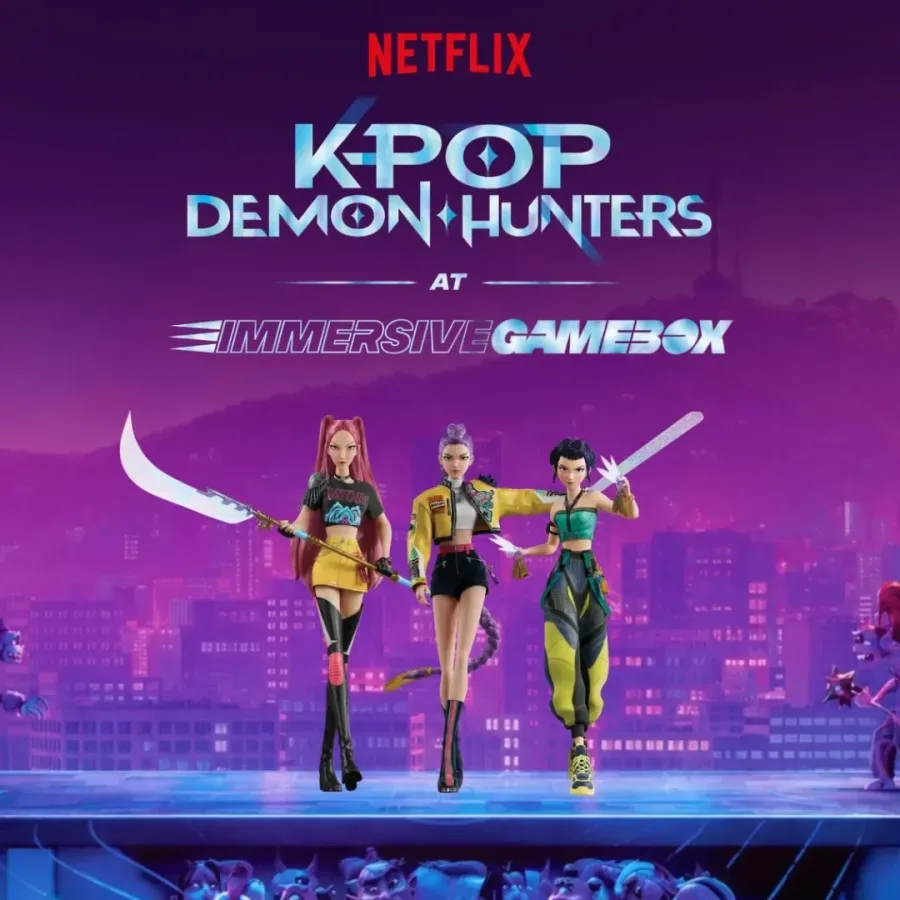
KPop Demon Hunters is expanding into another location-based interactive game experience. Immersive Gamebox is partnering with Netflix on a new attraction based on the animated hit, with launches planned for select locations across the United States in January 2027.
The experience is designed as a cooperative, in-person activity for groups of two to six people. Rather than putting players behind a controller or inside a conventional virtual-reality headset, it will place them in an interactive room built around movement, projection, sound, and shared challenges. Participants will create their own animated-style Superfan avatar before joining HUNTR/X on a mission connected to the Honmoon.
Tickets are expected to go on sale in December. Fans who want an earlier opportunity to reserve a session can sign up for the Priority Waitlist, which is set to provide 24 hours of access before the general ticket sale begins. Specific U.S. venues and ticket prices have not been announced.
A shared game built around movement and teamwork
Immersive Gamebox's KPop Demon Hunters attraction will use several forms of room-scale technology. The company says players will move, react, and cooperate through a run of interactive games using 3D motion tracking, projection mapping, touch-sensitive walls, and spatial audio.
For useful background on this topic, read Tim Sweeney Revives 2000 Looking Glass Closure Comments Amid Industry Layoff Debate.
That setup is important because it sets this apart from a traditional VR arcade game. The experience will not rely on large, enclosed VR goggles. Instead, participants will use lightweight motion-tracking headsets while remaining aware of their teammates and the physical space around them. The goal is a more social format: players stand together, see one another, call out solutions, and tackle each activity as a group.
The estimated running time is 60 minutes. Within that hour, players can expect a sequence of minigames and activities rather than one uninterrupted action scenario. The attraction will draw on recognizable characters, settings, and moments from the film, while building its own interactive route through the story's world.
For a property whose appeal includes music, spectacle, and the group dynamic surrounding its heroes, the approach is a natural fit. KPop Demon Hunters is being adapted not simply as a setting to look at, but as a setting that asks visitors to actively perform, respond, and work together. The cooperative requirement also means group composition may shape the experience. A pair can take on the game together, while a larger party of friends or family members can fill out the maximum six-player team.
Players begin by making a Superfan avatar
Before the action begins, each participant will create a "Superfan" avatar styled after the animated movie. Character creation is a small but notable part of the format, giving visitors a personal stand-in before they enter the story. It also aligns with the fan-centered framing of the game: players are not described as replacing HUNTR/X, but as joining the group's efforts.
After avatar creation, HUNTR/X will guide the team on a quest to protect the Honmoon. The Honmoon is at the center of the attraction's story, and both the Gamebox experience and Netflix's separate live immersive event are built around the film's original Honmoon narrative.
The available details do not identify the individual minigames or explain exactly which movie scenes will be recreated. That leaves open how heavily the hour will lean into rhythm, puzzle-solving, physical reactions, or other forms of collaboration. What is clear is that the experience will feature familiar material from the film alongside activities designed specifically for this room-scale format.
That distinction matters for fans deciding what to expect. This is not being positioned as a sequel, a new screen release, or a home game. It is a themed social outing where the core interaction comes from physically participating with a group in a dedicated venue. The technology is meant to make the room react to players' actions, while the KPop Demon Hunters setting supplies the characters, stakes, visual identity, and story framework.
Immersive Gamebox continues its Netflix collaborations
Immersive Gamebox began in London and opened its first U.S. location in 2020. The company has since developed a substantial presence in the location-based entertainment space, with more than 29 experiences across 35 venues.
Licensed collaborations have become a major part of that growth. The company has previously worked with Netflix on experiences based on Squid Game and Floor Is Lava. KPop Demon Hunters joins that line as another attempt to translate a streaming title into a social game people can play away from home.
"KPop Demon Hunters perfectly captures what we do best: transforming the world's most exciting stories into shared experiences that friends and families can play together," Immersive Gamebox CEO Lisa Paton said.
Paton also highlighted the importance of the film's music, movement, and fan energy, describing those elements as a strong match for a group activity built around joining the action. The emphasis offers a useful indication of the attraction's intended audience: it is aimed at existing fans looking to spend time in the property's world, but its two-to-six-player design also makes it suitable for mixed groups who want a collaborative activity rather than a solo attraction.
For Immersive Gamebox, recognizable franchises provide an immediate entry point. Visitors understand the tone and characters before entering the room, while the gameplay format can concentrate on quick communication and accessible group mechanics. For KPop Demon Hunters, the partnership extends the property into a format that is fundamentally different from watching an animated film, yet still tied to its central conflict.
A second KPop Demon Hunters immersive event is also on the way
The Gamebox attraction will not be the only way for fans to step into the KPop Demon Hunters universe. Netflix is also preparing KPop Demon Hunters: The Immersive Experience, due to open at two Netflix House locations in November.
While the two projects share the same underlying Honmoon story, their formats appear distinct. Netflix's event is described as using 3D technology alongside live actors, multiple sets, and themed food and drinks. That suggests a walk-through, theatrical, and hospitality-oriented experience, in contrast to Immersive Gamebox's game-focused 60-minute session driven by motion tracking, projected environments, touch-enabled walls, and team challenges.
The difference gives fans two separate kinds of participation. The Netflix House experience appears built around physical sets, performers, and themed surroundings. The Immersive Gamebox version is geared toward active play, scoring or completing challenges, and coordinating with a small group. Both remain rooted in the original Honmoon storyline rather than presenting a newly announced sequel plot.
Anyone interested in attending both should keep their expectations separate. One will be available at two Netflix House sites beginning in November, while the other is slated for select U.S. Immersive Gamebox venues in January 2027. Neither announcement provides enough information to assume that the same scenes, characters, or interactive moments will appear in both.
What this means for the franchise's next steps
The new attractions arrive as KPop Demon Hunters continues to broaden beyond its original animated release. Physical, interactive adaptations can keep a fandom engaged between major screen projects, especially when they invite visitors to share an activity with friends and family rather than simply revisit the film at home.
There is more action planned in the world of KPop Demon Hunters, although the next film may still be a long way off. Reports have indicated that a sequel might not arrive until at least 2029. Netflix has also agreed that KPop Demon Hunters 2 will receive a full theatrical release, correcting the distribution approach used previously.
Until more sequel details emerge, these immersive installations offer fans a nearer-term way to revisit HUNTR/X and the Honmoon conflict. The Gamebox version, in particular, is shaping up as a compact group adventure: create a Superfan, enter a technology-enhanced room, and work through an hour of challenges with a team.
With tickets planned for December and the U.S. opening window set for January 2027, the immediate remaining questions are where the experience will appear first and what sessions will cost. Those details have not yet been confirmed, but the Priority Waitlist is already open for people seeking early ticket access.
Community
Discussion
Start the conversation.
No comments have been posted yet.