

Krakout Amiga AGA Enhanced Edition is now available, giving a classic 8-bit arcade game a purpose-built return on Commodore's AGA-equipped Amiga computers. Created by thall72, the release has been written from the ground up in native Amiga machine code and is designed to run at full speed on a standard Amiga 1200 with no accelerator, fast RAM, or other expansion hardware required.
The project addresses a conspicuous gap in Krakout's history. The game became a familiar name to many Commodore 64 players, where its brisk, sideways take on brick-breaking action and Ben Daglish soundtrack helped it stand out. Although Krakout reached other systems over the years, it did not receive a dedicated Amiga 1200 version built to take advantage of the machine's Advanced Graphics Architecture. This Enhanced Edition is intended as that missing version: a faithful game conversion accompanied by a substantially renewed presentation.
For retro players, that distinction matters. It is not simply an older release being placed in an Amiga-compatible wrapper, nor is it a revised game that changes the foundations of what made Krakout work. The gameplay logic has been kept fully aligned with the 8-bit original, while the visuals, sound, interface, and convenience features have been rebuilt for AGA hardware.
A sideways brick-breaker built around the original game
Krakout takes the familiar break-the-bricks concept and rotates the usual arrangement. Rather than keeping a bat at the bottom of a playfield, players position their bat on either the left or right side as the ball ricochets across the screen. That changes the rhythm of play, making angle control, recovery, and awareness of the stage layout feel different from the more conventional vertical format popularized by other arcade brick-breakers.
For useful background on this topic, read Eddy & Co Brings a 1995 DOS Winter Platformer to Amiga 1200.
The Amiga AGA Enhanced Edition includes all 100 screens from the original game. Every brick-filled arena remains present, as do bonus bricks and the floating enemies that can make a seemingly manageable screen considerably more chaotic. The left-or-right bat placement has also been preserved, meaning returning players should encounter the same fundamental challenges and bounce behavior they remember.
That commitment to the original underlying design is the central promise of the project. It means the new edition is not attempting to modernize Krakout through altered rules, redesigned levels, or adjusted game flow. Instead, its upgrades are aimed at how the game looks and sounds on an Amiga 1200, while retaining the frantic arcade identity of its Commodore 64 counterpart.
AGA visuals replace the 8-bit presentation
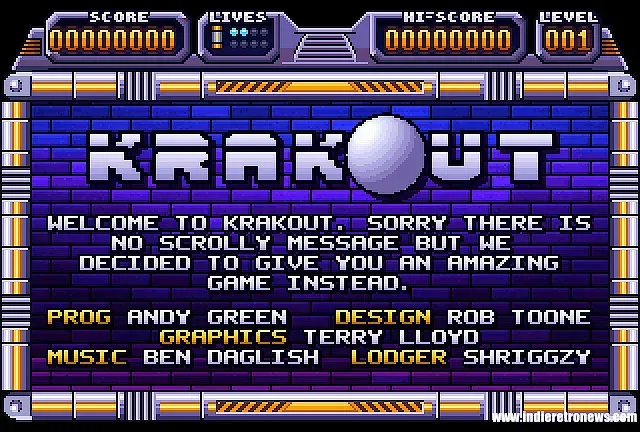
The most immediate changes arrive before a ball is launched. The game opens with a high-resolution, 256-colour intro that displays the original cover artwork. It is a clear statement of intent: the release recognizes its historical roots while presenting them through the capabilities of the AGA chipset.
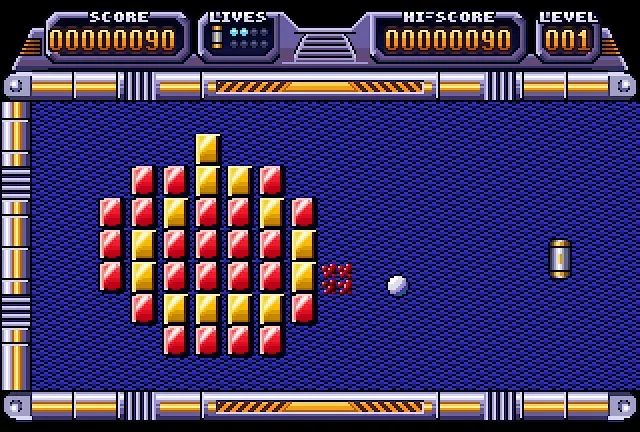
Once play begins, the stages receive a broader visual overhaul. The new edition features chrome-and-gold brick artwork, richer scrolling backgrounds, redrawn sprites, and a newly styled heads-up display. These elements aim to make each screen feel more suited to the Amiga 1200 without replacing the layouts that define the original progression.
AGA, introduced with machines including the Amiga 1200, offered a more flexible color palette and display potential than earlier Amiga graphics hardware. Krakout's new presentation uses that room for more elaborate colour and detail, but the developer has kept the focus on readability. In a game where the ball can move quickly and enemies can crowd the play area, clear visuals are more than decoration; they are part of maintaining the sharp, reactive play that a brick-breaker demands.
The redesigned HUD is another practical improvement. A cleaner interface can make a significant difference during quick attempts, particularly when players are balancing the ball's path against hazards, bonus opportunities, and the unusual side-mounted paddle arrangement. The Enhanced Edition's visual work is therefore not just about giving an older game a shinier coat, but about adapting its action for the screen and chipset of the target machine.
Ben Daglish's music is rearranged, not replaced
Audio has received comparable attention. Krakout is closely associated with music by Ben Daglish, whose work was an important part of the original game's Commodore 64 identity. The Amiga edition revisits that music using sampled instruments and an added drum kit.
Crucially, the rearrangement keeps the original notes and timing intact. That approach follows the same principle as the game's preserved mechanics: enhance the format without losing the character that players recognize. The result is intended to sound fuller on Amiga hardware while retaining the composition's established cadence and melody.
New sound effects accompany the musical update. Brick impacts, explosions, and other gameplay events now have refreshed audio, giving the action more immediate feedback. In a fast arcade game, those small details can reinforce the sensation of each successful hit and make the increasing pressure of a difficult screen easier to feel.
The balance between sampled instrumentation and faithful composition will likely be of particular interest to fans of classic computer-game music. Rather than treating the original soundtrack as material to be discarded, the Enhanced Edition treats it as a framework to be carefully translated into a different sound environment.
Modern convenience features for real hardware
Alongside its audiovisual rebuild, Krakout Amiga AGA Enhanced Edition adds a couple of features that make repeated play more convenient. High scores can be saved directly to disk, allowing players to preserve their best results between sessions. Because this saving system writes data back to the disk, users need to ensure their disk is write-enabled if they want their scores retained.
The game also includes a streamlined options menu. Settings can be toggled with a quick press of the fire button, avoiding a complicated configuration process and keeping the experience closer to the pick-up-and-play spirit of a classic arcade title.
These additions do not change the original campaign structure, but they suit the way people revisit retro games today. A disk-based score table gives a long-term goal beyond simply clearing a single batch of stages, while accessible options make it easier to tailor a session without interrupting its pace.
Hardware requirements and PAL/NTSC support
The release targets the Amiga 1200 and other Amiga systems equipped with the AGA chipset. Its requirements are notably modest:
- Amiga model: Amiga 1200 or another AGA Amiga
- Processor and expansions: Stock configuration; no accelerator or expansion is required
- Memory: 2 MB chip RAM, with no fast RAM required
- Kickstart: Version 3.0 or 3.1
- Media: ADF disk image
- Video: PAL and NTSC support from the same disk image
The single disk works on both PAL and NTSC machines. On an NTSC Amiga, the game changes to 50 Hz in order to preserve its intended original speed. That does carry one display consideration: the connected monitor or adapter must be able to accept a 50 Hz signal. Most RGB monitors and adapters should support this, but it remains an important setup detail for anyone planning to run the game on North American hardware.
The release has been tested on a real NTSC Amiga 1200 as well as in emulation. Native support for original hardware is especially relevant here because the project's technical goal is to achieve full-speed performance on a stock 68020-based system. No emulation is needed to play it on compatible Amiga hardware.
A careful revival for a distinct arcade favorite
Krakout Amiga AGA Enhanced Edition is a reminder that retro game preservation and retro game development are not always separate pursuits. A project can preserve a game's rules, screens, soundtrack structure, and personality while still building an entirely new technical implementation for old hardware. In this case, the aim is to let Krakout feel recognizable to longtime players while giving it the dedicated AGA Amiga treatment it never previously received.
With all 100 original screens intact, refreshed graphics, a respectful reworking of Daglish's music, new effects, score saving, and low hardware demands, thall72's release is shaped for both collectors with real Amiga systems and enthusiasts using emulation. It is an enhancement rather than a reinvention--one that lets a distinctive sideways brick-breaker bounce back onto the hardware generation it missed the first time around.
Community
Discussion
Start the conversation.
No comments have been posted yet.