


Kung-Fu Master A500 Edition is a new homebrew conversion of Irem's landmark 1984 arcade game for Commodore Amiga machines using the original OCS chipset. Built as a recreation of the side-scrolling martial-arts classic, the project sets out to bring the complete Devil's Temple climb to Amiga owners while retaining the visual, audio, and mechanical character that made the coin-op a foundational action game.
The release is designed with the base Amiga 500 firmly in mind. Its developer says the game can operate at 50 or 60 frames per second on unexpanded stock A500 hardware, an ambitious target for a conversion of an arcade title built around constant enemy pressure, scrolling movement, and immediate attacks. It also detects Fast RAM where available and can switch automatically for NTSC operation, giving the port room to accommodate more than one Amiga setup without abandoning compatibility with the machine most closely associated with the edition's name.
For retro players, the project is an opportunity to revisit a game whose influence can still be felt across beat-'em-ups, brawlers, and side-scrolling action titles. For Amiga enthusiasts, it is also a technical showcase: a newly produced game intended to work on period-correct hardware rather than merely serving as a modern remake inspired by an old arcade favorite.
An arcade rescue mission returns
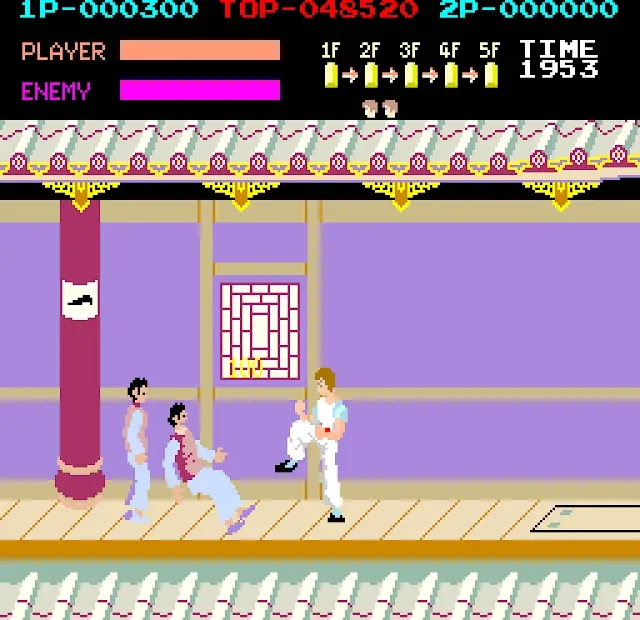
Kung-Fu Master places players in control of a martial artist on a mission to rescue Silvia, who has been taken to the Devil's Temple. The man behind the kidnapping, Mr. X, awaits at the top. Getting there is not a matter of simply advancing from left to right, however. The ascent covers five separate floors, each presenting increasingly demanding opposition before a guardian must be beaten to earn access to the stairs leading upward.
For useful background on this topic, read The Abbey of Crime Returns on Amiga 500 in a Faithful New Tribute Port.
The structure is simple, but it is the kind of simplicity that helped make the original so memorable. Players punch and kick through attackers approaching from both sides while managing positioning, timing, and the limited room available on screen. Grippers close in, knife throwers create hazards from range, and creatures including dragons and snakes complicate the path. Exploding balls add another threat to an already crowded fight. Survival depends on recognizing what is arriving, responding with the appropriate attack, and keeping the hero from being overwhelmed.
That design was central to the original game's arcade identity. Kung-Fu Master is often remembered for its direct control scheme and relentless pacing: it asks players to keep moving but punishes carelessness, particularly once multiple opponents begin entering the screen. The new Amiga edition preserves that familiar progression through the temple's five floors and the boss confrontation at the end of every stage.
Built around Amiga OCS hardware
The "A500 Edition" name highlights the target platform, but the stated minimum requirements make the scope clearer. The game requires an Amiga, or an accurate emulator, with a 68000 processor, OCS graphics hardware, 512 KB of Chip RAM, and 512 KB of Slow RAM. It can be run from a single bootable 880 KB disk, while systems configured for WHDLoad are also supported.
For another perspective on this story, read Kung-Fu Master A500 Edition Brings Irem's 1984 Arcade Fight to Amiga OCS.
Testing has included a PAL Amiga 500 using a 68000 and OCS, both on real hardware and in cycle-exact WinUAE emulation. That emphasis matters because Amiga software can behave differently depending on timing, memory configuration, chipset, video standard, and accelerator hardware. By calling out cycle-exact testing alongside use on an actual A500, the release is positioned as something intended to respect the constraints of the original platform rather than only function under loose emulation settings.
The performance claim is particularly notable because Kung-Fu Master is not a static screen game. Smooth animation and responsive controls are central to the experience, especially when the player is caught between enemies or needs to react to a projectile. Maintaining a 50 Hz or 60 Hz update rate on a stock system is therefore more than a technical footnote; it directly affects whether the conversion can capture the urgency of the arcade design.
Options for different play styles
While the game seeks a close recreation of the coin-op, it includes a dedicated options menu that gives players several ways to tailor the experience. Difficulty can be adjusted, and players can select the round where they begin. The latter is especially useful for practice, letting returning players concentrate on later sections without replaying the entire opening every time.
There are also switches for auto-fire and invincibility. These additions can make the game more accessible to newcomers, ease the pressure for a casual session, or help players explore levels that would otherwise require a long series of attempts. Players looking for the more demanding arcade-style challenge can leave those assists disabled.
Control support covers keyboard input as well as joystick configurations using either one button or two buttons. That is a practical inclusion for the Amiga ecosystem, where controllers vary considerably and original arcade control expectations do not always map neatly onto home-computer joysticks. The availability of both one- and two-button setups should allow players to choose an arrangement that feels appropriate for their hardware.
High score saving is built in as well. In a game designed around repeat attempts and incremental improvement, retaining a player's best result gives the conversion a welcome home version feature without changing its core arcade focus. The result is a package that appears to balance preservation with the conveniences expected from a contemporary retro homebrew release.
A reconstruction rather than a loose adaptation
The project is described as a port and reconstruction, with the stated aim of delivering a near 1:1 version of the arcade original. That distinction is important. Classic arcade-to-home conversions frequently had to make compromises due to memory limits, processor speed, color restrictions, storage media, or controller differences. Those versions can be cherished in their own right, but they do not always reproduce the original game's presentation or rhythm precisely.
Kung-Fu Master A500 Edition instead attempts to bring together the arcade game's recognizable sound effects, music, enemy encounters, stage sequence, and central rescue scenario on Amiga OCS. The release's technical approach combines new Amiga code with established tools and components. PTPlayer 6.4 by Frank Wille is used for audio playback, while ym2mod by adrdesign is credited as a converter for YM, AY, VGM, and SDNH audio formats. Compression and decompression duties involve the NRV2S 68000 decoder by ross and the Shrinkler executable cruncher by Blueberry.
The game was built with Bartman/Abyss's amiga-debug toolchain. These credits offer a useful look at the kind of collaborative technical foundation behind modern Amiga development, where new projects often rely on community-maintained utilities, compact codecs, and hardware-aware workflows to do more within the limits of vintage machines.
Why Kung-Fu Master still matters
Released by Irem in 1984, Kung-Fu Master arrived at a time when the vocabulary of side-scrolling combat games was still being established. Its one-on-one encounters and advancing stage design may look straightforward beside later brawlers packed with elaborate move lists, four-player co-op, and huge sprites, but its formula was hugely effective. The basic act of walking forward, striking enemies, dodging danger, and confronting an end-of-level opponent created a template that many action games would expand upon in the years that followed.
The game's appeal also comes from its clarity. Each floor has a clear objective, danger can arrive quickly from either side, and players understand immediately why a missed kick or poorly timed punch matters. That makes it well suited to short replay sessions, score chasing, and the kind of challenge that encourages players to learn enemy behavior rather than rely on a complicated upgrade system.
For an Amiga port, this is a fitting choice. The platform has a long legacy of arcade conversions and action games, while its continuing homebrew scene regularly demonstrates that decades-old computers can still receive polished new software. A faithful take on Kung-Fu Master lets that scene engage with an important piece of arcade history while creating something specifically tuned for OCS-era systems.
Requirements at a glance
- Amiga with OCS chipset, or an accurate compatible emulator
- 68000 processor
- At least 512 KB Chip RAM and 512 KB Slow RAM
- A bootable 880 KB disk, or a system able to use WHDLoad
- PAL and NTSC considerations supported through automatic NTSC switching
Kung-Fu Master A500 Edition is a focused retro release: a return to a five-floor arcade gauntlet, shaped for Commodore Amiga OCS hardware and supplemented with thoughtful configuration options. Whether players approach it as a preservation-minded recreation, a test for their Amiga setup, or simply another chance to take on Mr. X at the top of the Devil's Temple, its purpose is clear. The climb begins again, one punch and kick at a time.
Community
Discussion
Start the conversation.
No comments have been posted yet.