

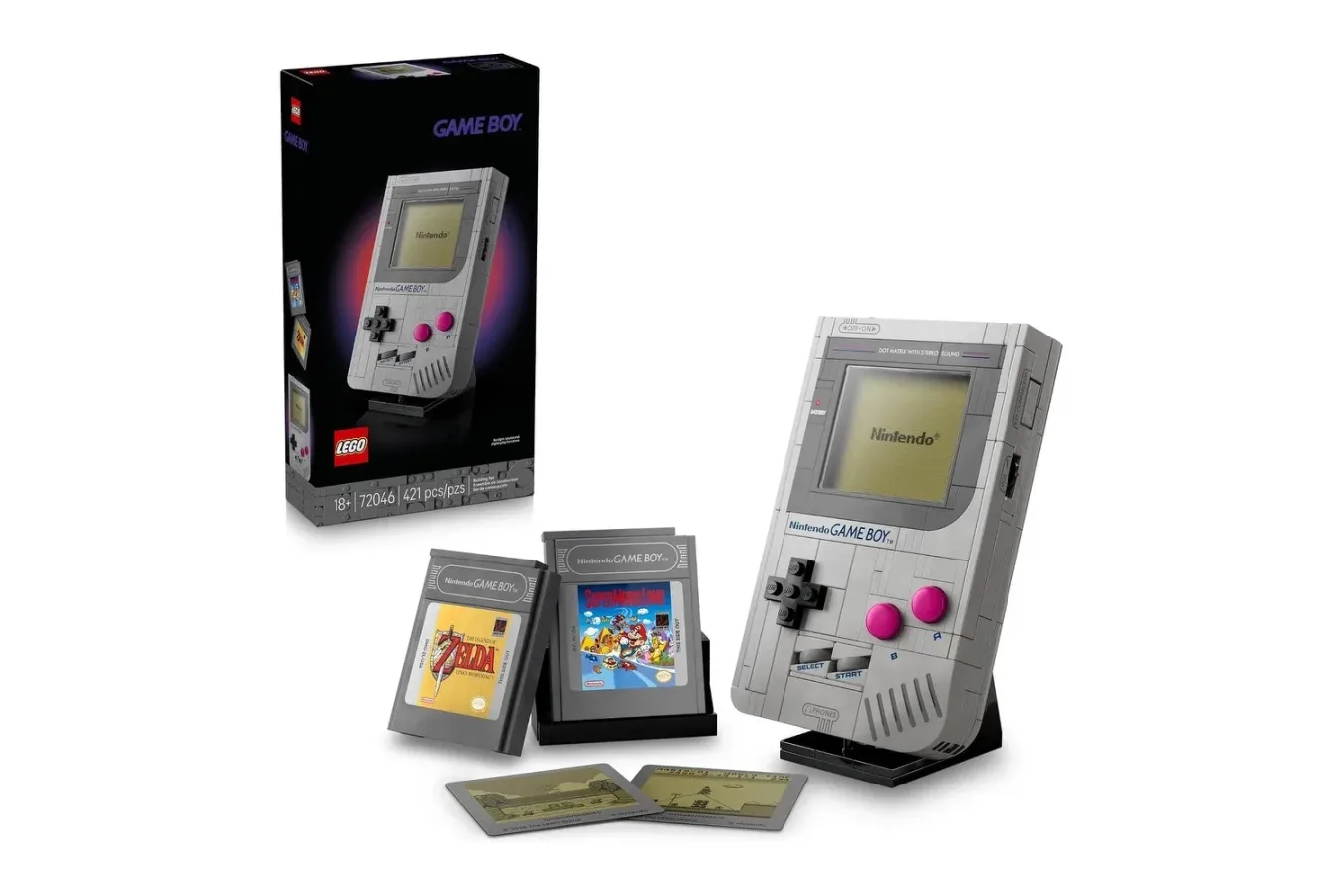
LEGO's brick-built celebration of Nintendo's original Game Boy is currently available for $50, a $10 reduction from its usual $60 price and a listed record low. For collectors who want a piece of handheld gaming history without chasing an aging console, damaged packaging, or temperamental original hardware, the LEGO Super Mario Game Boy offers a very different kind of nostalgia purchase: a display model designed to be built, handled, and regularly reconfigured.
The 421-piece set recreates the look of the classic Game Boy at nearly 1:1 scale. It is not a working game system, and it does not play Game Boy cartridges, but it leans heavily into the tactile and visual details that made Nintendo's first major handheld such an enduring piece of design. Its controls can be pressed, its cartridge slot accepts brick-built Game Paks, and its screen can be changed to represent different games and the familiar Nintendo startup display.
At $50, the set is aimed squarely at adult builders, retro game collectors, and Nintendo fans looking for something more substantial than a small desk ornament. The appeal is less about interactive play than the process of assembling a carefully recreated icon, then choosing which classic scene it will show on a shelf, in a game room, or alongside a collection of original hardware.
A recognizable handheld rebuilt in 421 pieces
The completed LEGO Super Mario Game Boy measures more than 5.5 inches high, 3.5 inches wide, and 1 inch deep. Those dimensions make it a compact model, but one that is close enough to the proportions of the original handheld to immediately read as a Game Boy from across a room.
For useful background on this topic, read Best Buy Gamers Sign-Ups Offer a Free $5 Reward Certificate for Early Members.
LEGO has reproduced many of the system's defining exterior elements. The model includes the cross-shaped +Control Pad, A and B face buttons, and the SELECT and START buttons. These pieces are functional in the sense that they can be physically pressed, adding an extra layer of hands-on authenticity even though they do not control software or electronics.
Other design touches are focused on making the model convincing from more than just its front-facing display angle. Builders will find contrast and volume dials, a Game Pak slot, printed labels modeled after the original hardware, and a rear battery cover. The result is intended to reward a closer look rather than functioning as a flat, simplified recreation of the console's silhouette.
That attention to recognizable hardware details matters for the Game Boy in particular. Nintendo's handheld was a utilitarian object: a pale casing, physical buttons, a cartridge sticking from the top, and controls that were simple enough to understand at a glance. Rebuilding those elements in bricks turns the original industrial design into the main event. Even without working games, the set captures much of the physical language that players remember.
Cartridges and screens are made to be swapped
The centerpiece feature is the ability to change the model's Game Pak and screen presentation. The package contains brick-built versions of Super Mario Land and The Legend of Zelda: Link's Awakening, two Game Boy releases that give the display a distinctly Nintendo-focused retro identity.
Each miniature Game Pak fits into the top cartridge slot in a manner meant to echo loading a real Game Boy game. The cartridges are not merely separate accessories to place beside the system; they are designed to slot into the model itself. For collectors who remember swapping cartridges between games, that small physical ritual is a large part of the set's appeal.
There are also three lenticular screens. One represents a scene from Super Mario Land, another represents Link's Awakening, and a third recreates the classic Nintendo startup screen. Lenticular printing creates the appearance of movement or shifting imagery when viewed from different angles. In this case, tilting or changing a viewer's position makes the screen scenes appear to change, giving the static build a little visual motion.
The cartridge and screen options mean the display does not have to remain fixed after construction is complete. A builder can showcase Mario for a while, switch to Link later, or use the startup image as a more hardware-focused presentation. The included display stand also provides a place to position the console at a slight angle, keeping the screen and buttons easy to see while allowing a cartridge to be displayed alongside it.
The set is built around the familiar act of loading a Game Pak and choosing a screen, translating a classic handheld routine into a shelf-display feature.
A display piece rather than a substitute for original hardware
For anyone hoping to play a library of original Game Boy games, this is not a replacement for a handheld system. It is a LEGO model first and foremost. Its functional buttons are physical details, while the cartridges and screens are display components rather than game media. That distinction is important, especially because the set's near full-size appearance could make it seem more like a novelty replica at a quick glance.
Its strengths are different from those of original hardware. Vintage Game Boys carry the charm of real play, original screens, batteries, link cables, and decades of software history. They can also require cleaning, repair work, replacement parts, or careful buying. The LEGO version sidesteps all of that by treating the Game Boy as an object of design and memory. It turns an instantly recognizable console into a construction project with a finished form that is safe to leave on display.
That makes it particularly suited to collectors who already have their original hardware stored away, fans who want a tribute without taking up much room, or builders who enjoy pop-culture sets with a clear purpose once they are finished. The stand, interchangeable screens, and cartridge options provide more flexibility than a conventional static model, even if the final product remains a display item.
Built for experienced fans, but approachable for newcomers
With 421 pieces, the LEGO Super Mario Game Boy is not among the largest or most demanding adult-oriented builds, but it offers enough detail to make construction feel like a focused evening project. The structure has to accommodate the front controls, dials, rear details, removable Game Paks, screen components, and display stand, so it should provide more variety than a simple decorative brick sculpture.
Step-by-step instructions are included, making the build accessible to newcomers as well as people who regularly assemble more complex LEGO sets. The moderate piece count can be especially appealing for someone who wants a satisfying, self-contained project rather than a massive build that occupies a table for days or weeks.
For longtime Nintendo players, the construction process may also be part of the nostalgia. Building the casing, fitting the controls into place, and inserting a cartridge at the end all mirror the way the original device's details are remembered. LEGO sets based on games often succeed when they do more than reproduce a logo; this one focuses on the physical identity of the platform itself.
What the $50 price means
The current $50 price is $10 below the set's usual $60 cost, representing roughly 17% off. While a $10 saving is not enormous in absolute terms, it is a meaningful reduction for a mid-priced display set that is likely to be purchased as a gift or collectible rather than a necessity.
The deal may be most relevant to buyers who had been waiting for a discount before picking it up. At its regular price, the model's specialized appeal is easy to understand: it is a faithful brick-built Game Boy, but not an actual game-playing handheld. At the reduced price, the combination of 421 pieces, two cartridge builds, three lenticular screen options, and a stand gives it a stronger case as a novelty collectible for a Nintendo-themed shelf.
It also arrives as an easy gift choice for fans of the original Game Boy era. Super Mario Land and Link's Awakening anchor the package in a specific period of Nintendo history, while the instantly recognizable console design makes the set accessible even to people who may not remember either game in detail.
For retro gaming fans, the LEGO Super Mario Game Boy is ultimately a celebration of the object as much as the games that ran on it. The $50 offer lowers the cost of adding that celebration to a collection, complete with pressable controls, changeable cartridges, shifting lenticular scenes, and a compact stand built for showing it off.
Community
Discussion
Start the conversation.
No comments have been posted yet.