

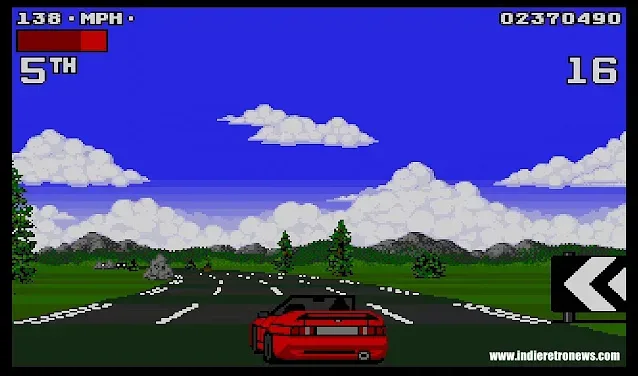
Lotus Turbo Challenge II DX has arrived as an ambitious fan-made upgrade for the Amiga version of the celebrated 1991 racer. Built for Amiga computers with at least 1 MB of Chip RAM, the DX release tackles one of the original game's most conspicuous technical compromises: players can now hear the soundtrack and in-race sound effects at the same time.
That may sound like a modest change to anyone encountering the game decades after its original release, but it speaks directly to a limitation veteran Amiga players have known for years. The original Lotus Turbo Challenge II delivered fast, colourful arcade racing, memorable music and a superb sense of speed, yet its audio presentation required trade-offs. This enhanced edition is designed to remove that compromise while retaining the identity and immediate playability that made the original so enduring.
The update is presented as the version fans always hoped to play: not a reinvention of the racing classic, but a technically expanded edition that respects its underlying design. Alongside mixed music and sound effects, version 13 adds a restored vocal checkpoint cue, expanded music selection before a race, and ten new two-tone colour schemes for rival cars.
A major audio improvement for the Amiga original
The headline feature in Lotus Turbo Challenge II DX is the ability to run music and effects together. In a game driven by speed, passing traffic and desperate checkpoint runs, the improvement has a practical as well as nostalgic appeal. Engine sounds, crashes, skids and other racing feedback can now sit beside the soundtrack rather than forcing the player to choose one part of the experience over the other.
For useful background on this topic, read Mappy Arrives on Commodore 64 in a New 1 MB REU Arcade Conversion.
The release also restores the authentic "Checkpoint" vocal announcement when the soundtrack has been muted. That detail matters because the game's structure is built around reaching checkpoints before time expires. The callout is more than a flourish; it reinforces the frantic rhythm of every run, providing a satisfying acknowledgement whenever the clock is kept alive.
Music has always been a major part of Lotus Turbo Challenge II's personality. Barry Leitch and Shaun Southern's work helped give the racer a distinctive identity among early-1990s home-computer games. The DX version lets players choose from all eight stage tracks, or select the main theme, before setting off. It is a welcome quality-of-life addition for players returning to favourite tunes and for newcomers discovering why the game's soundtrack remains so fondly remembered.
The original arcade race remains the focus
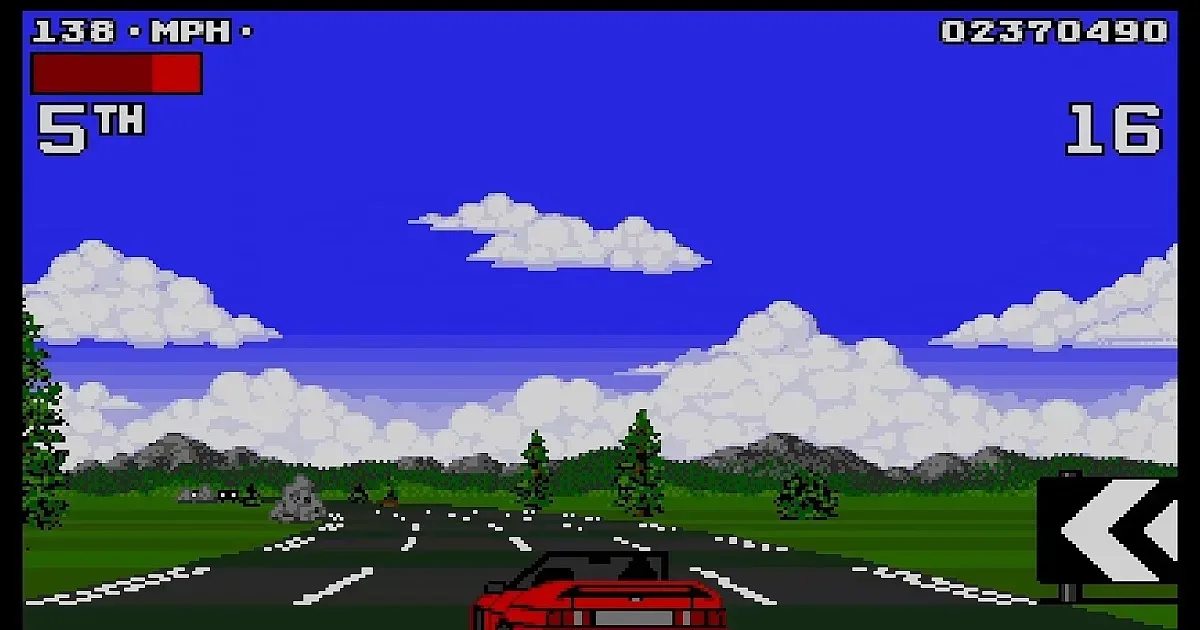
For all its enhancements, Lotus Turbo Challenge II DX keeps the core game intact. Players race from a behind-the-car viewpoint, guiding a Lotus through a sequence of visually varied courses while dealing with opposing drivers, civilian vehicles and a rapidly draining timer. The goal is not a conventional series of measured laps; it is survival through momentum. Every checkpoint reached adds precious time, and every collision risks turning a strong run into a failed attempt.
That structure gives the game a character distinct from many circuit racers of its era. The player is constantly encouraged to drive aggressively, find room through traffic and preserve speed. Time and speed boosts become especially valuable because the countdown is not just an abstract score system. It is the central pressure shaping every decision on the road.
The courses move through varied environments including snow-covered routes, desert terrain and busy two-way motorways populated by oncoming traffic. That last hazard remains a defining part of the game's tension. A road that seems open one moment can become a dangerous puzzle of rival cars and civilian traffic the next, demanding split-second steering corrections at high speed.
Players can take the wheel of the returning Lotus Esprit or choose the Lotus Elan convertible. The two vehicles offer a meaningful contrast: the Esprit brings back the familiar shape associated with the series, while the Elan is known for its stronger grip. The choice gives racers a small but important way to match their car to their preferred style, whether that means prioritising the confidence of handling or sticking with the iconic original machine.
New colours without changing the game's character
DX also introduces ten new two-tone paint jobs for opponents. It is a cosmetic addition rather than a change to the game's rules, but it adds variety to a racer whose split-second readability is important. Extra colour combinations can make the competition look more lively while preserving the familiar visual language of the original release.
The approach across the project is notably conservative in the best sense. It does not attempt to turn Lotus Turbo Challenge II into a modern racing simulator or replace its classic visuals with an unrelated style. Instead, it focuses on features that feel natural for an enhanced Amiga edition: better audio handling, greater control over music, a restored presentation detail and additional colour variation.
For retro players, this kind of enhancement can be particularly appealing because it provides a chance to revisit a game in a form that feels closer to an idealised memory of it. The fast controls, timer-driven races and bright environments are still the foundation. DX simply gives them a more complete audiovisual presentation.
Why Lotus Turbo Challenge II still matters
Lotus Turbo Challenge II was developed by Magnetic Fields and originally published by Gremlin Graphics in 1991. It became a high-profile Amiga racing game before appearing on other systems, including the Atari ST, Sega Mega Drive and Acorn Archimedes. Its reputation was built on a combination of accessible arcade handling, technical speed and excellent audiovisual style.
Magnetic Fields assembled a team whose work left a lasting mark on the game. Shaun Southern handled programming and also contributed to the music. Andrew Morris created the graphics, Peter Liggett was responsible for level design, and Barry Leitch joined Southern on the soundtrack. The DX project explicitly credits the original creators for the game itself, an important distinction for a fan-led upgrade built upon a much-loved commercial release.
Its enduring appeal is easy to understand. Lotus Turbo Challenge II is immediately readable: accelerate, avoid danger, reach the next checkpoint. Yet within that simplicity is a demanding arcade challenge. Racing lines matter, traffic patterns matter, recovery after a collision matters, and knowing when to take a risk can decide whether the timer reaches zero just short of safety.
The game also belongs to a period when home-computer racers often had to balance ambitious motion, colourful scenery and sound within strict hardware constraints. The original Amiga version's audio trade-off was part of that reality. By addressing it today, DX does not erase the original achievement. Instead, it highlights how much the original accomplished while offering an alternative that uses the available Amiga memory requirement to push the presentation further.
A fan project with an AI disclosure
Lotus Turbo Challenge II DX was created by John Boatofcar Shawler, with GPT-Codex credited in the project's AI disclosure. The release is therefore clear about the use of AI-assisted tooling in its creation. In a retro community where preservation, modification and technical craftsmanship are all closely watched, that transparency is useful context for anyone interested in how the project came together.
The project's stated requirements are equally straightforward: it is intended for Amiga hardware with a minimum of 1 MB of Chip RAM. No new commercial-platform release, price or wider availability details have been specified here, so players should treat it as an Amiga-focused enhancement rather than an announced port for contemporary consoles or computers.
An enhanced route back to 1991
Lotus Turbo Challenge II DX is ultimately aimed at people who already understand why the original remains special, but its improvements are easy to appreciate even without that history. Simultaneous music and effects make the racing feel fuller. The revived checkpoint voice adds personality. Track selection gives the player more agency over one of the game's strongest elements. New rival liveries offer a little extra variety without disrupting the established look.
Most importantly, the release leaves the classic race structure in place. Players are still charging through snow, sand and traffic, trying to preserve speed while the clock threatens to end the run. The Esprit and Elan are still there. The checkpoints still provide the lifeline. The result is an update that aims not to replace Lotus Turbo Challenge II, but to let its original design be heard and enjoyed with fewer technical compromises.
Community
Discussion
Start the conversation.
No comments have been posted yet.