


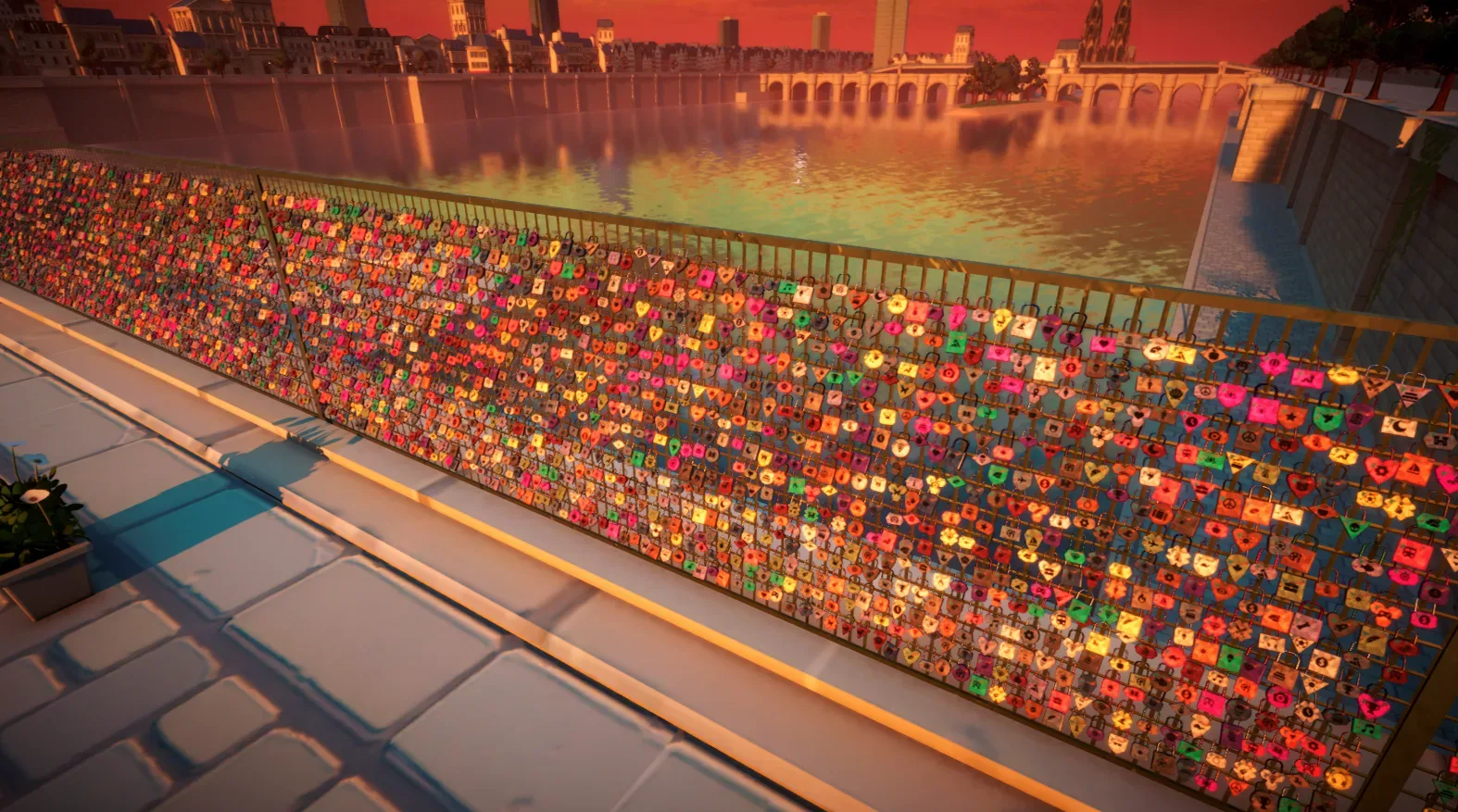
Love Locks, a first-person cleanup game from Blue Brain Games and Collision Games, will launch worldwide on December 3, 2026. Heading to Steam for Windows PC and macOS, the game gives players a remarkably specific restoration job: remove 100,000 love locks from a bridge in Paris.
The premise draws on the familiar custom of couples attaching padlocks to bridges as symbols of their relationships, often throwing away the keys afterward. In Love Locks, those discarded keys have wound up in the Seine, leaving the player with a large-scale puzzle and cleanup operation. Rather than simply clicking through a list of locks, players will use a specially outfitted drone to magnet-fish keys from the river, identify which locks they open, and steadily reclaim the bridge one piece at a time.
It is an intentionally calm concept on its surface, built around the satisfaction of making a crowded space clean again. But the developers are also giving the process a comic escalation. What begins with conventional keys and pliers will eventually expand into far more dramatic equipment, including saws, bolt cutters, shotguns and lasers.
A Huge Cleanup Job in Paris
The defining number behind Love Locks is 100,000. Players are not clearing a handful of objects or completing a small environmental side activity; the bridge is packed with one hundred thousand locks to dismantle. That scale makes the act of gradual progress central to the experience. Each removed lock should contribute to a visible transformation as the bridge is cleared.
For useful background on this topic, read Dreadline Express Earns Best Narrative and Soundtrack Nominations at The Horror Game Awards 2026.
The opening loop begins down at the river. Players control a drone capable of collecting keys with a magnetic fishing setup, then need to match a recovered key with its corresponding lock. It is a practical, tactile-sounding routine that frames cleanup as a sequence of small victories: search, retrieve, identify, unlock and remove.
Not every lock will apparently yield to the earliest equipment, however. Tool progression will let players move beyond basic hand tools. Keys and pliers form the initial foundation, while saws and bolt cutters offer stronger options as the work develops. The inclusion of shotguns and lasers suggests the game will lean into absurdity as much as it does simulated tidying. The result is a concept that can shift from a gentle matching exercise into a more exaggerated demolition task without abandoning its core goal.
That contrast is likely to be a major part of the appeal. Cleanup games often focus on simple repetition and the pleasure of restoring order. Love Locks retains that inviting, methodical setup, but its equipment list makes clear that it is not treating bridge maintenance as a completely straight-faced simulation. Removing a padlock with a laser is a far cry from delicately finding its key in the Seine.
For another perspective on this story, read Love Locks Sets December 3, 2026 Steam Launch for a 100,000-Lock Paris Cleanup.
Every Lock Has a Small Relationship Story
The locks are not presented purely as anonymous debris. Dismantling them will reveal humorous flashbacks connected to the relationships behind them. This gives the giant cleanup task a more character-driven layer, turning the bridge into a collection of tiny romantic--or perhaps not-so-romantic--stories.
The announced flashbacks fit the game's playful treatment of love-lock traditions. A lock may represent devotion, an awkward memory, or a relationship whose story is less sentimental than the gesture initially implies. Blue Brain Games and Collision Games have described these moments as humorous, so players should expect comedy rather than a purely reflective portrait of couples leaving symbols behind on a Parisian landmark.
That framing could also help sustain the long process of clearing 100,000 locks. The central mechanical objective is enormous, and the revealed relationship scenes offer an additional reason to keep investigating the next padlock. They make each individual removal part of a larger accumulation of jokes and memories, rather than only another number reduced from a vast total.
Solo Relaxation or Four-Player Online Co-op
Love Locks supports both solo play and online co-op for as many as four players. Players who want a quiet, individual cleanup session can work through the bridge at their own pace, while groups can share in the search for keys and the removal of locks.
The co-op approach includes independent locks and progress for each participant. That detail is important for a game centered on a very large cleanup count: each player has their own progression rather than simply being folded into another player's completion state. It should allow friends to tackle the bridge together while still maintaining personal advancement.
The game also plans to include a companion that can be unlocked for people playing without friends or a significant other. It is a fitting joke for a game built around declarations of romance, and it recognizes that not everyone will be approaching the co-op option with a ready-made partner. The companion provides another way for solo players to avoid feeling entirely alone during a task of this size.
Whether played alone or with a full group, the game's structure appears designed around flexible sessions. A player can spend time methodically magnet-fishing keys and using pliers, while another may prefer the eventual power-tool escalation. Co-op adds the potential for divided roles and shared chaos, especially once the available gear becomes more unconventional.
A Wedding or Divorce Prize for the Fastest Cleanup
To mark the launch, the developers are attaching a real-world incentive to the game's ultimate completion challenge. The player who clears all 100,000 locks in the fastest verified time will have the chance to receive up to US$5,000 toward either a wedding or a divorce.
The unusual prize mirrors the game's comedic attitude toward romance. Love locks are traditionally an expression of commitment, but Love Locks is willing to acknowledge both possible directions a relationship can take. The wedding-or-divorce framing turns the competitive race into another extension of the game's central joke.
Eligibility and the final terms will be governed by the official rules, so interested players will need to consult those rules when they become available. The announcement specifically describes the reward as a chance to receive up to US$5,000, rather than an unconditional payment for anyone who finishes quickly. Still, the competition gives dedicated completionists a reason to consider how quickly and efficiently an entire bridge can be cleared.
It also raises an intriguing question about strategy. The key-matching process may reward careful searching early on, while increasingly powerful tools could change the pace later. With a verified fastest-time target on the line, players may be tempted to experiment with routes, tool use and co-op teamwork once the game is available.
Release Details
Love Locks launches December 3, 2026, on Steam for Windows PC and macOS. Pricing has not yet been announced. Players can wishlist the game on Steam ahead of release.
For anyone drawn to restoration games, unusual first-person jobs, or co-op experiences that balance relaxed routines with sillier escalation, the premise has a distinct hook. There is a simple satisfaction in clearing an overcrowded bridge one object at a time, while the drone-based fishing, relationship flashbacks and increasingly excessive toolkit give that work its own identity.
Most importantly, the game is not hiding the scale of its objective. There are 100,000 locks waiting on the Parisian bridge, and every player will have to decide whether to approach that mountain of metal with patience, teamwork, or eventually a laser.

Community
Discussion
Start the conversation.
No comments have been posted yet.