

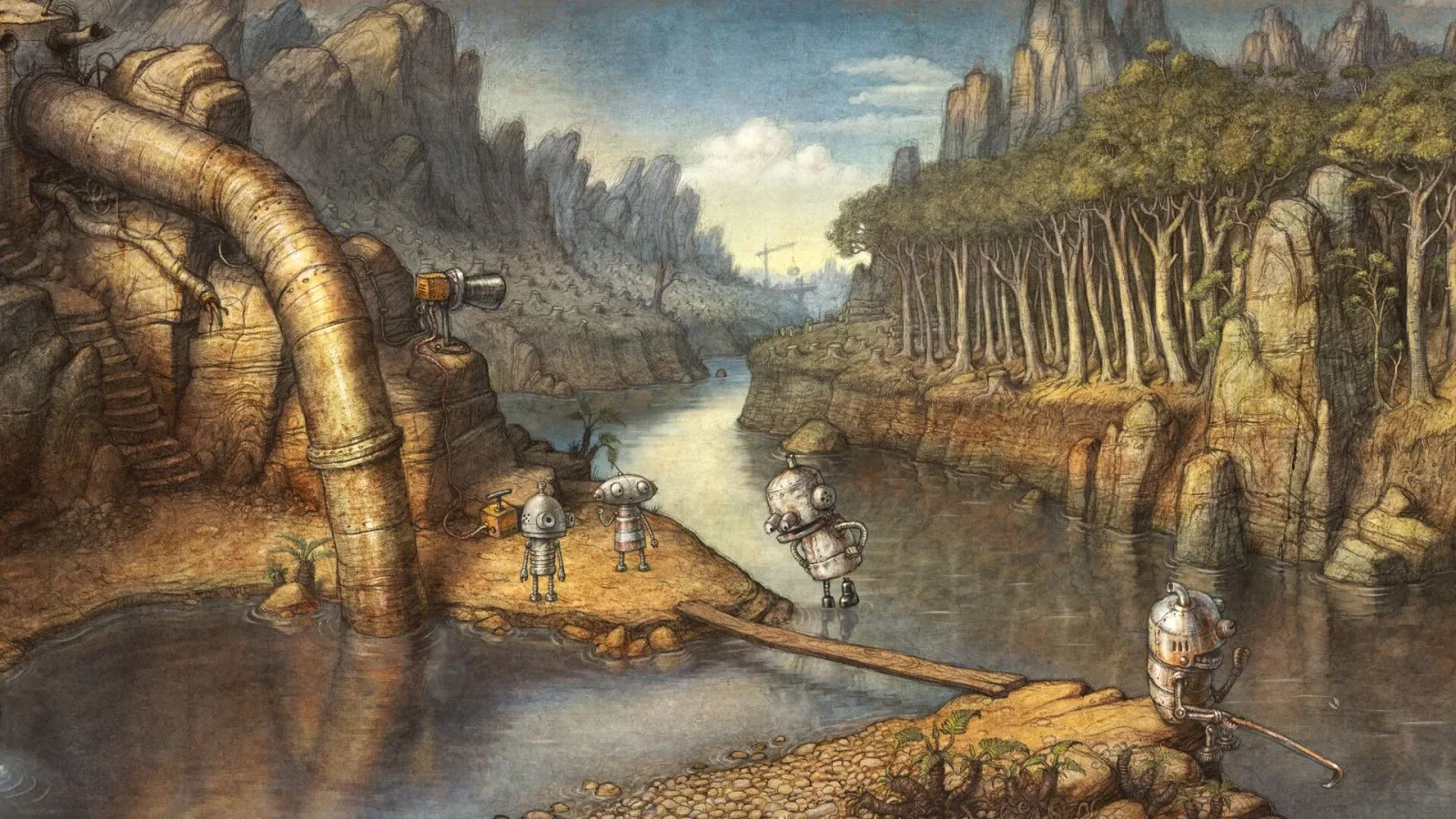
Machinarium 2 has been announced, marking a long-awaited return to Amanita Design's celebrated hand-drawn puzzle-adventure world. The new game arrives 17 years after the original Machinarium, once again placing the studio's small robot hero Josef at the center of a wordless journey filled with strange machinery, environmental puzzles, expressive animation, and imaginative settings.
The original game introduced players to Josef, a resourceful robot trying to save the city of Machinarium from the Black Cap Brotherhood. Its intricate illustrated environments, gentle sense of humor, and puzzles built around interacting with the scenery helped it become one of the most enduring independent adventure games of its era. Now, Amanita Design is picking up after that story's ending rather than simply revisiting the same city and conflict.
In Machinarium 2, Josef and his friend Berta escape Machinarium, only to crash-land in a new region known as the Barrens. Their arrival leads them toward a concealed green valley inhabited by two unusual robot communities. One tribe resides in a monastery high above the valley, while the other lives below. Both groups are reportedly facing a dwindling power supply, establishing a new problem for Josef and Berta to unravel together.
A New Journey Beyond Machinarium
The change of setting is an important one for the sequel. The first game was closely associated with its towering, industrial robot city: a place of rusting metal, pipes, junk heaps, workshops, and crowded mechanical neighborhoods. The Barrens and its hidden valley suggest that the follow-up will broaden the series' visual world considerably, pairing the familiar mechanical design language with a more lush and isolated environment.
For useful background on this topic, read Forza Horizon 6 PS5 Release Set for January 2027 With Cross-Play and Day-One Expansion Update.
Amanita Design's announcement footage offers an early look at the detailed cartoon art and animation for which the team is known. The studio has consistently favored handcrafted imagery over realism, building settings that feel like illustrated storybooks brought to life. That artistic approach has been a key part of the appeal of Machinarium and other Amanita projects, where every screen can contain visual gags, tiny moving parts, unconventional characters, and clues woven directly into the scenery.
There is no release date for Machinarium 2 yet. A Steam page is now live, allowing PC players to wishlist the game, but the announcement does not establish when it will launch or identify any additional platforms. For now, the reveal is primarily a confirmation that the follow-up is in development and that Josef's story will continue.
Josef and Berta Will Both Be Playable
One of the largest gameplay additions is the inclusion of two playable protagonists. Players will control both Josef and Berta, switching between them when needed as the pair works through the challenges ahead. The original game focused solely on Josef, whose ability to extend and retract his body was frequently used in its puzzles. Giving Berta a playable role opens the possibility for puzzles that depend on coordination, separate viewpoints, and character-specific interactions.
The exact nature of each robot's abilities has not yet been detailed. Still, the ability to move between Josef and Berta at will indicates that cooperation will be central to the sequel's design. The two characters may need to reach different areas, manipulate separate mechanisms, or combine their efforts to help the valley's two communities. It is a natural evolution for a series built around observational puzzle solving, since two characters can make a location feel more dynamic without abandoning the intimate, screen-by-screen structure associated with classic point-and-click adventures.
Communication will remain free of conventional written dialogue. Josef and Berta will express themselves through thought-bubble pictographs, continuing a defining Amanita Design tradition. Rather than relying on text-heavy conversations, the studio often uses images, gestures, sounds, and context to explain a character's needs or convey a joke. That design makes its games approachable across language barriers while asking players to pay closer attention to visual details.
The pictograph system also gives Amanita's worlds an unusual sense of universality. A robot can display an image of an object it wants, an emotion it feels, or an event it remembers, and players can interpret that information immediately. In the first Machinarium, this technique made even brief exchanges memorable and helped Josef's largely silent adventure feel warm and personal. Its return should ensure that the sequel retains the expressive, almost pantomime-like quality of the original.
A Signature Amanita Design Style
Amanita Design has spent years developing a distinctive identity in adventure games. The Czech studio is also responsible for the Samorost series, Botanicula, Chuchel, Creaks, and this year's Phonopolis. While these games differ in tone and subject matter, they share a fascination with unusual worlds, tactile animation, unconventional creatures, and storytelling that lets artwork and sound do much of the talking.
Machinarium remains one of the team's most widely remembered works, in part because it blended melancholy industrial scenery with a sweet-hearted central character. Josef's mission had high stakes, but the game's atmosphere was rarely harsh. Its dirty streets and intimidating machines were balanced by playful inventions, eccentric robots, and moments of quiet charm. The sequel's premise, with its stranded heroes and energy-starved robot tribes, appears positioned to continue that balance between mystery, comedy, and kindness.
Music will once again be an important part of the experience. Amanita's projects are strongly associated with the work of longtime collaborator Tomás "Floex" Dvorák, whose soundtracks have helped establish their dreamy, electronic, and sometimes melancholy moods. The announcement emphasizes the studio's familiar audiovisual character, and the return of that creative sensibility will be reassuring for fans who associate the first game with both its art and its atmosphere.
Machinarium 2 will continue the story with Josef and Berta leaving the city behind and entering an unfamiliar land where two robot societies need help.
Why the Sequel Is a Major Surprise
A 17-year gap makes Machinarium 2 an especially unexpected revival. The original arrived in 2009, and while Amanita Design has remained active ever since, it has generally moved between new settings and new casts rather than repeatedly returning to a single series. The studio's willingness to revisit an earlier favorite has precedent, however. Samorost 3 arrived in 2016, 11 years after the previous entry, proving that a lengthy absence does not necessarily mean a world has been left behind permanently.
That history makes the new announcement feel less like a nostalgic remake and more like a deliberate continuation. The developers are not merely reintroducing Josef for a short celebration of the original; they are giving him a new destination, a new companion role for Berta, and a premise designed around a different community in need. For returning players, it offers the chance to reconnect with a familiar character. For newcomers, it could also function as an entry point into Amanita's broader catalogue of visually driven adventures.
The original game's influence can still be felt in the independent puzzle genre. Its art style was immediately recognizable, and its interface showed how a point-and-click adventure could minimize words without minimizing personality. Its puzzles asked players to read a space carefully, experiment with objects, and occasionally make use of an in-game hint system when a mechanical challenge became too obscure. Whether every one of those features will return has not been confirmed, but the first details make clear that the sequel is preserving the foundations that made the original special.
What Players Can Expect Next
At this early stage, many practical details remain unknown. Amanita Design has not announced a launch window, and no price or console versions have been confirmed. The Steam listing establishes a PC destination for the game, while the reveal itself focuses on the new setting, the playable duo, and the continuation of the series' visual storytelling.
Those details are enough to set expectations for the kind of experience Machinarium 2 aims to be: a carefully illustrated adventure centered on exploration and puzzles rather than action, with Josef and Berta investigating a hidden corner of a robot-filled world. The dual-protagonist structure may bring a fresh layer to the formula, but the game's hand-drawn environments, animated characters, visual humor, and symbolic conversations all point toward a faithful return.
For a game that has spent nearly two decades as a standalone favorite, Machinarium 2 is a rare kind of sequel announcement. It honors a beloved past while moving its heroes somewhere entirely new. Josef is no longer simply trying to save his city; alongside Berta, he is stepping outside it, into the Barrens and toward a valley whose problems may require a very different kind of mechanical ingenuity.
Community
Discussion
Start the conversation.
No comments have been posted yet.