

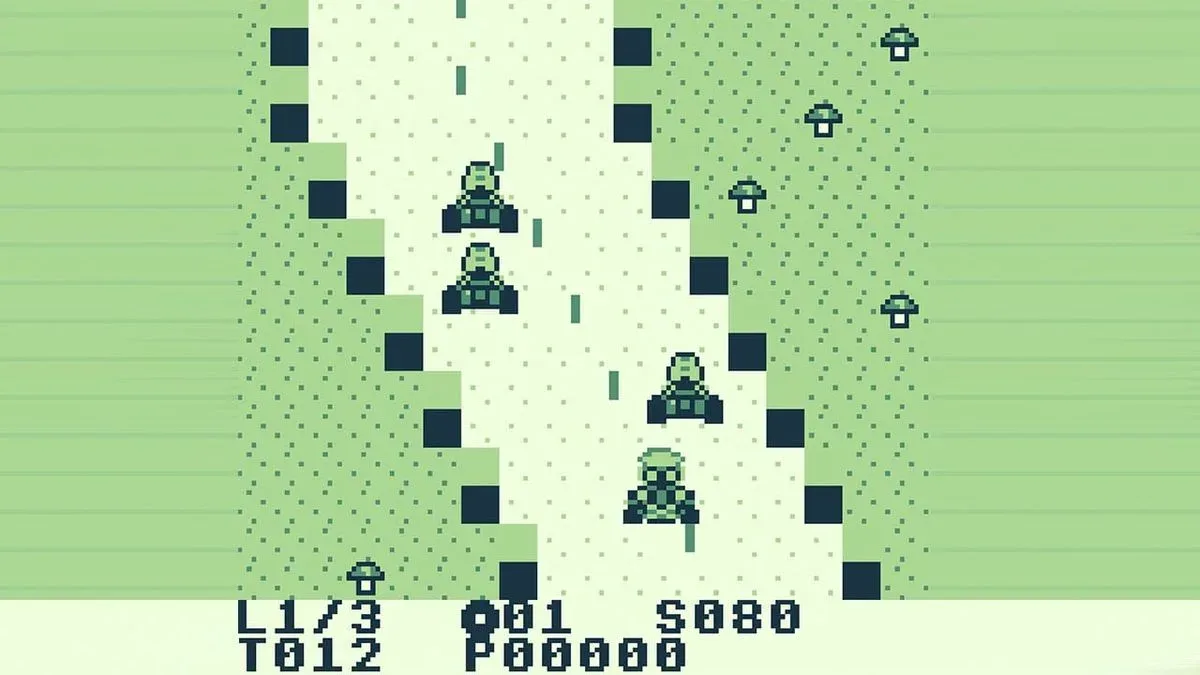
Mario Kart Rally DMG is a newly released browser game that reimagines the familiar kart-racing formula through the visual language of Nintendo's original Game Boy. Created by Dallasapp711 and available to play for free on Itch.io, the project presents an 8-bit, dot-matrix-inspired take on a type of game that would not receive an official handheld outing until years later.
The result is not a full recreation of any one Mario Kart entry, nor does it aim to match the technical scope of later portable racers such as Mario Kart: Super Circuit on Game Boy Advance. Instead, Mario Kart Rally DMG is a compact demake built around quick arcade-style sessions, monochrome presentation, chiptune audio, and a simple browser interface that can be used on phones and tablets as well as desktop devices.
For retro fans, that premise is the main attraction. The original Game Boy was enormously important to Nintendo's handheld history, but its hardware came with clear limitations: a monochrome screen, modest processing power, and no realistic route to the kind of fast, Mode 7-style visual tricks that defined Super Mario Kart on Super Nintendo. Mario Kart Rally DMG leans into that alternate-history appeal rather than trying to hide its constraints.
An imagined Game Boy version of kart racing
Demakes occupy a particularly interesting place in fan-game culture. Where a remake commonly updates an older release with modern visuals or systems, a demake asks the opposite question: what if a newer or more advanced game had been made for much older hardware? That exercise can be playful, technically ambitious, and revealing. It forces creators to choose which elements of a game are essential and which ones can be simplified without losing its identity.
For useful background on this topic, read Giant Pokémon Game Boy Color Build Turns Pokémon Yellow Into a Larger-Than-Life Adventure.
In this case, Mario Kart Rally DMG takes the broad idea of racing through colourful game-inspired environments and translates it to an original Game Boy-like framework. The visuals use the limited, highly recognizable look associated with the DMG model, with chunky sprites and an intentionally restricted display style. Chiptune tracks accompany the racing, reinforcing the impression of a cartridge-era game running on a small handheld screen.
The presentation is more than surface-level nostalgia. A convincing demake has to make its compromises feel purposeful. The Game Boy aesthetic works because it gives the project a clear identity: this is not trying to be a miniature version of a current console racer. It is trying to evoke the sensation of discovering a lost portable curiosity from the early 1990s.
Mario Kart Rally DMG is designed around the quick thrills and racing disorder associated with a classic kart racer, but delivered in a Game Boy-style format.
That imagined context also helps explain why the game is built for immediate play. There is no requirement to configure an emulator or manage a ROM file before starting. Players can open it in a web browser and begin racing, a setup that fits short sessions particularly well.
Checkpoint racing gives it an arcade focus
Mario Kart Rally DMG's gameplay is structured less like a deep championship simulation and more like an arcade time challenge. Players race through courses while attempting to reach checkpoints before the clock runs out. Progress depends on staying on pace, which gives every turn and obstacle added urgency.
This checkpoint-based approach is a sensible fit for the project's stripped-back design. Traditional Mario Kart games often layer several goals together: finishing position, item use, lap counts, multiplayer rivalries, shortcuts, and time trials. A smaller browser game does not need to reproduce every one of those systems to capture the pressure and excitement of racing. A timer, a sequence of checkpoints, and tracks that demand attention can deliver a focused challenge on their own.
The courses draw inspiration from classic game locations, while the moment-to-moment handling has been described as carrying a more arcade-like feel. That distinction is important. Mario Kart Rally DMG is not positioned as a historically accurate attempt to reverse-engineer a hypothetical Game Boy Mario Kart. It is a modern fan project using retro design cues to create something accessible and fast-moving.
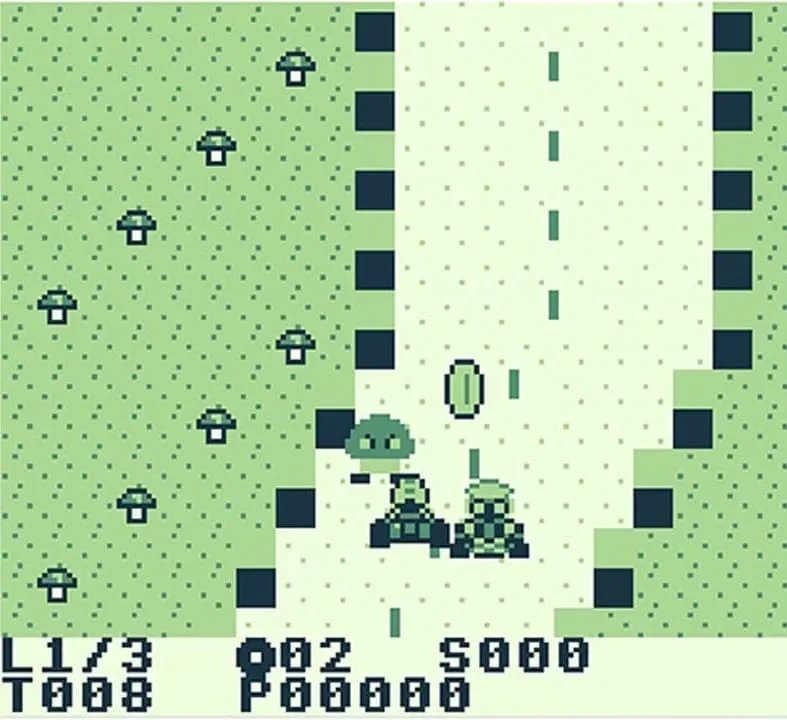
Players can also expect familiar genre touches, including coins to collect and 8-bit Goombas to encounter. Details like these matter because they connect the game's tiny monochrome tracks to the larger Mushroom Kingdom tradition, even as the project operates within a very different technical style.
Built for browsers, including mobile devices
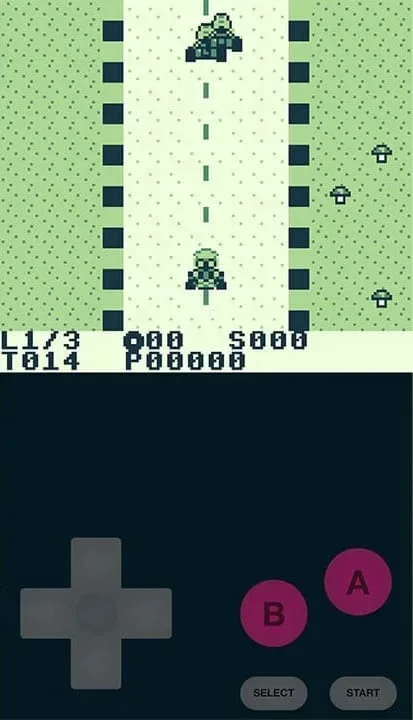
One of the most practical features of Mario Kart Rally DMG is its browser-based format. It can be opened without installing a dedicated emulator, and its simple Game Boy-inspired control presentation makes it suitable for touch-enabled devices. That means iPhone and iPad users can launch a race directly from a browser, rather than treating the game as a more involved retro-emulation project.
Browser games have become an increasingly useful home for short-form retro experiments. They remove much of the friction that can stand between curiosity and play. A player sees a game, opens a page, learns the controls, and can quickly decide whether they want to spend five minutes or much longer chasing better runs. For a small arcade racer, that convenience is especially appropriate.
The browser-only release does come with an important limitation. Although the game was optimized around the original DMG Game Boy concept, it is not playable on an original Game Boy or as a conventional handheld cartridge release. Its connection to the hardware is stylistic and design-driven rather than a literal physical-hardware deployment.
That does not diminish the appeal of the project. In some ways, using a modern browser to access a deliberately old-fashioned game is part of the charm. The contrast makes the demake easy to share and easy to sample, while its graphics and sound retain the personality of an earlier era of portable gaming.
A reminder of how far handheld Mario Kart came
Mario Kart Rally DMG also provides a useful point of comparison for the official series' portable evolution. The original Game Boy was never home to a Mario Kart release. Nintendo eventually brought the series to handhelds with Mario Kart: Super Circuit for Game Boy Advance, a system far more capable of presenting the speed, scaling effects, colour, and track complexity associated with the franchise.
Later entries would push portable kart racing much further, adding stronger multiplayer options, expanded rosters, more elaborate courses, and increasingly polished audiovisual presentation. Against that history, a Game Boy demake naturally feels modest. Its limited aesthetic is the point, however. The game invites players to imagine a version of the series that had to work with fewer buttons, less screen space, less memory, and a far more constrained display.
That thought experiment is part of why fan-made demakes remain compelling. They are not only nostalgia projects. At their best, they are design exercises that show how a game's core idea can survive radical changes in technology. Racing against time, steering around hazards, collecting items, and reading a course quickly are concepts that can still be recognizable even when the presentation has been reduced to a handful of shades and simple sprites.
An old-school project with a clear creative stance
Dallasapp711 has also stated that no AI was used in the creation of Mario Kart Rally DMG. For players interested in the craft behind small retro-styled projects, that detail speaks to the game's deliberately old-school character. Its appeal comes from authored pixel-art sensibilities, sound choices, and gameplay decisions intended to resemble a particular hardware era.
The project arrives at a time when retro visuals continue to thrive across indie games, homebrew releases, ROM hacks, and fan creations. The Game Boy remains one of the most enduring reference points in that space because its limitations are so immediately recognizable. Even people who never owned the system tend to understand what its green-tinted screen, large sprites, and simple audio represent.
Mario Kart Rally DMG uses that recognition effectively. It does not need to compete with the scale of modern Mario Kart games, and it does not need to replace them. It offers a different kind of novelty: a brief, playful glimpse at an alternate portable history where kart racing arrived on the DMG long before Game Boy Advance made the idea officially possible.
For anyone who enjoys demakes, browser games, or the enduring appeal of Game Boy-style design, it is an easy project to explore. The checkpoint races, coin collecting, chiptune backing, and compact controls all support the same idea: take a hugely familiar racing concept, strip it back to its essentials, and see how much fun remains when it is viewed through an 8-bit handheld lens.
Community
Discussion
Start the conversation.
No comments have been posted yet.