


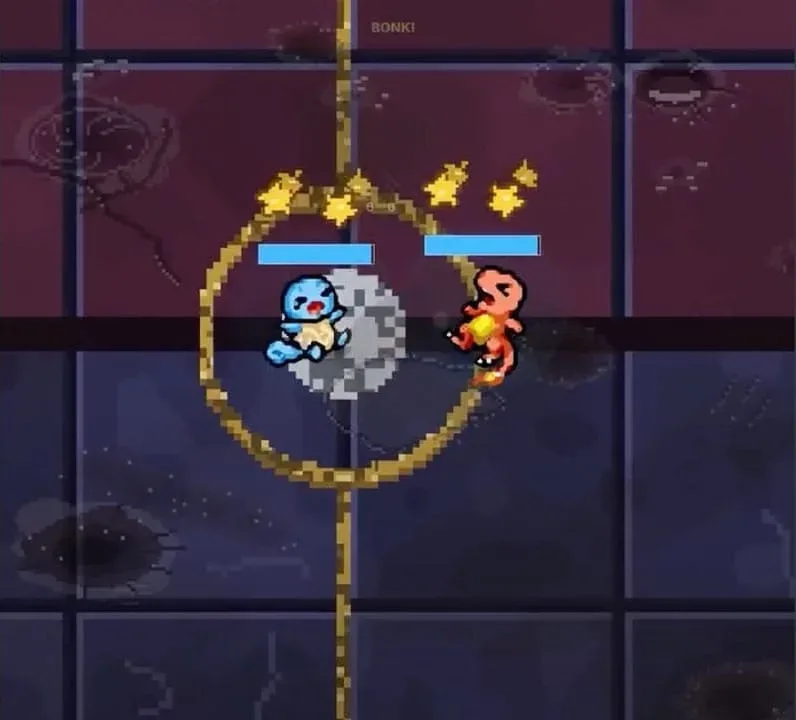
Pokémon Arena is an in-development battle project from Big Kid Nation that is drawing attention for a striking idea: put retro-styled Pokémon sprites into rapid, real-time arena fights rather than traditional turn-based encounters. Early teaser footage suggests a game built around movement, dodging, attacks and changing terrain, with a visual approach that recalls the earliest sprite-based Pokémon games while its combat ambitions lean toward modern action battlers.
There is still a great deal that has not been established. Big Kid Nation has shared teaser material and broad development comments, but there is no confirmed release date, no announced platform list and no full breakdown of the game's systems. Even so, the footage has made the central pitch clear enough to generate interest: Pokémon Arena appears to be aiming for fast, direct battles where players actively control their combatants in enclosed 2D spaces.
A different approach to Pokémon-style battles
Traditional Pokémon battles are defined by menus, turns, move selection and a deliberate pace. Pokémon Arena appears to move in the opposite direction. Its fights take place in real time, with combatants moving freely around arena-like stages and avoiding incoming attacks rather than waiting for a command sequence to resolve.
Embedded Instagram post
That distinction is important. The project may visually evoke old-school Pokémon through its compact pixel sprites, but it does not appear to be recreating the structure of a Game Boy-era role-playing battle. It also differs from the presentation associated with Pokémon Stadium, where players select commands and watch them play out through 3D animations. Here, positioning and immediate reactions seem to be central to the experience.
For useful background on this topic, read Giant Pokémon Game Boy Color Build Turns Pokémon Yellow Into a Larger-Than-Life Adventure.
The closest broad comparison is an arena fighter adapted to a 2D, sprite-driven format. Players can apparently evade attacks, pursue opponents and engage in a more kinetic exchange than the franchise's conventional RPG encounters allow. That could make Pokémon Arena especially notable for people who enjoy the designs and move sets associated with classic Pokémon but want a more hands-on competitive game.
Retro sprites, but not a simple nostalgia project
The early gameplay material uses an "OG" sprite style, giving its creatures a deliberately retro look. That aesthetic is likely to be the first thing many viewers notice, particularly because it contrasts sharply with the real-time action. Pixel-art monsters moving through active battlefields create an unusual blend: familiar visual language from handheld-era games paired with mechanics that seem designed for faster play.
The concept is not simply about putting sprite characters into a flat fighting-game stage. The arenas shown so far appear to have varied surfaces and environmental identities. Battles have been seen on water, grass, dirt and concrete-like terrain, giving the project more visual texture than a single neutral battlefield would provide.
More significantly, the terrain seems capable of responding to combat. Digging and heavy impacts, including body slams, can leave holes or craters in the stage. That detail could be much more than a visual flourish if it affects movement, sight lines, attack placement or the safe areas available during a match. At this early point, however, it is not yet clear how deeply those changes feed into the game's actual strategy.
Destructible or deformable arenas are a promising feature because they can make a fight feel less static. In a real-time game, a changing battlefield has the potential to reward awareness as much as attack execution. It may also help differentiate individual matches, especially if player actions leave lasting marks on the arena for the duration of a battle.
Footage points to larger-scale encounters
Teaser material has shown as many as five Pokémon fighting at once. That immediately raises questions about the intended format. A five-combatant clash could be a free-for-all, a team mode, a showcase battle or part of another ruleset entirely. Big Kid Nation has not yet supplied a detailed explanation of match structures, victory conditions, roster size, move systems or how each monster's abilities will translate into real-time play.
Still, the possibility of several combatants sharing one arena is one of Pokémon Arena's more intriguing elements. Multiplayer action games become dramatically more chaotic once players have to track attacks from multiple directions. With dodging, terrain effects and a potentially crowded screen all in play, clarity and balance will be crucial. The project will need readable effects, responsive controls and enough visual distinction between fighters for larger battles to remain understandable.
Big Kid Nation has said it plans to work on a multiplayer mode in the coming months. That wording is worth noting because it indicates multiplayer is an objective rather than a fully detailed, confirmed feature set ready for launch. Whether multiplayer will be local, online, competitive, cooperative, or some combination of those options has not been specified.
Two years of work and a long-held idea
Big Kid Nation has said the project has been in development for two years. The team also described the concept as something it had considered making for 17 years, suggesting that Pokémon Arena is the result of a long-running ambition rather than a sudden response to current trends.
The developer has indicated that the game is nearing the point where it can enter a public beta test. No date for that beta has been announced, and there are no confirmed details regarding how players might participate. A public test would nevertheless be an important next step. Short gameplay clips can demonstrate animation, stage effects and the basic appeal of the premise, but only hands-on testing can answer the bigger questions about responsiveness, balance and long-term appeal.
For a project centered on real-time combat, those questions matter enormously. A battle game can look exciting in a brief highlight reel while still needing substantial refinement in hit detection, movement speed, recovery windows, character balance and interface design. Public feedback could help establish whether Pokémon Arena's core ideas translate into matches that are satisfying to play repeatedly rather than merely interesting to watch.
Questions around presentation and AI use
The project's social-media presence has also prompted discussion because Big Kid Nation uses AI-generated material in some of its profile and promotional imagery. That has created understandable concern among viewers who want to know whether the game itself relies on generative visuals.
Big Kid Nation has stated that the visuals shown in its trailers are not AI-generated and that the material represents real gameplay. The developer has further said the game is being built from the ground up in Python. Based on those public statements, the footage should be viewed as gameplay rather than AI-made concept art or fabricated animation.
There remains no detailed public accounting of whether AI-assisted tools have been used in any part of the wider development process, including programming. That distinction matters, as AI use in marketing imagery, visual asset creation and code assistance are separate issues with different implications. Until the developer provides more specifics, viewers should avoid assuming details beyond what has been stated.
The immediate point for prospective players is that the retro sprites, moving characters, attacks and arena deformation seen in the trailers have been presented as active game content. If future builds support that claim with playable demonstrations, Pokémon Arena could earn attention on the strength of its own mechanical identity rather than only its nostalgic visual hook.
An appealing concept with major details still to come
Pokémon Arena has an easy-to-understand pitch: take pixel-art Pokémon-inspired creatures, place them in interactive 2D arenas and let them fight in real time. It is a compelling combination because it bridges two audiences that do not always overlap--fans of retro sprite work and players looking for immediate, skill-based action.
At the same time, it is too early to judge the project as a finished game. The footage offers a glimpse of its presentation and possible combat direction, not a complete explanation of its content or technical performance. Important information remains absent, including supported platforms, release plans, a complete roster, exact multiplayer functionality and the relationship between terrain effects and gameplay.
For now, Pokémon Arena is best treated as a project to watch closely as more footage and beta information emerge. Its blend of retro visuals, real-time movement, multi-character battles and reactive stages gives it a distinct identity. If Big Kid Nation can turn that promising foundation into a polished and clearly defined playable experience, it could become a memorable experiment in what a sprite-based monster arena fighter can be.
Community
Discussion
Start the conversation.
No comments have been posted yet.