

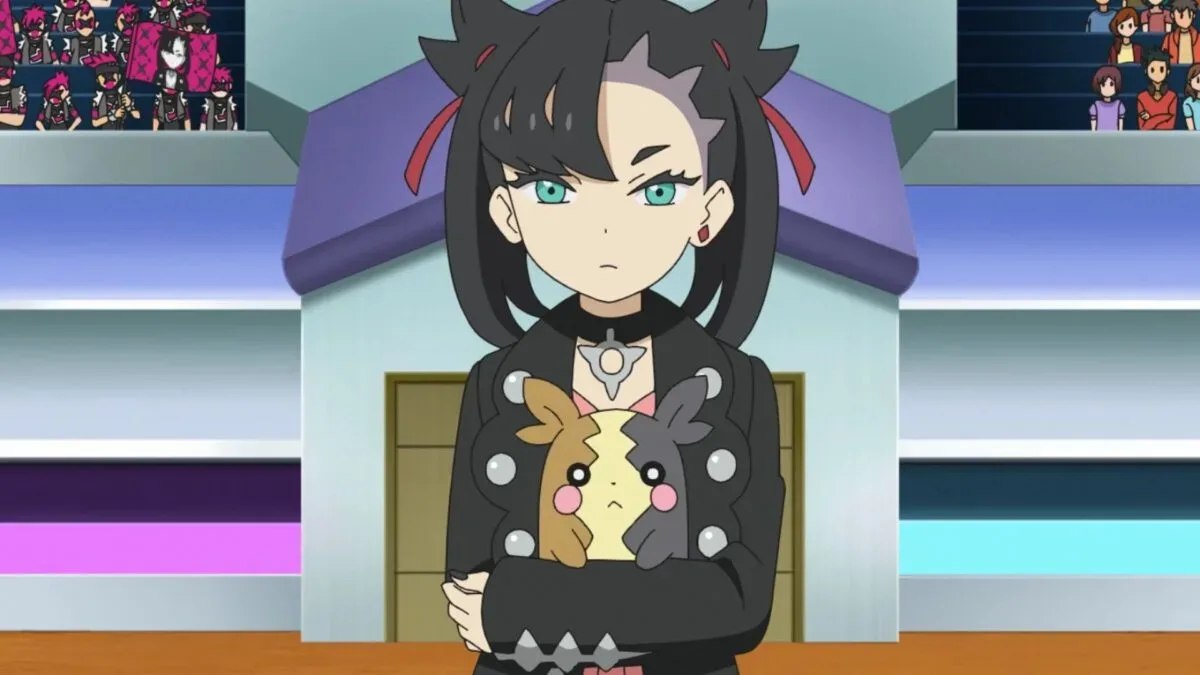
Seven years after Pokémon Sword and Shield arrived on Nintendo Switch, one of the games' most recognizable rivals is at the center of an unexpected discussion about character design, fan response, and the complicated relationship between an artist's work and a shared franchise.
Marnie, the quiet but determined challenger from the Galar region, has become one of the more enduring human characters introduced by the modern Pokémon games. Her black-and-pink look, Punk Girl-inspired fashion, signature Morpeko, and connection to Spikemuth gave her a distinct identity in a series crowded with rivals, Gym Leaders, professors, and champions. Merchandise, fan art, cosplay, trading cards, and broad player affection have all helped establish her as a major part of the era's character lineup.
But Yusuke Omura, the character designer associated with Marnie, recalled that the response was far more subdued when her artwork was first revealed ahead of the game's release. His anniversary message has now drawn tens of thousands of reactions on X and triggered a wider argument over whether his remarks were an honest professional reflection or an inappropriate public expression of frustration while working within an established intellectual property.
Embedded X/Twitter post
A Character Who Grew With the Game
Omura's comments were not framed as a denial of Marnie's eventual popularity. Quite the opposite: he acknowledged that she ultimately became popular and widely discussed. What stayed with him was the contrast between that later enthusiasm and the quieter reaction that greeted her initial character art.
For useful background on this topic, read Bandai Namco Highlights SOL-AVES Engine Optimizations for Future Fighting Games.
In his reflection, Omura said Marnie only truly took off after players experienced Pokémon Sword and Shield and came to understand more of her personality. He described remembering that delayed response and using it as motivation for future work, expressing a desire to create a character capable of finding a large audience through visual design alone from the moment they are first seen.
That distinction matters. A character's first promotional image carries one kind of appeal: silhouette, color palette, costume, facial expression, pose, and immediate mystery. The version audiences encounter in a finished role-playing game has access to an entirely different set of tools. Dialogue, story beats, rival battles, music, animation, relationships, voice and localization choices in later appearances, and the player's own memories can all change the way a design is perceived.
Marnie is an especially clear example of that gradual process. On paper, she was one of several rivals introduced for Galar. Within the game, however, players learned about her ambition, her reserved nature, her loyalty to her hometown, and her relationship with her overzealous Team Yell supporters. Her journey toward becoming a more confident competitor gave players context that a pre-release piece of artwork could not fully communicate.
The same applies to her visual details. Marnie's design was never just an arrangement of colors and accessories, but those elements gained greater meaning once tied to Spikemuth's rougher musical identity, her family situation, and Morpeko's presence at her side. The design may have been available before launch, but the character needed a story before many players formed a lasting attachment.
Why the Comments Became Controversial
For some social media users, Omura's message came across as overly focused on his own disappointment. Critics argued that a creator contributing to a major collaborative franchise should be careful about publicly discussing how a specific character's reception made them feel. Some framed the remarks as unnecessary, while others took issue with what they saw as an artist placing personal ego ahead of the broader team effort behind a popular character.
The criticism reflects a familiar tension around entertainment production. Fans often think of a character as belonging primarily to the fictional world, the game, or the franchise itself. Yet a character also comes from the labor of individual artists, writers, directors, modelers, animators, and many others. When one contributor talks openly about their hopes for audience reaction, listeners may interpret that statement either as a reasonable glimpse into creative work or as an attempt to claim too much ownership over something made by a team.
It is also easy for a short social-media post to lose nuance. Omura did not say Marnie was unsuccessful, nor did he dismiss the story's role in making her beloved. His point was specifically that the character's initial reveal did not inspire the kind of immediate response he had hoped for as a designer. Nevertheless, the phrasing invited a debate about whether design should be expected to carry that burden by itself.
That question has no simple answer. In games, especially long-form role-playing games, visual design is only the first step in a player's relationship with a character. A striking design can create instant interest, but it cannot guarantee affection. Conversely, a relatively unassuming character can become a fan favorite after a memorable story scene, a difficult battle, a surprising motivation, or a relationship that resonates with players.
Fellow Designers Recognize the Feeling
Many responses were more sympathetic, including one from Yusuke Kozaki, another prominent character designer whose work includes contributions to both Fire Emblem and Pokémon. Kozaki said he strongly related to Omura's feelings and explained that character popularity is most often determined after release through story, motivation, and a character's place in the game.
At the same time, Kozaki identified a particular satisfaction designers can feel when a character becomes popular before audiences have had the chance to play. In those cases, the visual concept itself has clearly created an immediate connection, allowing the designer to feel that their contribution has directly helped build anticipation for the project.
He pointed to Tracer from Overwatch and 2B from NieR: Automata as examples of characters whose designs achieved powerful recognition. Both have become iconic in part because their visual identities are instantly legible: strong silhouettes, distinctive costumes, memorable color contrast, and a clear sense of attitude or mystery. Their games and stories are essential to their long-term significance, but their designs also made a major impact before many people knew the full context.
Kozaki's response helped reframe Omura's original thought less as a complaint about Marnie and more as an artist's private standard made public. Creatives frequently measure their own work against difficult goals. For a character designer, one such goal may be creating a figure whose image alone sparks curiosity, admiration, discussion, and attachment. That does not mean the creator believes writing and game development are unimportant. It means they are thinking about the unique part of the production process they were tasked with shaping.
Marnie's Place in Pokémon's Modern Cast
Whatever the debate says about public creative commentary, Marnie's current standing is difficult to dispute. She is widely recognized as one of the standout human characters from Pokémon Sword and Shield. Her popularity reflects the combined effect of design and characterization rather than a victory for one over the other.
Her initial image did provide a strong foundation. The dark hair, pink accents, studded accessories, uneven expression, and compact silhouette immediately separated her from the more traditionally upbeat rival archetype. Morpeko's presence added another layer, pairing her with a Pokémon whose own two-sided gimmick fit Galar's blend of cute creatures and rock-influenced style. But it was the game's narrative that explained why she was fighting, why Team Yell rallied around her, and why her reserved demeanor had more underneath it than first appeared.
That layered reception is arguably a strength of the medium. Games give characters room to unfold over dozens of hours. A player can notice a design in a trailer, form an opinion during an early battle, and then revisit that opinion after later scenes provide more emotional context. Marnie's rise after release demonstrates how a character can gain power through that accumulation of encounters.
It also illustrates why anniversary conversations can be revealing. Years after launch, fans tend to remember characters not as isolated promotional assets but as parts of their personal experience with a game. A rival may be tied to a difficult match, a favorite route, a soundtrack cue, a story revelation, or a particular Pokémon used by the player. Those memories can transform initial indifference into long-lasting appreciation.
Design Is Only the Beginning
The discussion around Omura's anniversary reflection ultimately reaches beyond Marnie. It speaks to a larger reality of game development: character creation is collaborative, but each discipline still carries its own ambitions and anxieties. Designers want their visual work to be noticed. Writers want emotional arcs to land. Animators want gestures and movement to communicate personality. Every member of a team may be proud when a character connects with players, while also wondering how their own contribution was received.
For fans, the controversy is a reminder that beloved characters are often shaped by a long chain of creative decisions rather than one single moment of inspiration. Marnie's design helped establish the hook. Her role in Pokémon Sword and Shield gave players reasons to care. The community then extended that affection through art, discussion, cosplay, collectibles, and years of continued attention.
Omura's goal of making a future character instantly popular through design alone may be an ambitious one, but it does not erase what Marnie achieved. If anything, her story offers a different lesson: an initial reveal is not the final verdict on a character. Sometimes the strongest connection arrives only after audiences have had time to meet them, understand them, and make them part of their own journey.
Community
Discussion
Start the conversation.
No comments have been posted yet.