

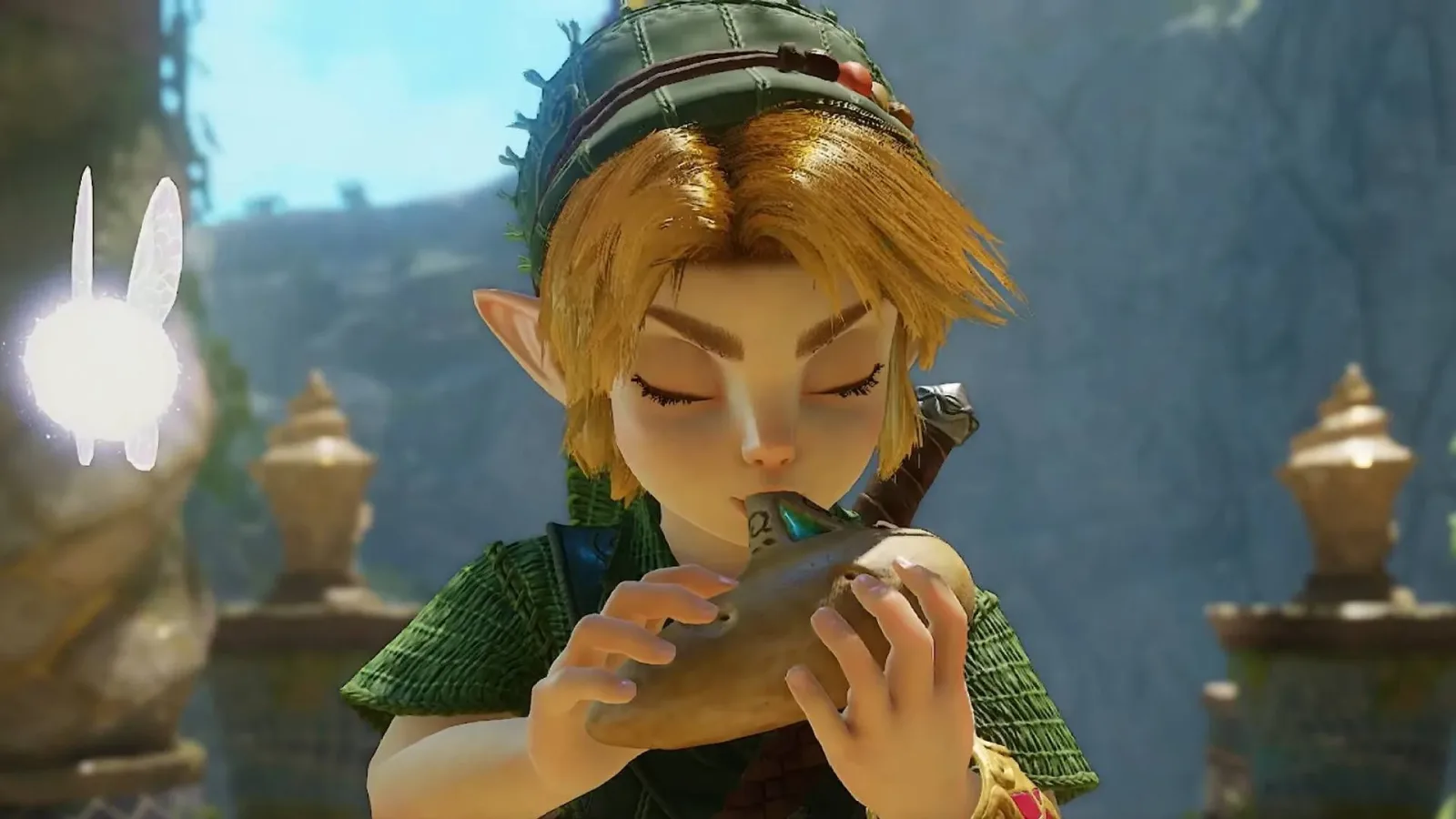
The Legend of Zelda: Ocarina of Time may be returning with decades of technical and design improvements behind it, but one especially modern convenience did not survive development. The new Switch 2 remake briefly featured a network of added warp points intended to make crossing Hyrule faster. Zelda series producer Eiji Aonuma ultimately asked for them to be removed after seeing how dramatically they changed the rhythm of the adventure.
The decision is notable because fast travel has become an expected feature in large modern games, including Nintendo's own The Legend of Zelda: Breath of the Wild. Yet for this version of Ocarina of Time, the team concluded that shaving down travel time also removed something more valuable: the unexpected discoveries players make between major objectives.
In a Nintendo Ask the Developer interview, Aonuma explained that the feature began as his own proposal. He looked at the way Breath of the Wild lets players jump quickly between numerous map locations and felt that the older adventure's traversal deserved attention in a remake. But after the extra warp points were implemented and tested, he found that they did not fit the structure of Link's journey.
A modern solution for an old Hyrule Field problem
Travel has always been a curious part of the original 1998 Nintendo 64 release. Hyrule Field is a major connective space, linking the castle town and its surrounding regions, but getting from one destination to another can take time. Before players gain access to faster options later in the quest, Link's movement can feel limited by contemporary standards.
For useful background on this topic, read Google's Zelda Search Easter Egg Sends Fans Back to 1998 Ahead of Ocarina of Time remake.
Aonuma acknowledged one of the enduring player habits born from that limitation: repeatedly using Link's forward roll to squeeze out a little more speed. For many longtime fans, rolling across the field became an oddly memorable part of the experience. It was not elegant, and it was certainly not as rapid as a modern fast-travel menu, but it reflected the game's original pace.
That was why the added warp points initially made sense on paper. A remake has a difficult balance to strike. It needs to respect an older game's identity while recognizing that player expectations, interface conventions, and ideas of accessibility have changed enormously since 1998. Giving players shortcuts between key locations could have reduced repetition and made a famously large world feel less cumbersome to revisit.
However, the development team discovered that the practical effect went beyond convenience. Teleporting from place to place changed the player's relationship with the spaces in between.
The value of stopping along the way
Aonuma said playing with the new warp points meant missing the moments where a player pauses during a journey and notices something unusual. A path may lead past an unfamiliar landmark, a side route, a character, or an area that becomes relevant later. Those encounters are not always major events, but they help make Hyrule feel like a place to explore rather than a collection of destination markers.
That distinction is central to Ocarina of Time. The game is highly structured, guiding Link through temples and story milestones in a deliberate order, but it also depends on curiosity. Progress often comes from observing the world, revisiting earlier areas with new abilities, and recognizing that a seemingly ordinary location may contain a secret.
Fast travel is not inherently at odds with exploration. Breath of the Wild used abundant warp points in a vastly different kind of world, one designed around wide-open navigation, emergent encounters, climbing, gliding, and a huge quantity of shrines. In that context, teleporting is part of a larger system that gives players freedom to set their own priorities across a massive map.
Ocarina of Time has another cadence. Its overworld works as a bridge between carefully authored sequences. The trip itself can establish mood, provide time for players to think through a puzzle, or lead them toward a distraction they would never have selected from a menu. Removing travel entirely may make an adventure more efficient, but it can also make it feel narrower.
Aonuma's conclusion was that the trial feature revealed how essential those incidental discovery moments are to the game's underlying design.
The producer's comments also show that remaking a classic is not simply a matter of adding every later improvement Nintendo has developed. A feature can be excellent in one Zelda game and still be a poor match for another. In this case, the remake team tested a contemporary quality-of-life idea, judged the result in play, and chose authenticity of experience over maximum speed.
Link will still move faster
The removal of the newly created warp network does not mean the remake is preserving every inconvenience of the original unchanged. Link has gained new movement options: he can run, and he can jump. Those additions should offer a more direct answer to the old rolling routine without allowing players to bypass Hyrule's connective spaces altogether.
Running seems particularly significant for a game whose field traversal has been a frequent subject of nostalgic jokes. The original's forward-roll technique is memorable precisely because players wanted to get somewhere faster and had limited tools to do it. Giving Link a proper run function addresses that frustration in a way that still leaves players physically present in the world.
Jumping could have equally broad implications for how the remake feels, though the available details do not establish exactly how it will work in exploration, combat, puzzle-solving, or level design. It is a substantial shift for a game built around movement that was more constrained than later Zelda entries. Whether it is used mostly for mobility or supports more extensive redesigns remains to be seen.
What is clear is that the team appears to be drawing a line between making Link more comfortable to control and removing the travel experience altogether. A run button can make an established route less tedious. Added warp points can change whether that route is experienced at all.
A remake's hardest task is preserving feel
There is a tendency to discuss remakes in terms of feature lists: improved visuals, smoother performance, cleaner controls, expanded maps, new quality-of-life systems, and reduced friction. Those elements matter, especially when a game is approaching three decades old. But Aonuma's explanation highlights another measure of success: whether the new version preserves the emotional and exploratory texture that made the original endure.
For Ocarina of Time, Hyrule Field is not merely empty distance between dungeons. It is the space where day turns to night, where distant destinations gradually come into view, and where the player can veer off course. It also reinforces the scale of Link's adventure. A trip from one kingdom region to another has weight because the player makes the journey.
Not every player will prefer that approach. Some will understandably value quick access to familiar locations, particularly on repeat playthroughs. Modern audiences are also accustomed to games respecting limited play time through flexible navigation tools. The decision to omit new fast travel may therefore be one of the remake's more debated choices.
Still, it is a revealing one. Rather than treating every historical inconvenience as a defect to erase, Nintendo's developers appear to be examining which rough edges contribute to the game's character and which can be improved without disrupting it. The answer, in this case, was to make movement faster while keeping the roads, fields, and chance encounters intact.
Why the change matters for Zelda's future revisits
The episode offers a useful view into how Nintendo may approach other legacy projects. Zelda's history spans games with radically different world structures, from compact, item-gated adventures to open-air experiences built around player-directed exploration. There is no single modern template that can be dropped onto every entry without consequences.
Ocarina of Time helped establish conventions that later Zelda games would refine, reinterpret, or abandon. Bringing it forward for Switch 2 gives the developers an opportunity to revisit those foundations, but it also requires restraint. Its dungeon progression, sense of place, and deliberate discovery are interconnected. Altering one part of that equation can affect the rest.
Aonuma's abandoned warp-point idea is therefore more than a small development anecdote. It illustrates a design question at the center of the remake: should a classic be made faster in every possible way, or should it retain the pauses that let players notice where they are?
For this remake, Nintendo has chosen the latter. Link may no longer need to roll endlessly across Hyrule Field to pick up speed, and his new ability to jump signals that the journey will not be frozen in 1998. But players will still need to travel through the land between their goals--and, if Aonuma's reasoning holds true, that is where some of the adventure's most important moments will happen.
Community
Discussion
Start the conversation.
No comments have been posted yet.