

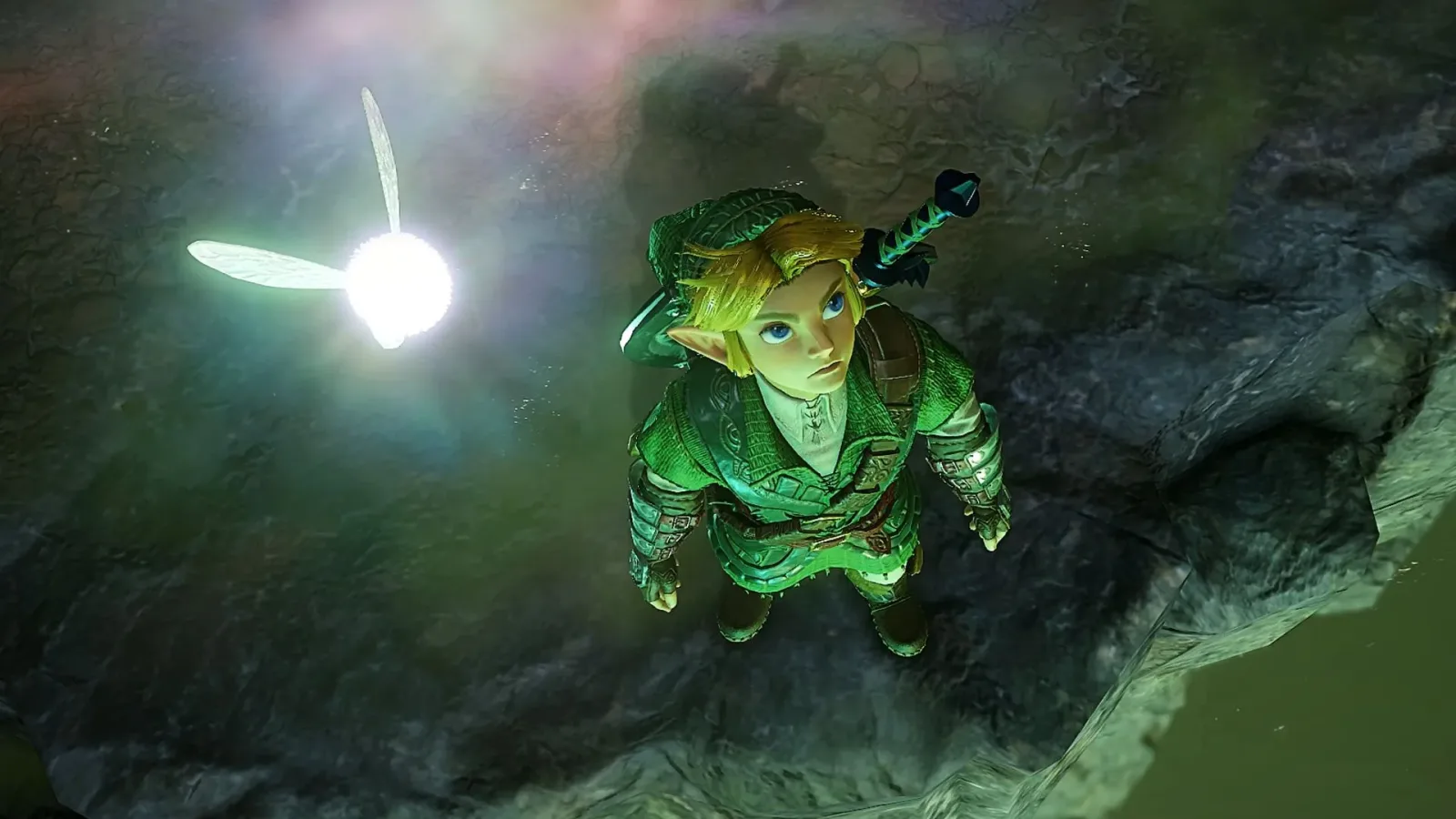
The newly revealed visual direction for The Legend of Zelda: Ocarina of Time remake was always likely to provoke a strong reaction. Ocarina of Time is not simply another classic game receiving a technical update; it is one of Nintendo's most scrutinized works, a title whose characters, environments, music, and defining moments have been held in players' memories since its 1998 debut. When Nintendo showed gameplay in September during its 40th-anniversary Zelda presentation, the remake's colorful, stylized look immediately became one of the biggest points of discussion.
Now, the development team has made clear that the look is not an accidental byproduct of modern hardware or a conventional attempt to make Hyrule more realistic. Its visual philosophy was built around the language of puppet shows and the tactile charm of practical-effects films. The goal was to reconstruct Hyrule as a more detailed and convincing place while retaining the strange, expressive identity that made the Nintendo 64 original so memorable.
That explanation gives the remake's polarizing first impression much more context. Rather than smoothing away the eccentricity of Ocarina of Time in favor of photorealistic textures and cinematic seriousness, Nintendo appears to be embracing artifice. The characters are intended to feel colorful and slightly unusual, but still believable within the world around them. It is a balancing act between density, atmosphere, and theatrical stylization.
A Hyrule That Feels Real Without Chasing Realism
Art director Aya Shida explained that the team wanted to remake Hyrule as a rich and dense world that players could believe in, without losing the feeling of the original adventure. That is an important distinction for a game such as Ocarina of Time. The 1998 release was revolutionary for its era, but its visual language was also shaped by the limits of Nintendo 64 technology. Sparse geometry, simple textures, exaggerated faces, and bold colors did not merely define its technical presentation; over time, they became part of the game's emotional identity.
For useful background on this topic, read Stardew Valley 1.7 Could Be Its Biggest Update Yet, With a 2027 Release Target.
A remake built solely around contemporary visual realism could risk replacing that identity with something more generic. Forests might gain individual leaves, stone walls might receive intricate surface detail, and character models might become more anatomically nuanced, but the resulting Hyrule could feel less like the one players remember. Nintendo's stated approach suggests the team is trying to avoid that trap.
Shida said early development discussions used phrases such as "a puppet-show feel" and "the analog feel of practical effects films" to communicate the intended direction. These references are especially revealing because neither form aims to duplicate everyday reality perfectly. A puppet may move in an obviously crafted way; miniature sets and creature effects in older films often invite viewers to see the artistry behind the illusion. Yet that handmade quality can make an imaginary world more inviting, distinctive, and emotionally resonant.
For Ocarina of Time, the team saw a connection between that kind of stylization and the nostalgia associated with the original game. The remake is therefore not pursuing a literal recreation of how Hyrule would look in real life. It is pursuing an interpretation of how Hyrule feels in memory.
Why Puppetry Fits Zelda's Fantasy Language
The puppet-show comparison may sound surprising at first, but it sits comfortably beside Zelda's long history of experimental visual styles. The series has never been tied to one immutable definition of realism. From the storybook watercolor aesthetic of The Legend of Zelda: Link's Awakening on Switch to the bold cel shading of The Wind Waker, Zelda has repeatedly used art direction to establish tone as much as graphical technology.
Even Ocarina of Time itself contains a mixture of moods that could benefit from a handcrafted, theatrical quality. Kokiri Forest is playful and storybook-like. Castle Town has broad, cartoonish energy. Kakariko Village carries a homespun warmth. At the other end of the spectrum, the Shadow Temple, Bottom of the Well, and the ruined future version of Hyrule are deliberately unsettling. A visual style that makes the world feel manufactured, posed, or slightly unreal could strengthen that contrast. What is charming in one location may become eerie in another.
Practical-effects cinema offers a similarly useful reference point. Models, sets, masks, costumes, and stop-motion-inspired movement can create a texture that computer-generated realism does not always provide. The point is not that Ocarina of Time's remake is trying to imitate old technology. Instead, it appears to be seeking the warmth and intentional imperfections associated with physical craft.
That approach can also help preserve the exaggerated designs of Zelda's characters. The world contains Deku Scrubs, Gorons, Zoras, Stalfos, redead enemies, Great Fairies, and countless residents whose forms were never meant to be entirely naturalistic. If the environments became too realistic while the characters remained highly stylized, the two sides might clash. The puppet-show approach gives the team a framework in which unusual characters can belong naturally within a more intricate Hyrule.
An Idea Predicted by a Zelda and Star Fox Veteran
The connection to puppetry had already been suggested by Takaya Imamura, whose history with Nintendo makes the observation especially notable. Imamura designed the Star Fox crew and served as art director on The Legend of Zelda: Majora's Mask, the Ocarina of Time follow-up that introduced Tingle. His view that the remake's look had been influenced by puppet shows was initially understood as personal interpretation, but the developers' comments have now confirmed that it was remarkably close to the team's actual thinking.
There is also an understandable link between this approach and Nintendo's broader creative history. Shigeru Miyamoto's appreciation for puppetry has been associated with the distinctive direction of Star Fox projects in the past. The newly confirmed creative keywords for Ocarina of Time's remake do not mean that the two franchises will look alike, nor that Zelda is simply borrowing from Star Fox. Still, they demonstrate how physical performance, expressive figures, and visible craftsmanship can remain meaningful reference points for game developers working with sophisticated modern technology.
For fans, the confirmation may shift the conversation around the remake's first footage. A divisive art style often invites immediate comparisons to older versions, with every facial expression or material texture judged against an idealized memory. Knowing that the team is deliberately using a puppet-show sensibility does not mean every player will prefer the result, but it clarifies that the differences are purposeful. The remake is making an aesthetic argument, not merely applying a new rendering pipeline to familiar locations.
Nostalgia Is the Central Design Goal
Series producer Eiji Aonuma framed the choice as an attempt to express a particular kind of nostalgia within the current development team. Not every developer working on the remake played Ocarina of Time when it first launched, yet the game has still created a lasting emotional impression across generations. That distance is significant. Nostalgia is not necessarily about reproducing every polygon, animation, or texture exactly as it was. It can also be about identifying the emotional qualities that made a work endure and translating them through new creative tools.
Aonuma, who was one of the original developers on Ocarina of Time, said the new direction made sense to him as a progression. That endorsement carries weight because it comes from someone with firsthand knowledge of the original team's ambitions and compromises. Ocarina of Time's creators were working at the beginning of Zelda's transition into 3D, defining how targeting, dungeon navigation, cinematic storytelling, and an interconnected fantasy world could function in three dimensions. A remake has the difficult task of respecting those achievements without treating the 1998 game as a museum piece.
The puppet-show and practical-effects concepts may be Nintendo's answer to that problem. They allow the remake to look clearly different from the Nintendo 64 release while maintaining a sense of distance from modern blockbuster realism. In other words, the game can feel newly built without presenting itself as a completely different vision of Zelda.
A Remake That Will Continue to Be Debated
The early response to Ocarina of Time remake footage shows how high the expectations are. Some players will always favor a more realistic reinterpretation, perhaps expecting a visual step closer to the open-air landscapes of more recent Zelda games. Others may welcome a stylized direction that protects the original's humor, strangeness, and fairytale atmosphere. Both reactions reflect the unusual status Ocarina of Time holds within the medium.
What is now clear is that Nintendo's team is not treating stylization as a fallback option. The puppet-show feeling is a foundational concept, used from early development to guide how environments and characters coexist. The analog inspiration is meant to lend the world a distinct texture, while the richer construction of Hyrule aims to make its places feel more tangible than before.
Whether that balance succeeds will ultimately depend on how it plays across the full journey: from Link's earliest steps in Kokiri Forest to the time-spanning transformation of Hyrule, its temples, and its climactic confrontations. For now, the developers' explanation establishes a clear creative promise. This remake is not trying to erase the oddness of Ocarina of Time. It is trying to turn that oddness into something that feels lovingly crafted, theatrical, and recognizably Zelda.
Community
Discussion
Start the conversation.
No comments have been posted yet.