

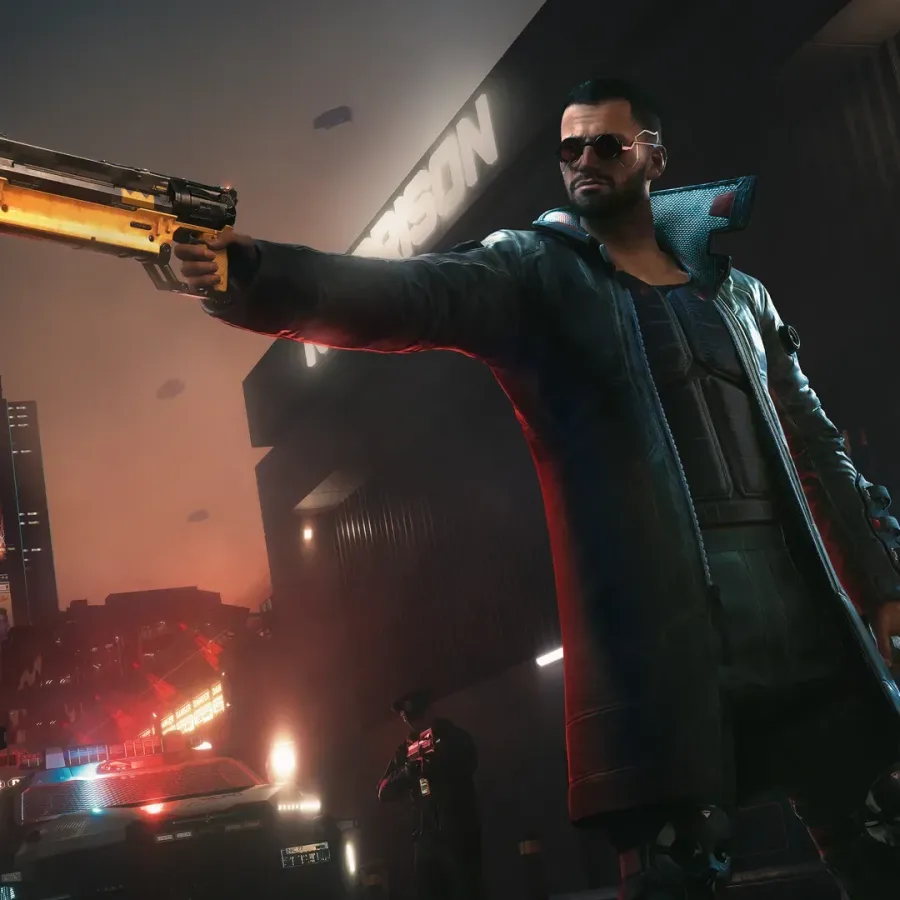
Cyberpunk 2077 players looking to share Night City with far more than a small co-op group have a new modding project to investigate. Open//77 has entered alpha, offering a multiplayer framework built around big, player-hosted servers, roleplay communities, PvP activities, and the kind of open-ended social play usually associated with persistent online crime sandboxes.
The project arrives shortly after another major fan effort, NightCoop, gave players a way to progress through Cyberpunk 2077 with friends. But the two projects appear to be pursuing distinctly different goals. NightCoop is geared toward a comparatively familiar cooperative experience, supporting groups of up to eight players moving through the game and its story together. Open//77 instead treats Night City as a shared playground, where a server's rules, theme, activities, and player community can matter as much as the original campaign.
It is an ambitious proposition for a game that once had official multiplayer plans of its own. Those plans were ultimately abandoned following Cyberpunk 2077's troubled launch, leaving the community to explore what a connected Night City could look like through unofficial projects. Open//77 is still early, but its alpha release means interested PC players can now try that experiment themselves.
Embedded X/Twitter post
Embedded X/Twitter post
Embedded X/Twitter post
From co-op campaign to a Night City sandbox
Open//77's central appeal is scale. Individual servers can bring together well over 100 players, while the popular NCRP roleplay server is designed to support up to 1,000 participants. That is a dramatic change from the solitary atmosphere of the base game and from conventional small-group co-op. Rather than seeing a handful of other versions of protagonist V during missions, players can enter a Night City shaped by a much larger collection of people pursuing their own roles and routines.
For useful background on this topic, read Bruce Nesmith Says Baldur's Gate 3's Locked Paths Made Choices Feel More Meaningful.
Roleplay is a major part of the pitch. Each server establishes its own identity, giving communities room to decide what sort of experience they want to create. NCRP caters to players who want to inhabit characters and participate in a large-scale roleplay setting. Other servers place greater emphasis on combat and player-versus-player encounters. That variety is important because Open//77 is not simply attempting to add online connectivity to the existing game; it is offering tools for communities to make their own versions of Night City.
As a result, a player's experience may depend heavily on where they log in. One server may focus on character-driven interactions, businesses, law enforcement-style scenarios, and social gatherings. Another could prioritize fights, rival groups, or freer forms of chaos. The mod's open-world emphasis means that the usual structure of quests, combat encounters, and story missions is no longer the only framework for spending time in the city.
Social play, third-person views, and customization
Early footage highlights a more relaxed side of the multiplayer concept. In one example, players gather in a rented room to play a board game together. It is a small activity, but it illustrates the project's broader ambitions. Open//77 is designed not only around shooting, driving, or completing objectives, but also around the unscripted moments that emerge when a large number of people share a digital space.
The project also includes third-person play, offering a viewpoint not normally central to Cyberpunk 2077's first-person experience. For a roleplay-focused environment, that option could have obvious appeal: players can better see their character, outfits, animations, vehicles, and the social scenes taking place around them. It also helps Open//77 feel less like a standard replay of the single-player RPG and more like a separate multiplayer layer built on Night City's streets.
Vehicle personalization is another area receiving added attention. Footage points to an expanded vehicle customization menu, giving players another way to establish an identity on a server. In a large online community, visual expression can become part of the social experience, whether that means arriving at a meetup in a distinctive car, fitting a character concept, or simply showing off a preferred style.
These details distinguish Open//77 from an effort narrowly focused on making campaign missions playable in multiplayer. Its purpose is closer to providing a toolkit and a space for emergent play. The base game supplies Night City, its vehicles, districts, and atmosphere; server operators and players supply much of the structure that makes the world feel persistent and communal.
What players need before installing Open//77
Open//77 is available in alpha, so players should approach it with the usual expectations for an early modding project. Features may change, servers may differ in stability and rules, and compatibility concerns can arise--particularly for people whose Cyberpunk 2077 installations already include a long list of mods.
There are two firm ownership requirements: players need both Cyberpunk 2077 and its Phantom Liberty expansion. Anyone who does not own the expansion will not be able to use Open//77. No additional official multiplayer mode is being activated here; this remains a community-made modification for the PC version of the game.
The mod does support other mods, which opens the door to customized server experiences. It can also temporarily download a host's mods when a player joins that server. That is a convenient idea in principle, since it can reduce the burden of manually tracking every requirement for a particular community. At the same time, players with heavily customized installations may need to be cautious. Mod interactions can be unpredictable after major game updates, and one hands-on attempt with Open//77 encountered problems with a substantially modded setup.
For players eager to experiment, a clean or lightly modified install may be easier to manage than a game folder packed with unrelated scripts, visual overhauls, interface changes, and gameplay systems. Backing up files and reviewing a server's requirements before joining are sensible precautions. Alpha projects can be exciting precisely because they are evolving quickly, but that also means they may demand more troubleshooting than an official online release would.
AI disclosure is part of the conversation
Open//77 has also drawn attention because its creators openly acknowledge using AI during development. That disclosure places the mod at the center of an ongoing debate within modding communities. Fan-made projects have long involved complex technical work, and unofficial multiplayer efforts existed well before generative AI tools became widely used. Even so, the rapid arrival of ambitious projects associated with AI-assisted work has prompted questions about transparency, authorship, quality, and the place of those tools in community development.
The issue has become significant enough that Nexus Mods, one of the largest mod distribution platforms, recently introduced mandatory disclosure for mods that use AI-assisted code. The platform also allows users to filter AI-assisted mods from search results and preferences. That policy gives players more information and more control over what they choose to download, while avoiding the assumption that every mod user will reach the same conclusion about AI involvement.
For Open//77, the disclosure may be relevant to prospective players deciding whether they want to support or participate in the project. It does not change the practical appeal of large-scale roleplay servers for those who want them, but it is clearly part of the context surrounding the mod. As with any community project, players can weigh its technology, policies, feature set, server culture, and stability before deciding whether it is worth their time.
A glimpse at the multiplayer Night City that never officially arrived
Cyberpunk 2077 was originally expected to receive an official multiplayer component. That plan did not survive the aftermath of the game's difficult launch, as attention shifted toward fixing and improving the core experience. Since then, the game has undergone a major turnaround through patches, the Phantom Liberty expansion, and continued player interest in exploring Night City.
Open//77 cannot replace a fully supported, official multiplayer mode, and its alpha status makes that distinction especially important. It relies on community development, individual server operators, and the technical compromises that come with modifying a single-player game. But it also demonstrates why demand for multiplayer Cyberpunk persists. Night City is a setting built around dense streets, striking fashion, vehicles, conflict, and memorable spaces--elements that naturally invite social storytelling once many players are allowed to occupy them together.
For now, the project offers a choice that Cyberpunk 2077 has not previously provided at this scale. Players can pursue a more traditional cooperative route through NightCoop, or they can step into Open//77's more unruly vision of the city, where roleplay, social events, PvP, and server-specific activities define the session. With a Cyberpunk sequel in development, the question of whether the series might eventually return to official multiplayer remains open. Until then, mods such as Open//77 are testing just how much life Night City can have when it is shared.
Community
Discussion
Start the conversation.
No comments have been posted yet.