

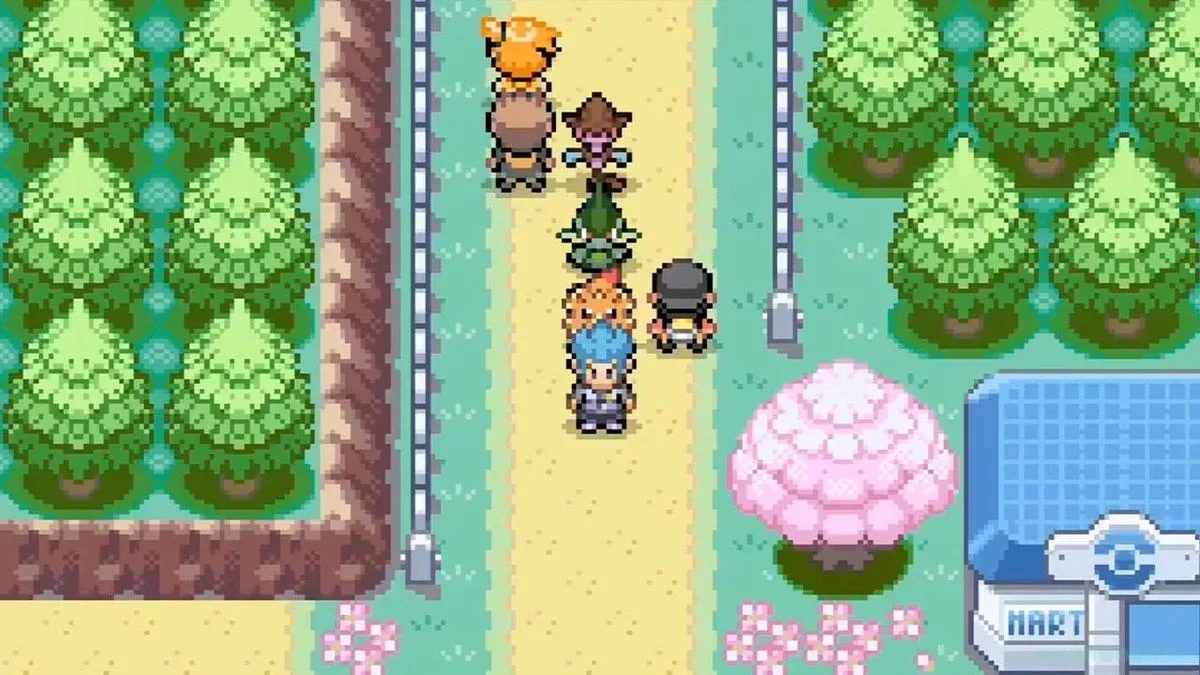
Pokémon Quetzal version 0.9.1 is changing how its three-region adventure can be approached. The Pokémon Emerald-based fan project, created by Tenma, now allows players to move between Kanto, Johto and Hoenn while their journeys are still in progress, rather than making them wait until they have defeated the Elite Four.
That is a substantial shift for a game built around the appeal of revisiting several of Pokémon's most celebrated settings. Kanto, Johto and Hoenn each represent a different era of the series' Game Boy and Game Boy Advance history, and Quetzal's new approach means players do not have to treat them as a fixed sequence. They can progress through one region, take a break to begin another, and return later with their overall collection of Pokémon and items available for management across the connected adventures.
The update turns what could have been a traditional post-game reward into a core part of the experience. Instead of seeing a new region only after one campaign has concluded, players can effectively keep three separate adventures moving at once.
A parallel approach to classic Pokémon regions
Earlier versions of Pokémon Quetzal required players to beat the Elite Four before they could change regions. That structure gave each campaign a more conventional sense of completion before unlocking the next destination. Version 0.9.1 removes that barrier, allowing Kanto, Johto and Hoenn to be explored in parallel.
For useful background on this topic, read Emufii Beta Brings Long-Distance Multiplayer Tools to Android Handheld Emulation.
For players who enjoy switching games or rotating between different RPGs, the format could be especially appealing. One session might be spent making progress through Hoenn, while another could focus on building a fresh team in Johto or revisiting Kanto. The regions retain their individual identity, but they are no longer isolated by a long endgame requirement.
This does not simply mean selecting a different map from a menu with no consideration for progress. When a player chooses to change regions, the game saves them in a safe outdoor location before performing the swap. The intent is to ensure that progress is retained and that a region change does not leave a character in an unsuitable interior area or interrupt a key moment.
It is an important detail for a project whose central feature now depends on frequent movement between campaigns. Saving at a reliable point before transitioning helps make the feature feel closer to an intentional travel system than a risky experiment with separate save states.
For another perspective on this story, read Pokémon Quetzal 0.9.1 Lets Players Switch Between Kanto, Johto and Hoenn.
Pokémon and items can be managed across regions
The regional swapping feature is accompanied by shared management for both Pokémon and items. Players can organize their collection between the games and move resources around as they see fit. In practical terms, that opens the door to many different ways of structuring a playthrough.
A player might begin in one region, catch a Pokémon they want to use elsewhere, then change locations and adjust their party. Items can likewise be managed between the available adventures. The feature gives the three-region setup a connected quality that goes beyond simply offering multiple campaigns from one package.
It also creates room for personal rules and unconventional team-building. Some players may choose to keep every region self-contained, treating each as a separate classic-style journey. Others may lean fully into the shared system, assembling a party from creatures caught throughout Kanto, Johto and Hoenn. Neither approach changes the fact that progress in each area is being recorded, but the ability to decide how connected the adventures should feel is a defining part of Quetzal's appeal.
There is also a social angle to the broader regional access. With players able to be active in different regions rather than having to reach the same late-game milestone first, friends can explore different corners of the project at the same time. The update is designed to make the game more flexible for anyone who prefers variety over a single uninterrupted route through one region.
An expanded list of starting Pokémon
Version 0.9.1 also expands the starter selection to 84 Pokémon. The newly added options are Marill, Axew, Pancham, Skrelp, Mareanie, Jangmo-o, Falinks and Dreepy.
The selection spans Pokémon from several generations, which is fitting for a project that already brings together regions associated with the earliest mainline entries. Marill offers a familiar Water-type option with a long history in the series, while Axew and Dreepy provide Dragon-type choices. Pancham, Skrelp, Mareanie, Jangmo-o and Falinks add further variety in typing, design and potential team roles.
A roster this large makes the opening decision considerably less predictable than the standard three-starter setup. Rather than beginning every playthrough with one of a small number of expected picks, players can tailor the first member of their party to a preferred type, a favorite generation, or a particular challenge idea.
For anyone who does not want to deliberate over dozens of choices, Pokémon Quetzal can also generate random starter options from the pool. That function offers a simple way to make a repeat run feel less planned. Randomized selection can be especially useful in a game designed around replaying and alternating between multiple regions, since it gives each newly started adventure a chance to begin from a different foundation.
A bicycle from the beginning
Among the larger regional and starter changes, version 0.9.1 includes a notably practical quality-of-life option: players can choose to ride a standard bicycle from the beginning of the game.
Early-game travel has always been a recognizable part of classic Pokémon pacing. Routes that later become short commutes can feel much longer before faster transportation is unlocked. Giving players access to a regular bicycle at the outset can make repeated travel less of a chore, particularly in a project where players may be moving between regions and revisiting areas more often than in a single linear campaign.
It is a modest feature compared with the ability to move among three regions, but it reflects the same design priority. Pokémon Quetzal is not solely interested in preserving a familiar old-school format; it is also adding conveniences that can make a large, replayable journey easier to navigate. Players who want a more traditional pace can simply avoid relying on the bicycle option, while those looking to reduce downtime have a useful tool immediately available.
What Pokémon Quetzal represents
Pokémon Quetzal is part of the long-running fan-made ROM hack scene that has found new ways to rework classic Pokémon games. Its foundation in Pokémon Emerald places it in the Game Boy Advance era, while its use of Kanto, Johto and Hoenn taps into a particularly influential stretch of the franchise's history.
Kanto is the setting that introduced players to the original Pokémon adventure and its foundational gym-and-League structure. Johto expanded that framework with its own towns, mythology and day-to-day refinements. Hoenn, meanwhile, brought the series to the Game Boy Advance and introduced mechanics and features that remain important parts of Pokémon games. Putting those three places within one flexible project has obvious appeal for players who have strong memories of all of them.
The new version's most interesting idea is not merely that all three regions are present. It is that the player is no longer asked to wait until one story is fully resolved before enjoying another. That makes Quetzal 0.9.1 feel less like a collection of campaigns arranged in a strict order and more like a set of ongoing adventures that can be revisited when the mood changes.
That flexibility may suit players with different priorities. A completion-focused fan can work steadily through each region while organizing a growing collection. A player interested in team experimentation can start several files of progress in spirit, moving between regions to test different starter choices and party combinations. Someone returning to the older games for nostalgia can focus on a favorite setting without giving up access to the others.
How to play version 0.9.1
Pokémon Quetzal version 0.9.1 requires players to use the Pokémon Quetzal patcher with a legally acquired copy of Pokémon Emerald. As with ROM hacks generally, the patch itself and the original game data are separate matters; players should ensure they have the appropriate legal rights to the game file they use.
The project also has a Moemon Quetzal option for players interested in that alternative version. Beyond that, prospective players should keep in mind that fan projects can change as they are updated. Features, balance and compatibility may evolve between releases, so version-specific information matters when setting up a playthrough.
For now, the headline addition in 0.9.1 is clear: Kanto, Johto and Hoenn are no longer destinations that must be unlocked one after another by defeating the Elite Four. With safe transition saves, shared Pokémon and item management, an 84-choice starter pool and an optional bicycle from the start, Pokémon Quetzal offers a more open-ended way to revisit three classic regions.

Community
Discussion
Start the conversation.
No comments have been posted yet.