

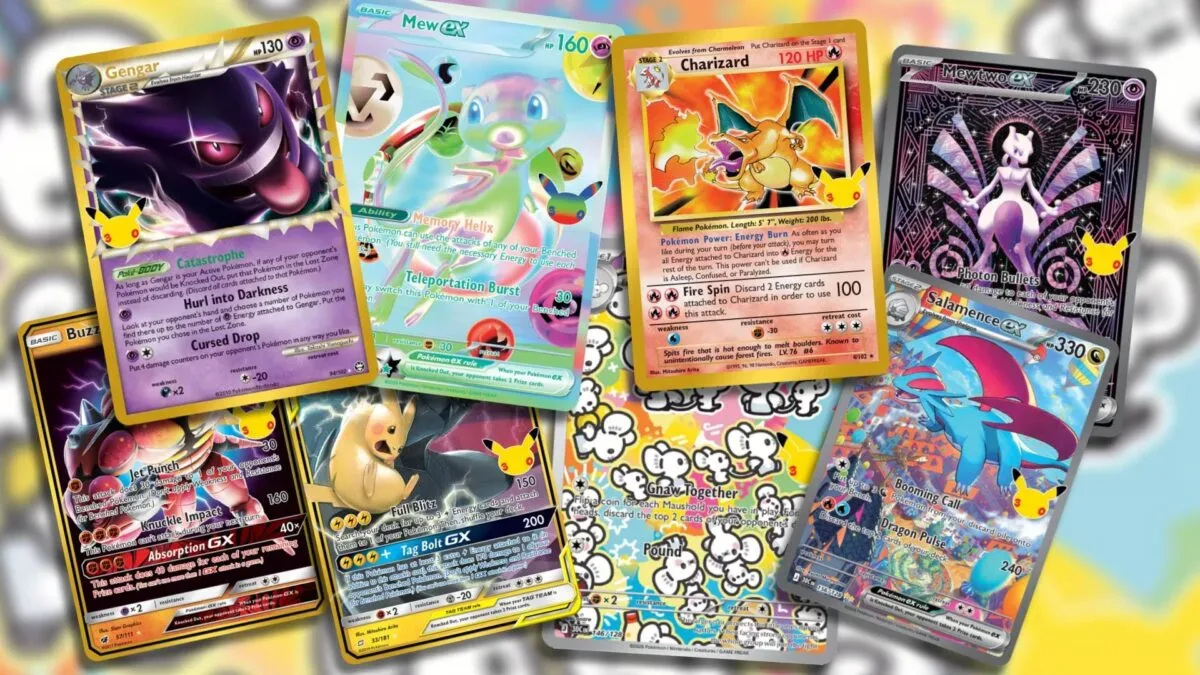
The Pokémon Trading Card Game's 30th Celebration expansion is attracting attention for a reason collectors have wanted to see for years: early openings indicate that desirable cards may be substantially easier to pull than they have been in recent releases.
Community testing is still underway, and there are no finalized official probability figures for the set. Even so, multiple large pack-opening samples are painting a remarkably consistent picture. The early results suggest that ex cards appear in more than half of packs, while Illustration Rares and Special Illustration Rares are showing up at rates far above those generally associated with the Scarlet & Violet era and the more recent Mega Evolution releases.
That shift is already having an immediate consequence outside of sealed-product openings. Resale prices for high-profile cards, including the new Mew and Mewtwo Future Rares, have fallen dramatically from the eye-catching prices seen around launch. For players and collectors interested in owning attractive cards rather than treating packs as a route to a payday, that could make 30th Celebration one of the more welcoming Pokémon TCG products in years.
A five-card format with a surprising amount of value
30th Celebration follows the recurring anniversary-set approach of mixing new cards with callbacks to Pokémon TCG history. Every card carries an anniversary Pikachu stamp, and the expansion includes a 30-card Pikachu subset alongside a broad selection of modern rarities, classic reprints, and exceptionally scarce chase cards.
For useful background on this topic, read VR Games Showcase: The New Essentials Returns With Seven PC VR Games for $26.
It also marks a notable distribution change. International audiences are receiving the set alongside Japan, rather than waiting for a separate release structure. That means booster packs contain five cards, matching the standard Japanese configuration and giving buyers half the card count they may expect from many international Pokémon TCG boosters.
On paper, fewer cards per pack could sound like a less generous arrangement. Early results suggest the opposite may be true. Every card is holographic, every pack includes a holographic Energy card, and every pack has a guaranteed holographic Pikachu from the anniversary subset. More importantly, the high-rarity slots appear to be arriving frequently enough that the smaller pack size has not stopped openings from feeling rewarding.
There are standard ex cards, Illustration Rares, Special Illustration Rares, and the new Future Rare treatment for Mew and Mewtwo. The expansion's Classic Collection adds another layer, revisiting 30 popular cards from the game's history. That selection ranges from the original Base Set holographic Charizard and Gengar Prime to the widely admired Magikarp illustration first seen in Paldea Evolved.
The result is a product built around nostalgia, but it is the apparent distribution of the cards--not merely the checklist--that has become the main story.
Early testing suggests a major increase in premium pulls
Several pack-opening projects have supplied the first useful evidence. These are not official odds and should not be read as guarantees for an individual box, Elite Trainer Box, or collection product. Randomized products can vary considerably in small samples. However, the available samples range from hundreds of packs to repeated openings that have produced similar outcomes, making the trend difficult to ignore.
One early data set covering 420 packs placed the appearance rate for the Mew and Mewtwo Future Rares at close to 1 percent. That is considerably more generous than the pull experience collectors have associated with Hyper Rares in prior expansions.
The most striking figure concerns Special Illustration Rares, commonly called SIRs. Early estimates place their pull rate at 5.24 percent, or a little better than one per 20 packs. For years, these elaborate full-art cards have often felt nearly absent from typical openings. A commonly cited recent experience was roughly one SIR in 80 packs, although actual results varied from set to set and sample to sample. If the current estimate holds as more data is collected, 30th Celebration's SIR rate would be roughly four to five times better than those recent benchmarks.
Illustration Rares may be similarly improved. Initial counts suggest an IR roughly once every five packs, compared with around one in 10 packs in many recent products. That kind of difference changes the emotional experience of opening cards. Instead of purchasing a sizeable quantity of packs and potentially seeing only standard hits, collectors have a realistic chance of finding standout artwork in a relatively modest opening.
Early pack data is not a substitute for official odds, but the scale and consistency of the first results suggest 30th Celebration is behaving very differently from many recent Pokémon TCG sets.
Other high-volume openings have supported the impression that hits are plentiful. In one 151-pack opening, both Mew and Mewtwo Future Rares appeared within the first 50 packs. Such a result does not establish a definitive rate on its own, but it aligns with the larger early sample suggesting that these cards are not being distributed like the nearly unattainable headline pulls collectors have come to expect.
Why comparisons to Crown Zenith matter
The closest recent comparison is Crown Zenith, the special Sword & Shield-era release from January 2023. That expansion earned a particularly positive reputation because its Galarian Gallery cards were visually ambitious, widely appealing, and attainable often enough to make opening packs satisfying. It had approximately a 50 percent chance of yielding a V card or better, a level of generosity that made it stand apart from many surrounding sets.
After Crown Zenith, the Pokémon TCG moved deeper into the Scarlet & Violet era. Holographic cards became guaranteed pack contents, which made them far less distinctive in practical collecting terms. At the same time, ex cards became common and full-art rarities such as IRs and SIRs increasingly became the cards that collectors wanted most. The problem was that many of those premium hits felt exceptionally scarce.
For some collectors, an entire booster box could pass without a Special Illustration Rare. Others spent far more than the price of a desired single while chasing it through sealed packs. That scarcity helped create a difficult resale environment, particularly when demand surged around a few visually spectacular cards. Speculators and resellers could ask prices that bore little relationship to the card's actual appeal as a game piece or collectible.
30th Celebration appears to be recreating part of the Crown Zenith appeal: premium art cards are still special, but they may not be so rare that only the luckiest buyers can reasonably expect to see one.
Resale prices are reacting quickly
The secondary market has already responded. Mew and Mewtwo Future Rares were initially listed around $1,000 near release, but completed sales have moved closer to $150. That is still a significant amount for a single modern card, but the direction is important. Buyers are recognizing that more copies are entering circulation as packs are opened.
Prices during a set's first days are almost always unstable. Collectors are still learning the checklist, deciding which illustrations they value, and waiting for enough cards to reach the market. It often takes two or three weeks after release for a more sensible price range to develop. Some cards may decline further as supply rises, while others could recover or increase if demand settles on particular artwork, characters, or conditions.
Still, a rapid drop in the first wave of headline prices is a welcome sign for anyone fatigued by the hobby's recent speculation cycle. When premium pulls are obtainable in meaningful numbers, resellers have less ability to frame every desirable card as an impossibly rare investment object. People can buy singles without feeling forced into inflated launch pricing, and people opening packs have a better chance of pulling something memorable for themselves.
The RGB Mew chase remains
30th Celebration has not eliminated extreme rarity altogether. The set reportedly includes three RGB Mew cards that have not been formally acknowledged by The Pokémon Company. Very few have surfaced so far, leaving their real pull rates unknown. Unverified discussion has suggested odds as low as one in 20,000 packs, though that remains speculation until a far larger pool of openings can be studied.
Those cards preserve an ultra-rare chase for collectors who enjoy the idea of finding something extraordinary. Crucially, their existence does not appear to require the rest of the set's best artwork to be nearly unreachable. That balance could be the expansion's strongest feature: a true long-shot mystery card can coexist with ex cards, IRs, SIRs, and nostalgic Classic Collection pulls that ordinary buyers can actually encounter.
A promising moment, not necessarily a permanent change
Collectors should remain cautious about assuming 30th Celebration signals a permanent overhaul of Pokémon TCG pull rates. Crown Zenith was also notably generous, yet it was followed by expansions with much less forgiving distributions. Anniversary releases and special sets can operate under different design priorities than ordinary booster expansions, so this may prove to be a celebratory exception rather than a new baseline.
For now, though, the early evidence is encouraging. A five-card pack format has not prevented 30th Celebration from delivering frequent hits, premium illustrated cards seem far more accessible than they have been for several years, and the market is already adjusting to greater supply. Final pull-rate analyses will provide a clearer answer once more packs have been opened, but the initial message is simple: this looks like a set designed to let more collectors enjoy the cards they came for.
Community
Discussion
Start the conversation.
No comments have been posted yet.