

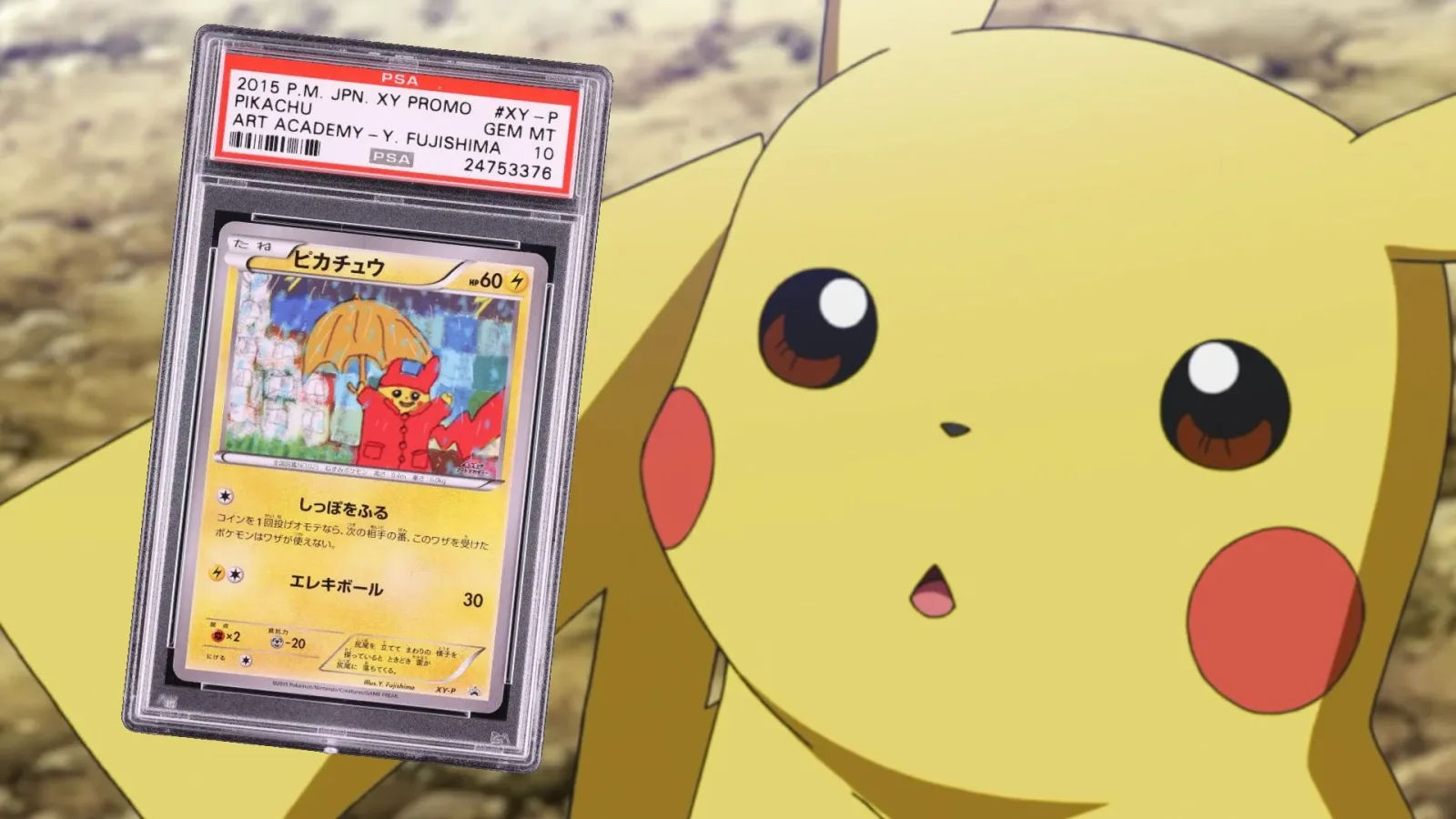
A remarkably rare Pokémon Trading Card Game promo known to collectors as Raincoat Pikachu has sold for $8.4 million, including the buyer's premium. The result puts the charming, umbrella-carrying Pikachu among the most valuable trading cards ever to reach auction, and makes it the second-most expensive Pokémon card auction sale on record.
The card sold on September 28 through Fanatic Collection and was graded PSA 10 Gem Mint. That pristine condition is important in any high-end collectible sale, but it is only one part of the story here. Raincoat Pikachu is not a conventional set card that collectors could once find in booster packs, buy from a store shelf, or obtain through a retail promotion. Just 100 official copies were produced, each originally awarded as a personal prize after a global art competition.
That extreme scarcity, combined with a hugely recognizable character and an unusually storybook-like illustration, makes this particular promo a natural target for the very top end of the Pokémon card market. It is an enormous leap over the card's already substantial prior sales, demonstrating how much condition, provenance, and collector competition can change the value of a rare promotional card.
A Pikachu promo unlike almost any other
Fans call the card Raincoat Pikachu because its artwork depicts Pikachu prepared for wet weather. The electric mascot wears a raincoat, holds an umbrella, and smiles with a cheerful, slightly goofy expression. Rather than resembling the battle-focused art found on many Pokémon TCG cards, the image has the warmth of a children's picture book. Its gentle color palette and playful costume have made it particularly memorable among collectors.
For useful background on this topic, read RetroAchievements Can Now Be Tracked on an Original PlayStation 2.
The art was created by Fujishima as part of a 2015 contest connected to Pokémon Art Academy on Nintendo 3DS. The software was designed to teach players how to draw Pokémon, with guided lessons and tools built around the franchise's famous creatures. For the competition, entrants submitted their own artwork, and Fujishima won in the Dress-Up Pikachu category.
The prize was extraordinary: 100 officially printed copies of the winning card design. Those copies were not subsequently released for sale to the broader public. That distinction separates Raincoat Pikachu from even many limited Pokémon promos. Plenty of scarce cards were tied to events, magazine giveaways, retail campaigns, or tournament participation. Raincoat Pikachu was instead awarded in a very limited quantity directly to the contest winner, giving the card a notably unusual origin.
In practical terms, a print run of 100 means the surviving population available to serious collectors is almost certainly smaller than 100. Some copies may remain in private collections, some may have been damaged, and others may be unavailable for sale for years at a time. A Gem Mint copy is rarer still, because a perfect-looking card must survive handling, storage, shipping, and grading without the tiny flaws that can affect corners, centering, surfaces, or edges.
Second only to Pikachu Illustrator
The $8.4 million result places Raincoat Pikachu behind only Logan Paul's famous Pikachu Illustrator card in the Pokémon auction hierarchy. That Pikachu Illustrator sale reached $16.4 million, an enormous benchmark that remains ahead of the newly sold Raincoat Pikachu.
The comparison is fitting. Pikachu Illustrator is long regarded as one of the hobby's defining grails, in part because of its own contest-prize history and exceptionally limited availability. Raincoat Pikachu belongs to a different era, and it has a very different visual personality, but both cards reflect a central truth of the Pokémon market: the most desired cards are often not necessarily the strongest in gameplay terms or the flashiest in battle presentation. Their appeal comes from the intersection of rarity, character popularity, condition, history, and the emotional pull of owning something few others can ever obtain.
Pikachu is uniquely positioned to benefit from that formula. It is the face of Pokémon, familiar far beyond the audience that plays the TCG or follows competitive collecting. When a card combines Pikachu with a limited prize history, distinctive original artwork, and a top-tier grade, it can attract interest from collectors whose focus extends beyond conventional card communities.
The Raincoat Pikachu design also has an advantage that is harder to quantify but easy to understand. It is simply appealing. Pikachu's rain gear and umbrella turn the card into a tiny character illustration rather than only a collectible game piece. The image feels personal, lighthearted, and immediately readable, even to someone who knows nothing about promo-card history. At auction levels measured in millions, objective scarcity matters enormously, but an artwork's ability to inspire affection can matter too.
Why the PSA 10 Gem Mint grade matters
The sold copy's PSA 10 Gem Mint grade is a key part of the $8.4 million figure. Grading is not a guarantee that every collector will value a card identically, and buyers may have their own preferences for grading companies, card presentation, or historical importance. Still, at the top of the market, a recognized perfect-grade assessment provides a widely understood shorthand for condition.
For a card with only 100 official copies, the difference between an excellent example and one certified Gem Mint can be dramatic. There are not enough copies in circulation for collectors to assume another equivalent card will appear soon. When the available card also looks as close to untouched as possible, bidders seeking the best example may be willing to pay sharply higher prices.
There is also a meaningful distinction in the grade description. This card was identified as PSA 10 Gem Mint, and the "Mint" designation can carry extra appeal for collectors comparing elite examples. The terminology surrounding grading can become complicated, particularly as collectors scrutinize labels, population data, qualifiers, and case presentation. But the broad point is straightforward: the buyer was purchasing an exceptionally rare prize card in the strongest widely recognized condition category.
A huge rise from earlier sales
Raincoat Pikachu was valuable long before this auction. Its tiny print run and beloved artwork ensured it had already become a high-end collectible. Even so, the latest result represents a startling escalation. A similarly graded version of the card reportedly sold for $19,200 in 2025, a sum that would be extraordinary for nearly any modern-era trading card but is dwarfed by the new $8.4 million sale.
That difference should not be interpreted as a simple, universal price tag for every Raincoat Pikachu. Collectibles do not trade like identical commodities. Individual cards can differ in the details of their grade, their visual eye appeal, their sale venue, the timing of the auction, and the specific bidders participating. A card's documented ownership history and presentation can also influence confidence and desirability.
More importantly, a headline auction result reflects the outcome of a particular contest between motivated buyers. A record sale can show that at least two or more parties saw exceptional value in a specific item at a specific moment. It does not mean that every copy would immediately command the same amount. With only 100 printed, however, the sale does reinforce the broader view that Raincoat Pikachu sits in an extraordinarily exclusive corner of Pokémon collecting.
What the sale says about the Pokémon card market
Pokémon cards continue to occupy an unusual space between gaming memorabilia, pop-culture art, nostalgia-driven collecting, and high-value alternative assets. The hobby has room for people opening packs for fun, players building decks, collectors chasing favorite Pokémon, and investors pursuing scarce historical pieces. Those groups sometimes overlap, but a multimillion-dollar one-of-100 contest promo exists in a market far removed from the everyday experience of buying a booster or trading cards with friends.
Modern products can still be expensive due to sustained demand and reseller activity, especially around major anniversary releases and special sets. Yet the Raincoat Pikachu sale is a reminder that the highest auction records are generally built on conditions most ordinary cards cannot replicate: microscopic supply, a compelling backstory, a globally recognized mascot, years of collector attention, and elite preservation.
Its connection to Pokémon Art Academy also gives the card a special place in the franchise's broader creative history. The prize did not merely celebrate collecting or competitive play. It recognized fan-made Pokémon art and transformed a winning illustration into an official, physical TCG card. That origin helps explain why the promo feels more intimate than many expensive cards. It is rare not just because so few copies exist, but because its existence began with an individual artist's successful interpretation of Pikachu.
For most fans, an $8.4 million Pokémon card will remain an almost unimaginable collectible. But Raincoat Pikachu's appeal is easy to see regardless of its price. The umbrella, the raincoat, and the bright expression make it an unusually endearing piece of Pokémon art. Its historic sale may be defined by a massive number, yet the character of the card itself is much smaller and sweeter: Pikachu, dressed for a rainy day, still looking delighted to be outside.
Community
Discussion
Start the conversation.
No comments have been posted yet.