

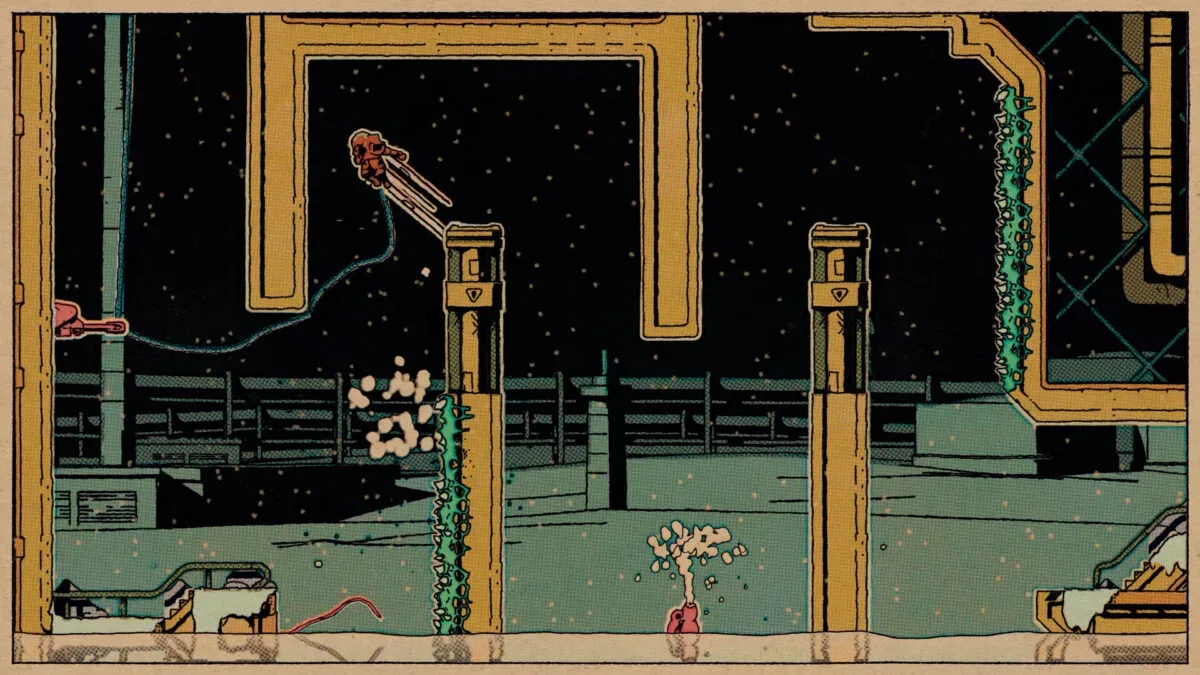
Rebounder made a strong early impression at PAX West by taking a familiar precision-platforming structure and making repeated failure feel less like a stop sign than a cue to keep moving. In a brief hands-on session, the game's loops of jumping, throwing, bouncing, missing, and instantly trying again created the kind of momentum that can make a difficult platformer feel exhilarating rather than exhausting.
It is an especially notable reaction because platformers built around demanding jumps often invite caution. The usual approach is recognizable: edge toward a ledge, study the gap, calculate a route, make an attempt, fall, then reassess. Rebounder initially appears to fit comfortably within that modern school of hard-but-forgiving platform games, where tight rooms and frequent deaths are softened by quick restarts. Yet its early stages seem designed to push players away from slow deliberation and toward a more instinctive rhythm.
Within only a handful of rooms, Rebounder's movement reportedly began to feel readable at a glance. Instead of stopping before every obstacle, the player could grab unusual orb-like objects suspended from vines, toss them toward the next destination, and leap after them. Activating the resulting explosion launches the character upward, turning each thrown object into both a tool and a source of propulsion. The sequence is simple to describe, but the sensation is more important: throw, jump, detonate, rise, repeat.
That flow appears to be the central promise of Rebounder. It wants players to see a switch, send an orb into it, use the explosion to keep their own momentum going, and pass through a newly opened door without allowing the action to flatten into a series of isolated puzzles. The game's rooms may demand precision, but the demo suggested that its systems are tuned to reward committing to a route.
For useful background on this topic, read Stellar Blade: Complete Edition Will Be Fully Stored on Its Switch 2 Game Card.
A Platformer Built Around the Next Attempt
Immediate recovery is a major part of why that confidence can build. Rebounder ties its worker-like spacefaring protagonist to a line anchored at the start of each room. When a jump goes wrong and the character drops into a pit, the tether swiftly pulls them back to the beginning. It is not merely a standard reset presented with different visual dressing. The return mechanism is part of the game's fiction and visual identity, while also keeping downtime to a minimum.
Fast resets have become a defining quality of many beloved difficult platformers. They acknowledge that failure will be frequent, then remove the annoying parts surrounding it. No long death animation, no extended reload, no meaningful distance lost before another attempt. Rebounder seems to take that philosophy seriously. A mistake is meant to be understood quickly, corrected quickly, and left behind quickly.
In the best cases, that can create something close to sight-reading: the ability to enter a new room, identify a likely sequence, and execute it without needing to fully memorize the stage first. That does not mean the game will remain effortless or that later challenges will not require repeated practice. A 20-minute demo can only show so much. But the early impression is that Rebounder is unusually good at making a player trust their own reactions.
That trust depends on more than quick respawns. The character's speed, jump height, and airborne control must communicate clearly. The explosive boosts need to send the player where they expect to go. The timing of switches, doors, hazards, and collectible objects must all be legible even while the player is moving rapidly. Rebounder's initial rooms apparently deliver that clarity well enough that hesitation gives way to a kind of forward-driven problem solving.
Explosions, Tethers, and an Interstellar Job
Mechanically, the orb interactions are the standout feature of the demo. These objects hang within reach, inviting the player to collect and throw them across a room. Their explosions create a visible burst and a satisfying push, allowing the protagonist to gain height or bridge the gap toward another platform. The action is tactile rather than abstract: an object is flung, a button is pressed, there is a burst of smoke and sound, and the character is propelled onward.
That physicality may be a key reason Rebounder's setbacks feel easy to accept. When the game gives immediate feedback through sharp effects, smooth animation, and reliable movement, players can usually tell why an attempt failed. Perhaps an orb was thrown too late, a bounce was triggered too early, or a landing was approached from the wrong angle. The answer is visible enough that the next attempt begins almost automatically.
There is also an appealing tension between the liberating feel of movement and the premise implied by the protagonist's tether. The player may be flying through rooms with explosive boosts, but they are still literally attached to a line. That image fits the game's early narrative hints, which appear to place its unnamed space worker in a bleak corporate environment.
The protagonist seems to be carrying out an important task involving that line across a larger map, though the exact nature of the job remains unclear. Their employer does not appear especially benevolent. The setting suggests the familiar science-fiction shape of exploitative labor: a worker performing essential duties for a company that may offer little in return, possibly while keeping employees in unpleasant company housing.
Between maps, the demo includes conversations with the person managing the housing facility. This figure speaks from behind an unsettling helmet, adding a slightly eerie edge to the workplace setting. Crucially, the dialogue does not seem interested in spelling out every rule of the universe for the player. The characters talk as if they already live in this world, leaving its structures, jargon, and broader stakes to be inferred over time.
That restraint could serve Rebounder well. The premise has room for commentary on labor, corporate control, and the strange compromises of life in a remote industrial outpost, but the game does not appear to announce all of those themes immediately. Its narrative is still a mystery, and that uncertainty is part of the appeal. The player is encouraged to keep moving while gradually learning what sort of work they are actually doing and who benefits from it.
A Faded Comic-Book Future
Rebounder's visual presentation also helps distinguish it from the broad field of precision platformers. The demo showcased smooth, fluid animation rendered in a comic-inspired style. Its colors and linework have a deliberately weathered quality, resembling an older printed issue whose edges and hues have softened with age. That approach gives the sci-fi setting a handmade character rather than a sterile, glossy futurism.
Occasional eruptions of text add another unpredictable layer. Incongruous fonts can spill across the scenery, including at least one moment that recalled the look of a medieval manuscript. These interruptions are visually chaotic, and the pace of play can make them difficult to stop and read. Still, they contribute to the sense that Rebounder's universe is not entirely stable, orderly, or comfortable.
The combination of faded comic art, explosive traversal, creepy housing administration, and blue-collar space work may not immediately sound like an obvious match. But the hands-on demo indicates that the pieces reinforce each other. The protagonist is a small worker in a potentially hostile system, tethered to a job and pulled back whenever they fall. At the same time, the player experiences that worker as an agile, forceful presence capable of turning thrown objects and controlled blasts into a rapid escape through each room.
Early Promise Beyond the Celeste-Like Label
Comparisons to Celeste are understandable because Rebounder embraces tight platforming rooms, high failure rates, responsive controls, and near-instant retries. Those qualities have become a useful shorthand for a particular kind of design, one that asks a lot from players while respecting their time. But Rebounder's demo suggests it has its own particular flavor through its throwable explosives and tether-based reset system.
More importantly, it captures the emotional payoff that makes this style of platformer work. The goal is not simply to survive a brutal jump after enough repetition. It is to enter a room, recognize its moving parts, make decisions in motion, recover from errors, and eventually feel like the challenge is being played almost musically. A good run becomes a chain of actions rather than a list of pauses.
Rebounder has only offered a small glimpse so far, and the brief session cannot answer how demanding its later maps become, how deeply its story develops, or whether its early momentum remains intact across the full experience. But its first impression is compelling precisely because it transforms apprehension into eagerness. It looks like a game where failure is inevitable, yet so cleanly handled that the natural reaction is not to step away from the ledge. It is to hit retry, throw another orb, and go again.
Community
Discussion
Start the conversation.
No comments have been posted yet.