

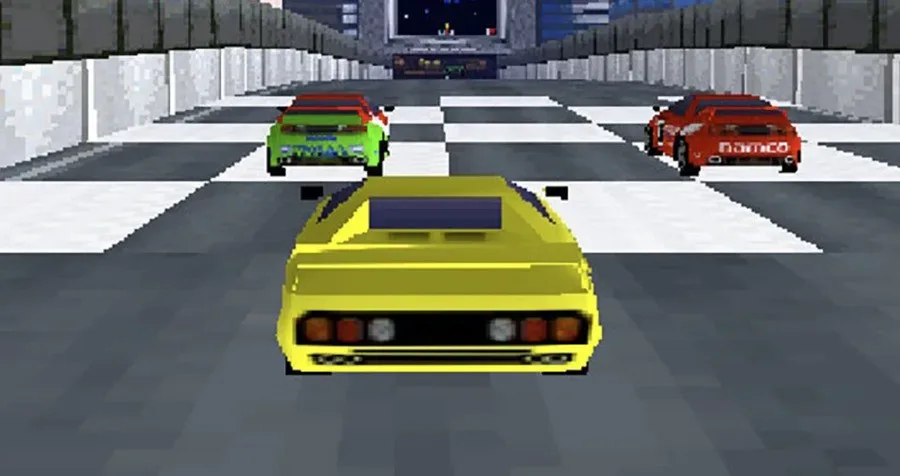
Ridge Racer is preparing for another modern reappearance, but this one comes with a very different perspective. G-MODE Archives+ Ridge Racer is bringing a Japanese feature-phone adaptation of the arcade racing series to Nintendo Switch and Steam. Rather than attempting to recreate the original arcade presentation across a modern widescreen display, this release preserves an unusual element of its mobile origins: races are displayed in a vertical, portrait-oriented aspect ratio.
The Nintendo Switch version is scheduled to launch on September 3 through the Japanese eShop, where it is listed at 800 yen. A Steam edition will follow with a worldwide release on September 16. The available details indicate that the Switch release is limited to Japan's eShop, while the PC release is the version set to reach players internationally.
For a series associated with full-size arcade cabinets, broad roads, and dramatic slides through long sweeping corners, the prospect of playing Ridge Racer in portrait format is certainly unconventional. Yet that is precisely the point of the G-MODE Archives+ line. The initiative is focused on preserving games originally made for Japanese mobile phones before the smartphone era, including titles designed around the dimensions and limitations of flip-phone hardware. This Ridge Racer is therefore not positioned as an arcade-perfect conversion, nor as a newly built remaster of the famous original.
Instead, it is a chance to revisit a distinct branch of Ridge Racer history: a compact 3D racing game built for a device whose display was taller than it was wide.
For useful background on this topic, read White House Launches Arcade.gov With Political Mini-Games Based on Classic Formats.
A mobile-era Ridge Racer with a vertical view
The game at the center of this release is a port of a Ridge Racer title previously released for G-MODE-compatible flip phones in Japan. While the hardware context is very different from the PlayStation and arcade versions many players will know, it remains a 3D racer and retains key ideas associated with the franchise.
Most notably, its driving is based around Ridge Racer's recognizable drift-focused style. The arcade series built much of its identity on high-speed cornering, where controlled slides are not simply a recovery tool but a central part of maintaining momentum and negotiating courses. The feature-phone game reportedly offers a reasonably faithful interpretation of that approach, adapting it to a much smaller-scale format.
Portrait presentation will naturally change how the action reads. Traditional Ridge Racer games generally benefit from a wide view of upcoming corners and the surrounding scenery, while a vertical screen narrows the horizontal space available to the player. That limitation is a direct reflection of the original phone hardware rather than a new optional display mode created for this re-release. For retro game preservation enthusiasts, that makes the format part of the appeal: it reflects how this particular adaptation was originally experienced.
It also distinguishes the game from the other Ridge Racer projects that have recently surfaced on current storefronts. Players looking for a direct arcade recreation should keep their expectations in check. G-MODE Archives+ Ridge Racer is a preservation-minded mobile port, with its own technical compromises and structure, rather than an arcade restoration.
Modes, cars, and familiar racing fundamentals
Despite originating before modern smartphones became the dominant mobile gaming platform, G-MODE Archives+ Ridge Racer includes more than a single quick-race option. The game features three difficulty settings, giving players a way to adjust the challenge around its distinctive handling and vertically framed presentation.
A Time Trial mode is also included. That is especially fitting for a Ridge Racer release, as the series has long encouraged players to refine racing lines, commit to drifts, and shave small amounts of time from each lap. Time Trial should offer a more focused route into learning the game's courses and the rhythm of its slides without the immediate pressure of racing opponents.
Players can choose from four vehicles. No further specifics about the cars have been announced, so it is not yet clear how extensively they differ in performance or handling. Still, having multiple selectable vehicles gives this smaller mobile adaptation an additional element beyond a single fixed driving experience.
The combination of difficulty options, time-based competition, vehicle selection, 3D visuals, and drift-oriented driving suggests an impressively feature-conscious design for its original platform. Feature phones hosted a wide range of games in Japan, from simple puzzle releases to ambitious adaptations and original productions. Titles such as this one are often difficult to access once the services and devices that supported them disappear, making their return through archival collections notable even when their design is markedly different from their console counterparts.
G-MODE Archives+ continues feature-phone preservation
G-MODE Archives+ has become a vehicle for returning older Japanese mobile games to active platforms. These releases are valuable not only because they make individual games playable again, but because they preserve a major period of game development that can otherwise be especially vulnerable to loss.
Physical consoles and arcade boards can be collected, maintained, and studied decades later. Mobile games created for proprietary handsets and distributed through phone-network services face a different problem. Their original storefronts can close, compatible devices become scarce, and software may rely on formats that are no longer convenient to run. As a result, games from the feature-phone period are often less visible than console releases from the same era, even when they belong to well-known series.
Ridge Racer's name makes this release particularly eye-catching. The franchise has been present across arcades, home consoles, handhelds, and mobile devices, but its phone-specific entries are far less likely to be remembered by players outside Japan. Reissuing this version preserves a curious snapshot of how an arcade racing identity was translated to a device designed primarily for calls, messages, and compact downloadable applications.
There is also an important distinction between preservation and modernization. A game designed around a portrait phone screen may look strange when loaded up on a Switch or PC monitor in 2026, especially beside contemporary racing games designed for large landscape displays. But retaining that layout makes the release more historically specific. It demonstrates the constraints developers worked within and the creative decisions made to fit a high-speed 3D racer onto the technology of the time.
Another Ridge Racer option on current platforms
The arrival of G-MODE Archives+ Ridge Racer comes during a period in which Ridge Racer fans have had several reasons to pay attention to modern releases. The original arcade Ridge Racer and its arcade-only follow-up, Rave Racer, have both become available relatively recently, giving players renewed access to foundational entries in the series.
This flip-phone conversion is a notably different proposition from those arcade releases. The original coin-op game is one of the defining racers of its era, remembered for its 3D visuals, energetic presentation, and drifting that became synonymous with the Ridge Racer name. Rave Racer expanded on that arcade formula. By contrast, the G-MODE game is an adaptation shaped by mobile hardware restrictions, a portrait display, and the practical needs of a pre-smartphone platform.
That contrast may make the title more appealing to players interested in the broader evolution of the series than to those seeking the most polished or definitive way to play Ridge Racer. It is an opportunity to see how the core premise was compressed and reworked for a radically different device category. The game's value lies in that unusual context as much as in its immediate racing action.
For Switch owners, the key caveat is regional availability. The Switch edition launches on September 3 and appears to be available only through Japan's eShop, with a price of 800 yen. Steam users will have the more straightforward option internationally when the PC version arrives on September 16.
What players should expect
- Format: A re-release of a Japanese G-MODE flip-phone Ridge Racer game, rather than an arcade-perfect port.
- Presentation: 3D racing displayed in portrait orientation to match the original mobile hardware design.
- Gameplay: Drift-based racing inspired by the coin-op Ridge Racer formula.
- Modes and options: Three difficulty levels, Time Trial, and four selectable vehicles.
- Switch release: September 3 on the Japanese eShop for 800 yen.
- Steam release: September 16 worldwide.
G-MODE Archives+ Ridge Racer will not replace the arcade originals for players chasing the classic full-screen Ridge Racer experience. It is not meant to. Its appeal is in offering a rare, eccentric, and historically specific version of the series--one where the familiar act of throwing a car sideways through a turn has been reshaped for a tall, narrow flip-phone screen.
For Ridge Racer collectors, enthusiasts of Japanese mobile-game history, and anyone curious enough to try arcade-style drifting in portrait ratio, September brings an unusual addition to the modern racing-game library.
Community
Discussion
Start the conversation.
No comments have been posted yet.